Business Relief and Inheritance Tax: Protecting Your Business
If you've built a business over your lifetime, one of the last things you want is for Inheritance Tax to force your family to sell it when you die. Business Relief (formerly known as Business Property Relief) exists to prevent exactly that. It can reduce the value of qualifying business assets by up to 100% for IHT purposes, potentially eliminating the tax entirely.
But Business Relief is not automatic, and not all businesses qualify. Understanding the rules now gives you time to structure things properly while you're still here to do something about it.
What is Business Relief?
Business Relief is a relief from Inheritance Tax that reduces the taxable value of qualifying business assets that form part of your estate when you die. The relief also applies to certain lifetime transfers.
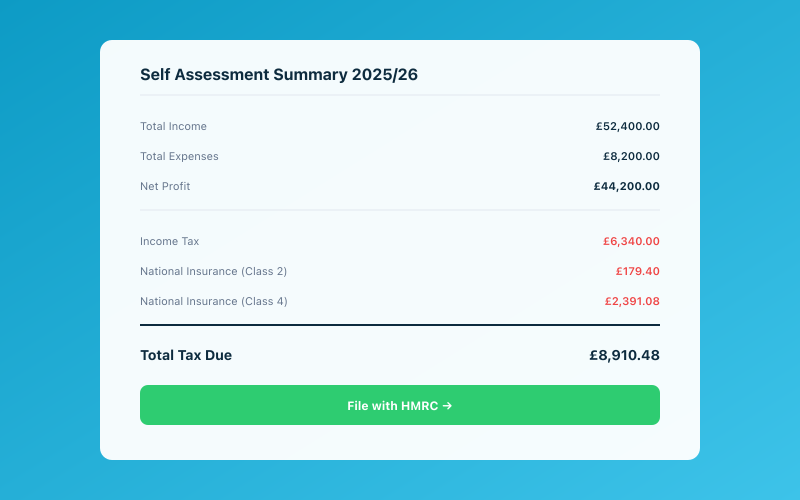 Your Accounted dashboard shows your real-time tax position
Inheritance Tax is charged at 40% on estates above the nil-rate band (£325,000 for 2025/26, plus potentially the £175,000 residence nil-rate band if you're leaving your home to direct descendants). Without Business Relief, a business worth £500,000 could generate a significant IHT bill on top of the tax due on the rest of the estate.
The Autumn Budget 2024 Changes
The Autumn Budget 2024 announced significant changes to Business Relief that will take effect from April 2026. From that date, 100% Business Relief will only apply to the first £1 million of combined business and agricultural property. Above £1 million, the relief drops to 50%, meaning a 20% effective IHT rate applies to the excess.
For the 2025/26 tax year (deaths before April 2026), the existing rules still apply in full. But these changes make planning even more important for business owners with assets above £1 million.
The Two Rates of Relief
Business Relief is available at two rates:
100% Relief
The full 100% relief applies to:
- A business or an interest in a business: This covers sole traders and partners in a partnership. The entire value of the business, including goodwill, stock, debtors, equipment, and cash used in the business, qualifies.
- Unquoted shares: Shares in a company that isn't listed on a recognised stock exchange qualify for 100% relief. This includes shares in private limited companies and shares listed on AIM (the Alternative Investment Market), which are treated as unquoted for Business Relief purposes.
50% Relief
The reduced 50% relief applies to:
- Land, buildings, or machinery owned personally but used in a business you control: If you own a commercial property in your personal name and your limited company trades from it, the property qualifies for 50% relief.
- Shares or securities in a quoted company that gave you control: If you held a controlling interest (more than 50% of voting rights) in a fully listed company, the shares qualify for 50% relief. This is rare for small business owners.
The distinction between 100% and 50% is important. If your business operates through a limited company and the company owns its trading premises, the whole lot (shares including the property value) should qualify for 100%. But if you personally own the building and lease it to the company, the building only gets 50% relief.
Qualifying Conditions
Business Relief isn't given to just any business-related asset. There are several conditions that must be met.
Two-Year Ownership Requirement
You must have owned the business asset for at least two years before your death (or before making a lifetime transfer). There's no tapering; it's a hard two-year minimum.
If you inherited the business from your spouse and they'd owned it for at least two years, their ownership period is added to yours for this test. This also applies in cases of replacement business property, where you sold one qualifying business and bought another within three years.
The Business Must Be Trading
This is the single biggest stumbling block. Business Relief only applies to businesses that are mainly trading. HMRC will deny relief if the business is wholly or mainly one of:
- Dealing in securities, stocks, or shares
- Dealing in land or buildings
- Making or holding investments
The word "mainly" is key. HMRC applies a test often referred to as the "wholly or mainly" test, looking at whether more than 50% of the business activity (by various measures, including turnover, profit, assets, and management time) is investment rather than trading.
Investment Businesses Do Not Qualify
This is where many business owners get caught. If your company's main activity is holding investment properties and collecting rent, it's an investment company, not a trading company. Business Relief won't apply to the shares.
Similarly, if you're a sole trader landlord with a large property portfolio, the property business is an investment activity. The rental properties won't qualify for Business Relief.
The line between trading and investment can be blurry. A company that develops properties and sells them may be trading. A company that builds properties and holds them for rental income is investing. A mixed company that does some of each needs careful analysis.
Excepted Assets
Even within a qualifying trading business, HMRC can deny relief on "excepted assets." These are assets that weren't used in the business or weren't required for future business use in the two years before death.
The most common excepted asset is surplus cash. If your company has £200,000 sitting in a deposit account that isn't needed for working capital or planned business expenditure, HMRC may argue that this cash is an investment, not a trading asset, and exclude it from Business Relief.
This is an area of active dispute between taxpayers and HMRC. The safest approach is to have a clear business purpose for significant cash balances, whether that's planned investment in equipment, a contract deposit requirement, or a demonstrable working capital need.
Practical Examples
Example 1: The Sole Trader
Sarah runs a consultancy as a sole trader. She's been operating for ten years. Her business assets include equipment worth £15,000, outstanding invoices of £30,000, and goodwill valued at £100,000. The entire business qualifies for 100% Business Relief. On her death, none of this value is subject to IHT (assuming death occurs before April 2026, or the total is within the £1 million threshold after that date).
Example 2: The Company Director
James owns 100% of the shares in his engineering company. The company owns its workshop (worth £400,000), has equipment worth £200,000, and has goodwill of £300,000. The shares are unquoted and he's owned them for fifteen years. The full value of the shares, including the workshop owned by the company, qualifies for 100% relief.
Example 3: The Mixed Company
Priya owns shares in a company that runs a restaurant and also owns two flats above the restaurant that are let to tenants. The company's value is £600,000, of which £150,000 relates to the investment flats. HMRC would look at whether the company is "wholly or mainly" trading. The restaurant is clearly the main activity, so the shares should qualify for 100% relief on the full value, though HMRC might seek to exclude the investment element.
Example 4: The Property Investor
David owns a limited company that holds twelve residential properties. The company's sole activity is collecting rent. This is an investment company. The shares do not qualify for Business Relief at any rate. On David's death, the full value of the shares is subject to IHT at 40% (above the nil-rate band).
Planning Strategies
Keep Investment Assets Separate
If your trading company has accumulated significant investments (such as a property portfolio bought with retained profits), consider whether the investment activities could disqualify the company from Business Relief. Separating the trading and investment activities into different companies can protect the trading company's relief.
Monitor Cash Balances
Don't let surplus cash accumulate in the business without a clear purpose. If you've retained more profit than the business needs, extracting it as dividends (and paying it into an ISA or pension) may be better than risking HMRC treating it as an excepted asset.
Use AIM Shares for Estate Planning
AIM-listed shares qualify for 100% Business Relief after two years of ownership. Some investors use this as an IHT planning tool, holding a portfolio of AIM shares specifically to reduce their taxable estate. This carries investment risk, however, as AIM shares tend to be more volatile than those on the main market.
Life Insurance
Where Business Relief doesn't fully cover your business assets, or where you're uncertain about qualification, a life insurance policy written in trust can provide funds to pay IHT without the business needing to be sold. The key is writing the policy in trust so the payout isn't itself added to the estate.
Get Your Business Records in Order
Business Relief is valuable, but HMRC will scrutinise whether your business qualifies. Clean, well-organised financial records demonstrating that your business is actively trading, that assets are used for business purposes, and that you've owned the business for the required period make all the difference. Accounted keeps your business finances meticulously tracked, so if your executors ever need to make a Business Relief claim, the evidence is already there. Start your free trial today and ensure your business records support the reliefs you're entitled to.
Related Reading
-
Can I Claim Clothing as a Business Expense? HMRC Rules Explained
-
Overlap Relief Explained: What Happens When Basis Periods Change
Start your free trial and let Penny handle your bookkeeping automatically.
Penny, your AI bookkeeper, tracks your tax position in real time and flags opportunities to reduce your bill. Meet Penny →
Tax & Compliance Specialists
Our tax specialists have decades of combined experience in UK sole trader and small business taxation, MTD compliance, and HMRC submissions. All content is reviewed against current HMRC guidance before publication and updated quarterly to reflect legislative changes.
Ready to try Accounted?
Join UK sole traders who are simplifying their bookkeeping and tax.
Start your 14-day free trial