Overlap Relief Explained: What Happens When Basis Periods Change
What Is Overlap Relief?
If you have been self-employed for a few years, you may have heard of overlap profits — and you may have been told they would be useful "one day." That day has arrived. The basis period reform that took effect from 2024/25 means overlap relief is now directly relevant to every sole trader and partner who has overlap profits sitting unused.
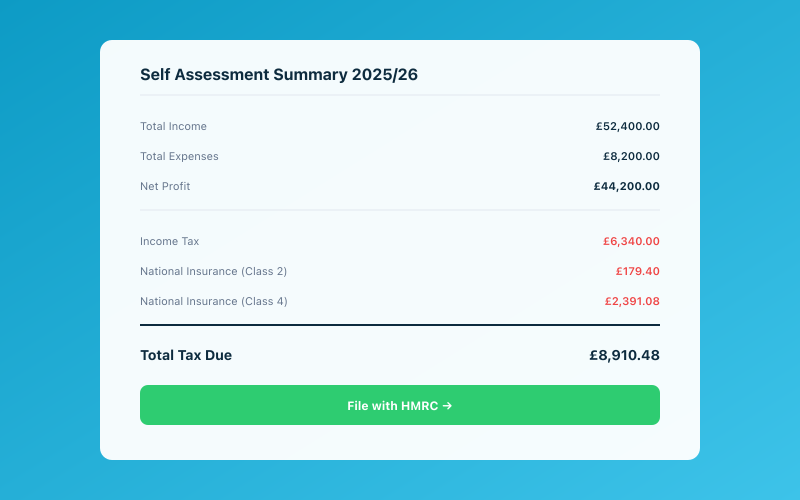 Your Accounted dashboard shows your real-time tax position
This guide explains what overlap profits are, how the basis period reform works, and how to claim the relief you are owed.
The Old Basis Period Rules
Before 2024/25, sole traders and partnerships were taxed on profits based on their accounting period ending in the tax year. If your accounting year ended on 31 March or 5 April, this was straightforward — your accounting year matched the tax year almost exactly.
But if you had a different accounting date — say 30 June — the rules were more complicated. In your early years of trading, some of your profits were taxed twice. These doubly-taxed profits are your overlap profits.
How overlap profits arose
When you first started trading, HMRC used special rules to assign profits to your first few tax years. These rules often resulted in some months of profit being included in two consecutive tax years.
For example, if you started trading on 1 July 2018 and drew up accounts to 30 June each year:
- 2018/19 (year of commencement): You were taxed on profits from 1 July 2018 to 5 April 2019 — nine months of profit.
- 2019/20 (second year): HMRC used the 12 months to your accounting date ending in the tax year, which was the year to 30 June 2019. This included profits from 1 July 2018 to 30 June 2019.
The period from 1 July 2018 to 5 April 2019 was taxed in both years. Those nine months of profit are your overlap profits.
Why they mattered
Overlap profits were supposed to be given back to you as relief when you either changed your accounting date or ceased trading. In practice, many sole traders traded for decades without ever using them — and inflation eroded their real value over time, since the relief was given at the original profit figure, not adjusted for inflation.
The Basis Period Reform
From 2024/25 onwards, HMRC moved all sole traders and partnerships to a tax year basis. This means you are now taxed on profits arising in the tax year (6 April to 5 April), regardless of your accounting date.
If your accounting date already aligned with the tax year (31 March or 5 April year-end), the reform had no practical impact on you. You probably have no overlap profits, and nothing changed.
If your accounting date was anything else, the 2023/24 tax year was a transitional year, and your overlap profits became directly relevant.
The Transitional Year: 2023/24
The 2023/24 tax year was the transition year. In this year, HMRC needed to bridge the gap between the old rules and the new tax year basis. This meant some sole traders had a longer-than-normal basis period.
How it worked
For a sole trader with a 30 June accounting date:
- Under the old rules, 2023/24 would have been based on the year to 30 June 2023 (12 months of profit).
- Under the new rules, 2024/25 onwards is based on profits from 6 April 2024 to 5 April 2025.
- The transition year (2023/24) covered everything from the end of the old basis period to 5 April 2024 — in this case, from 1 July 2022 to 5 April 2024, which is 21 months of profit.
That is nine extra months of profit being taxed in one year. Without overlap relief, this would be a massive additional tax bill.
Overlap relief reduces the blow
Your overlap profits are deducted from the transitional profits. If you had nine months of overlap profits at £2,000 per month (£18,000 total), this £18,000 is deducted from the extra profits in the transitional year.
If the nine extra months of transitional profit were £27,000 (at current, higher, profit levels) and your overlap profits were £18,000, the additional taxable amount would be £9,000 (£27,000 minus £18,000).
Spreading the Transitional Profits
Even after deducting overlap relief, many sole traders will have additional taxable profit in the transitional year. HMRC allows you to spread this additional profit over up to five tax years: 2023/24 to 2027/28.
How spreading works
The transitional profit (after deducting overlap relief) can be spread equally over the five years. Using the example above:
- Additional transitional profit after overlap relief: £9,000
- Spread equally: £1,800 per year for five years (2023/24 to 2027/28)
You do not have to spread. If your income is lower in 2023/24 (perhaps you had other losses or low income), it might be better to take the full hit in one year and pay tax at a lower rate. This is a planning decision worth discussing with an accountant.
Interaction with other income
The spread transitional profit is added to your other income in each year. If it pushes you into a higher tax bracket, you might prefer a different spreading pattern. You can choose to accelerate the spread — taking more in earlier years — but you cannot take less in earlier years and more later.
How to Find Your Overlap Profits
This is often the hardest part. HMRC does not keep a central record of your overlap profits — you are expected to know them from your original tax returns.
Where to look
- Your tax returns from when you started trading. The overlap profit figure should have been calculated and noted at the time.
- Your accountant's files. If you had an accountant when you started, they should have a record.
- HMRC's Self Assessment records. You can ask HMRC, but they may not have the figure readily available.
- Your SA103 (self-employment pages). Box 82 on the SA103 asks for overlap profits brought forward — if this was completed correctly in previous years, you can find the figure.
If you cannot find them
If you genuinely cannot locate your overlap profits, you may need to reconstruct them from your original accounting records. This involves going back to your first year of trading and working through the basis period rules to identify the doubly-taxed period and its profits.
If your records from that period no longer exist, HMRC may accept a reasonable estimate — but this is a grey area, and professional advice is recommended.
Worked Example
Sarah is a freelance consultant who started trading on 1 October 2017. She draws up accounts to 30 September each year.
Original overlap calculation (when she started):
- 2017/18: Taxed on profits from 1 October 2017 to 5 April 2018 (six months) = £15,000
- 2018/19: Taxed on 12 months to 30 September 2018, which includes 1 October 2017 to 5 April 2018 again
- Overlap profits: £15,000 (the six months taxed twice)
Transitional year (2023/24):
- Old basis period would have been year to 30 September 2023: profit = £60,000
- New rules require taxing up to 5 April 2024
- Additional period: 1 October 2023 to 5 April 2024 (six months): profit = £35,000
- Total transitional profit: £60,000 + £35,000 = £95,000
- Less overlap relief: £15,000
- Net transitional profit: £80,000
- Additional transitional profit (above normal 12-month basis): £80,000 - £60,000 = £20,000
- Sarah can spread the £20,000 over five years: £4,000 per year
Result: Instead of paying tax on £95,000 in one year, Sarah pays tax on £64,000 in 2023/24 (her normal £60,000 plus £4,000 of spread transitional profit), with £4,000 added to each of the next four years.
Changing Your Accounting Date
With the new tax year basis in place from 2024/25, many sole traders are choosing to move their accounting date to 31 March or 5 April. This simplifies everything — your accounting year matches the tax year, and there are no apportionment calculations.
You are not required to change your accounting date. You can keep any year-end you like. But if your accounting date does not align with the tax year, you will need to apportion your profits to the tax year each year, which adds complexity.
How Accounted Handles This
Basis period calculations and overlap relief can be genuinely confusing. Accounted tracks your accounting periods and tax year alignment automatically. Penny, the AI bookkeeper, flags transitional profit adjustments and ensures your Self Assessment captures the correct figures — including any spread amounts carried forward from the transitional year.
Start Your Free Trial With Accounted
Do not let overlap relief go unclaimed. Accounted keeps track of your transitional profits, spreading elections, and tax year calculations so you do not overpay. Start your free trial today and let Penny make sure you claim every penny you are owed.
Related Reading
Start your free trial and let Penny handle your bookkeeping automatically.
Penny, your AI bookkeeper, tracks your tax position in real time and flags opportunities to reduce your bill. Meet Penny →
Tax & Compliance Specialists
Our tax specialists have decades of combined experience in UK sole trader and small business taxation, MTD compliance, and HMRC submissions. All content is reviewed against current HMRC guidance before publication and updated quarterly to reflect legislative changes.
Ready to try Accounted?
Join UK sole traders who are simplifying their bookkeeping and tax.
Start your 14-day free trial