Tax on Tips and Gratuities for Self-Employed Workers
If you're self-employed and your customers tip you — whether that's a hairdresser whose client rounds up, a taxi driver who gets a few extra quid, or a personal trainer whose client adds a gratuity to their payment — you need to know how those tips are treated for tax purposes. The short answer: they're taxable. But there's a bit more nuance to it than that, especially when it comes to how you record them, when VAT applies, and what happens with different payment methods.
This guide covers everything self-employed workers need to know about tips and tax in the UK.
Tips Are Trading Income
Let's get the fundamental point out of the way first. If you're self-employed and you receive tips or gratuities in connection with your work, those tips form part of your trading income. They need to be included in your Self Assessment tax return, and you'll pay income tax and National Insurance on them.
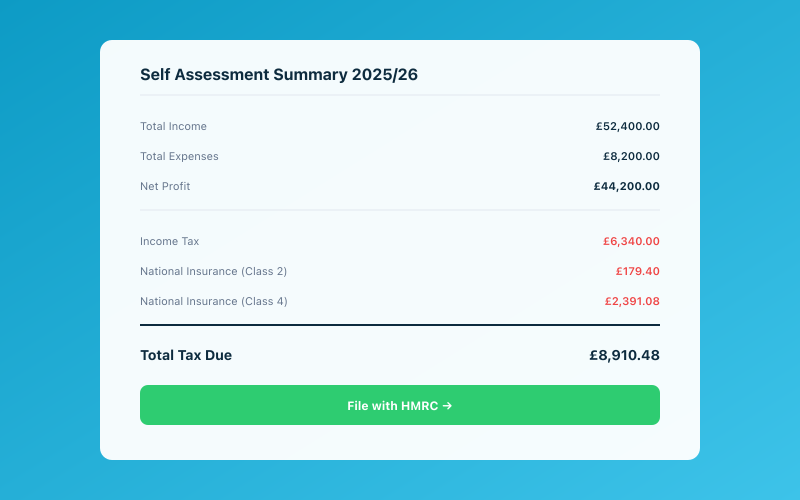 Your Accounted dashboard shows your real-time tax position
This is different from the rules for employed workers, where tips are handled through PAYE (or should be). As a self-employed person, you're responsible for declaring all your income, including tips, and paying the right amount of tax.
HMRC's view is straightforward: a tip is a payment received in connection with your trade. It doesn't matter that it's voluntary or that the customer wasn't obligated to pay it. If you received it because of the work you do, it's part of your business income.
This applies whether the tip is:
- Cash handed to you directly
- Added to a card payment
- Sent via a digital payment platform
- Given as a gift (such as a bottle of wine at Christmas — though small gifts may fall below the threshold of practical concern)
Cash Tips vs Card Tips
The method of payment doesn't change the tax treatment — all tips are taxable — but it does affect record-keeping.
Cash tips are the trickiest to track because there's no automatic paper trail. But that doesn't mean you can ignore them. You should keep a record of cash tips received, ideally on a daily basis. A simple notebook or spreadsheet works, or you can log them in your accounting software.
It's tempting to think that cash tips are invisible to HMRC. And yes, it's true that HMRC can't see every cash transaction. But they're not naive about it either. If your declared income seems unusually low for your profession, or if there are lifestyle indicators that suggest you're earning more than you're declaring, HMRC may open an enquiry. Hairdressers, taxi drivers, and hospitality workers are among the professions where HMRC knows tips are common, so declaring none at all is likely to raise questions.
Card tips are easier to track because they flow through your payment processor and appear in your bank or merchant account. If you use a card reader like SumUp, iZettle (now Zettle), or Square, tip amounts are typically shown separately in your transaction records. When you reconcile your bank statements in Accounted, Penny can help you identify and categorise tip income so it's properly included in your totals.
Digital tips — through platforms like PayPal, Venmo-style apps, or dedicated tipping platforms — also leave a digital trail. Make sure these are included in your records even if they go to a different account from your main business banking.
How Tips Affect Your Tax Bill
Tips are added to your total self-employment income for the year. This combined figure is what determines your tax liability.
For example, if you earned £28,000 from your hairdressing business and received £3,000 in tips over the year, your total trading income is £31,000. After deducting your business expenses and your Personal Allowance, you'll pay income tax on the remainder.
Tips also count towards your National Insurance liability. As a self-employed person, you pay Class 2 NI (a flat weekly amount) and Class 4 NI (a percentage of your profits above a threshold). The tips form part of the profits on which Class 4 NI is calculated.
If tips push your income over certain thresholds, there can be knock-on effects:
- Personal Allowance — currently £12,570. Once your income exceeds £100,000, you start losing your Personal Allowance (£1 lost for every £2 over £100,000). This is unlikely to be solely due to tips, but it's worth knowing.
- Higher rate threshold — currently £50,270 for most of the UK. If tips push you from basic rate to higher rate, you'll pay 40% on the excess.
- VAT registration threshold — currently £90,000. If tips are part of your taxable turnover and your total exceeds the threshold, you may need to register for VAT. More on this below.
- Student loan repayments — if you have a student loan, tips increase the income on which repayments are calculated.
Do Tips Count Towards VAT Turnover?
This is a question that catches a lot of self-employed people out, and the answer depends on how the tip is structured.
Voluntary tips — where the customer freely chooses to add a gratuity with no obligation — are generally outside the scope of VAT. They're not consideration for a supply, so they don't form part of your taxable turnover for VAT purposes.
However, if a "service charge" is compulsory — meaning the customer has no choice but to pay it — it's treated as part of the consideration for the supply and is subject to VAT. This is more common in restaurants than for self-employed individuals, but if you add a mandatory service charge to your invoices, be aware that VAT applies to it.
The practical implication is that genuinely voluntary tips shouldn't push you towards the VAT registration threshold. But if there's any ambiguity about whether the payment is truly voluntary, err on the side of caution and take advice.
For a broader look at how income reporting works, our guide on what counts as trading income covers the fundamentals.
Record-Keeping Requirements
HMRC expects you to keep accurate records of all your business income, and that includes tips. You don't need a separate record for every single tip, but you do need a reliable system that captures the total.
Here's what good practice looks like:
-
Daily tip log. Keep a record of tips received each day. For cash tips, note the amount. For card tips, your payment processor records will suffice.
-
Separate tracking. It's helpful to track tips separately from your main service income, even though they'll be combined for tax purposes. This gives you a clearer picture of your earnings and makes it easier to answer questions if HMRC asks.
-
Bank reconciliation. When you reconcile your bank account — something Accounted makes straightforward — make sure tip income is accounted for. Card tips will appear in your bank automatically. Cash tips should be banked regularly and recorded.
-
Year-end summary. At the end of the tax year, you should be able to produce a total for tips received. This goes into your Self Assessment return as part of your trading income.
With Making Tax Digital for Income Tax coming into effect, quarterly reporting will become the norm for many sole traders. Having a solid system for tracking tips throughout the year — rather than scrambling to estimate at year-end — will become even more important.
Tips on Platforms and Gig Economy Work
If you work through a platform — as a delivery driver, ride-hailing driver, or freelancer on a marketplace — tips may be processed through the platform itself. In these cases, the platform typically reports the tip separately from your earnings, and the money is paid into your account alongside your regular income.
The same rules apply: tips are taxable income. The platform may or may not report tip amounts to HMRC (different platforms have different reporting obligations), but regardless of what the platform reports, you're responsible for declaring everything.
Some platforms allow customers to tip in cash outside the app. These tips are still taxable, even though the platform has no record of them. Keep your own records.
Common Questions About Tips and Tax
Do I need to declare tips under £1,000? Yes. There's no minimum threshold for declaring tips. The £1,000 trading allowance applies to total trading income, not specifically to tips. If your total self-employment income (including tips) is under £1,000, you don't need to register for Self Assessment at all. But if you're already self-employed and earning above that, all tips must be declared.
What about gifts from clients? Small gifts — like a box of chocolates or a bottle of wine — are generally not something HMRC expects you to declare. There's no specific exemption, but pragmatically, these are de minimis. If a client gives you a substantial gift (say, a piece of electronics or a gift card worth hundreds of pounds) because of your business relationship, that's more likely to be treated as income.
Can I deduct expenses related to earning tips? Not specifically. Your general business expenses are deductible against your total income (which includes tips), but there's no separate category of "tip-related expenses." The expenses you'd normally claim — materials, travel, equipment — all reduce your overall profit, which naturally reduces the tax on your tips as well.
What if I share tips with colleagues or assistants? If you pass tips on to someone who works with you, the tax treatment depends on their status. If they're your employee, you'd need to process the tips through payroll. If they're self-employed, they should declare their share as their own income. Either way, you can only be taxed on the tips you actually keep.
Getting It Right Without the Hassle
The reality is that for most self-employed people, tips aren't a huge proportion of their income — but they do add up over the year, and HMRC does expect them to be declared. The easiest approach is to build tip tracking into your regular bookkeeping routine.
If you use Accounted, logging tips takes seconds — Penny can recognise tip patterns in your transactions and prompt you to categorise them correctly. That way, when it comes time to file your return, everything's already in order.
If you're also employed and self-employed, the interaction between your different income sources can be complex. Our guide on tax when employed and self-employed explains how it all fits together.
Related Reading
Start your free trial and let Penny handle your bookkeeping automatically.
Accounted helps UK sole traders stay on top of their bookkeeping and tax. Start your free 30-day trial at getaccounted.co.uk.
Penny, your AI bookkeeper, tracks your tax position in real time and flags opportunities to reduce your bill. Meet Penny →
Tax & Compliance Specialists
Our tax specialists have decades of combined experience in UK sole trader and small business taxation, MTD compliance, and HMRC submissions. All content is reviewed against current HMRC guidance before publication and updated quarterly to reflect legislative changes.
Ready to try Accounted?
Join UK sole traders who are simplifying their bookkeeping and tax.
Start your 14-day free trial