What Counts as Trading Income for Self Assessment?
When you sit down to complete your Self Assessment tax return, one of the first things you need to work out is what counts as trading income. It sounds like it should be straightforward — money you earned from your business, right? But in practice, the line between trading income, casual earnings, and other types of income isn't always crystal clear.
Getting this right matters. Declare too little and HMRC may come knocking. Declare something in the wrong category and you could end up paying more tax than you need to — or missing out on allowances you're entitled to.
Let's break down exactly what HMRC considers trading income, what falls outside that definition, and how to handle the grey areas.
What HMRC Means by "Trading Income"
In HMRC's eyes, trading income is the money you earn from carrying on a trade, profession, or vocation. That's a broad definition, and it's meant to be. It covers everything from running a plumbing business to freelance writing to selling handmade candles at craft fairs.
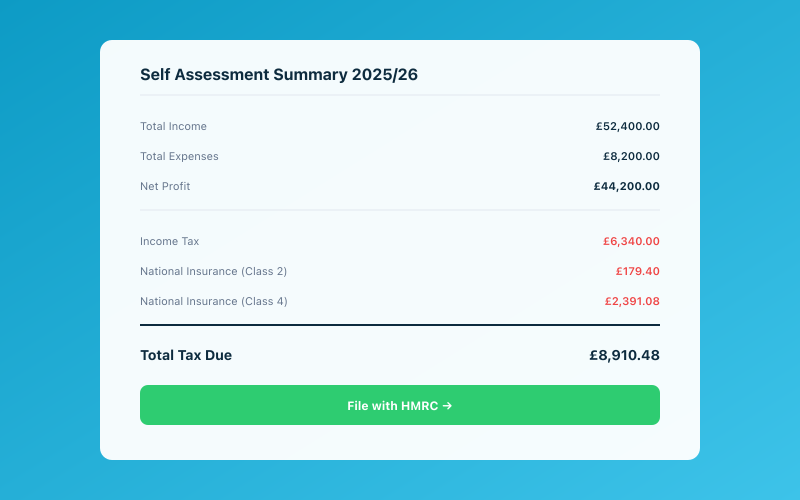 Your Accounted dashboard shows your real-time tax position
The key characteristics HMRC looks for when deciding whether an activity counts as "trading" include:
- Regularity: Are you doing this repeatedly, or was it a one-off?
- Profit motive: Are you trying to make a profit, or is it just a hobby?
- Organisation: Do you operate in a businesslike manner — invoicing, keeping records, marketing your services?
- Frequency of transactions: Are you buying and selling regularly?
- Modification of assets: Are you adding value to something before selling it?
- Connection to existing trade: Is the activity connected to something you already do commercially?
No single factor is decisive. HMRC looks at the overall picture. Someone who sells a piece of furniture on Facebook Marketplace probably isn't trading. Someone who regularly buys furniture, restores it, and sells it for a profit almost certainly is.
Types of Income That Count as Trading Income
Let's look at the specific categories of income that HMRC expects you to include as trading income on your Self Assessment return.
Income from Your Main Business
This one's obvious. If you're a self-employed sole trader — whether you're a graphic designer, a personal trainer, a taxi driver, or anything else — the money you receive for your services or products is trading income. This includes:
- Payments from clients and customers.
- Cash and bank transfer payments alike.
- Income received through platforms (like Uber, Deliveroo, or Fiverr).
- Bartered income (if you exchange services rather than money, the market value of what you received counts).
Freelance and Contract Work
If you take on freelance projects alongside employment or another business, that income counts as trading income too. It doesn't matter whether it's a one-off project or ongoing work — if you're operating in a self-employed capacity, it's trading income.
For those balancing employment with self-employment, our guide on tax when employed and self-employed explains how these two income streams interact.
Side Hustles and Gig Economy Income
The gig economy has blurred a lot of lines, but HMRC's position is clear: if you're providing services through an app or platform and you're classified as self-employed, your earnings are trading income. This applies whether you're driving for a ride-hailing service, delivering food, renting out equipment, or offering your skills on a freelance platform.
Online Sales
If you regularly sell goods online — whether through eBay, Etsy, Amazon, or your own website — and you're doing so with the intention of making a profit, that's trading income. HMRC has been increasingly focused on online sellers in recent years, and from January 2024, platforms like eBay and Airbnb are required to report UK sellers' earnings directly to HMRC.
Commission and Tips
If you receive commission or tips as part of your self-employed work, these count as trading income. Even cash tips need to be declared.
Grants and Subsidies Related to Your Trade
Business grants — including any government support payments you may have received — generally count as trading income if they relate to your trade. There are some exceptions (capital grants, for instance, may be treated differently), but the default position is that they're taxable.
The £1,000 Trading Allowance
Here's an important allowance that many people don't know about. HMRC offers a £1,000 trading allowance. If your total trading income for the tax year is £1,000 or less, you don't need to declare it or pay tax on it.
If your trading income is above £1,000, you have a choice:
- Deduct the £1,000 allowance from your gross income instead of claiming actual expenses.
- Claim your actual allowable expenses in the normal way.
For most established businesses, claiming actual expenses will save you more. But if you have a small side income with minimal expenses — say you earned £2,500 from occasional freelance work and didn't incur much cost — the trading allowance might be the simpler option.
You can't use both. It's one or the other.
What Doesn't Count as Trading Income
Equally important is knowing what isn't trading income. Declaring income in the wrong category on your return can cause confusion and potentially affect your tax calculation.
Employment Income
Money you earn as an employee — paid through PAYE — is not trading income. It goes in the employment section of your return. Your employer handles income tax and National Insurance deductions for you through your payslip.
Investment and Savings Income
Interest from savings accounts, dividends from shares, and returns on investments are not trading income. These have their own sections on the Self Assessment return and may benefit from separate allowances (like the dividend allowance of £500 for 2025/26 or the personal savings allowance).
Rental Income
Income from renting out property is classified as property income, not trading income. It's reported in a different section of your Self Assessment return and has its own set of rules about allowable expenses. The one exception is if you're running a property business that HMRC considers a trade — such as a furnished holiday let (though the rules on these changed from April 2025).
Capital Gains
If you sell an asset (like equipment, a vehicle, or an investment) for more than you paid for it, the profit is generally a capital gain, not trading income. Capital gains have their own tax rules and allowances. However, if you're regularly buying and selling assets as part of your business, HMRC might argue that it's actually trading income — this is one of those grey areas where the badges of trade come into play.
Casual or One-Off Earnings
A one-off payment for helping a neighbour or selling some old belongings typically isn't trading income. But be careful here — if the activity starts to look regular or organised, HMRC may reclassify it.
Grey Areas and How to Handle Them
Tax is rarely black and white, and there are plenty of situations where it's genuinely unclear whether income is "trading" or something else.
Hobby vs. Business
This is one of the most common grey areas. If you make money from something you also enjoy — photography, baking, crafting — is it a hobby or a business? HMRC will look at factors like whether you're advertising, how often you sell, whether you're trying to make a profit, and whether you keep business records.
The honest answer is that if you're regularly selling goods or services and making (or trying to make) a profit, it's probably a trade. If you occasionally sell something at a craft fair and spend more on materials than you earn, it's probably a hobby.
Cryptocurrency
Crypto income can be particularly confusing. If you're mining or trading cryptocurrency as a business, the income is trading income. If you're simply buying and holding crypto and then selling at a profit, that's usually a capital gain. HMRC has published specific guidance on this, and it's worth reading carefully if crypto features in your finances.
Income from Abroad
If you're a UK tax resident and you earn trading income from overseas clients, that income still needs to be declared on your UK Self Assessment return. You may be able to claim relief for any foreign tax you've already paid on it, but the income itself is fully taxable in the UK.
Declaring Your Trading Income Correctly
When it comes to filling in your return, your trading income goes in the self-employment section (the SA103 supplementary pages if you're filing on paper, or the equivalent online section). You'll need to declare your total turnover — that's your gross trading income before expenses.
From there, you'll deduct your allowable expenses to arrive at your taxable profit. Remember the basics for 2025/26:
- Personal allowance: £12,570 tax-free.
- Basic rate: 20% on taxable income from £12,571 to £50,270.
- Higher rate: 40% on taxable income from £50,271 to £125,140.
If you're dealing with multiple income sources, each type of income goes in its own section. Your total tax liability is then calculated on your combined income.
Keep Clear Records
Whatever your trading income looks like, keeping clear, accurate records is essential. Track every invoice, every payment, and every expense. Tools like Penny — the AI-powered bookkeeper built into Accounted — can do much of this for you, automatically categorising bank transactions and ensuring nothing slips through the cracks.
Good records don't just make filing easier. They also protect you if HMRC ever asks questions about your return. If you can show clear documentation for every figure, any enquiry is likely to be resolved quickly and painlessly.
Key Takeaways
- Trading income includes all earnings from your self-employed business, freelance work, side hustles, and regular online selling.
- The £1,000 trading allowance means you don't need to declare very small amounts of trading income.
- Employment income, savings interest, dividends, rental income, and capital gains are not trading income — they're declared separately.
- If you're unsure whether something is a trade, look at HMRC's "badges of trade" — regularity, profit motive, and organisation are the key tests.
- Keep detailed records of all income, regardless of category.
When in doubt, it's always safer to declare income than to leave it off your return. HMRC is far more understanding about honest mistakes than about undeclared earnings.
Related reading:
- Self Assessment When You Have Multiple Income Sources
- Tax When You're Employed and Self-Employed
- How to File Your Self Assessment Tax Return in 2026
Accounted helps UK sole traders stay on top of their bookkeeping and tax. Start your free 30-day trial at getaccounted.co.uk
Related Reading
Start your free trial and let Penny handle your bookkeeping automatically.
Accounted files your Self Assessment directly to HMRC, with your return pre-populated from your records. See Self Assessment filing →
Tax & Compliance Specialists
Our tax specialists have decades of combined experience in UK sole trader and small business taxation, MTD compliance, and HMRC submissions. All content is reviewed against current HMRC guidance before publication and updated quarterly to reflect legislative changes.
Ready to try Accounted?
Join UK sole traders who are simplifying their bookkeeping and tax.
Start your 14-day free trial