End of Year Accounts — A Sole Trader's Preparation Guide
If you're a sole trader, preparing your year-end accounts is one of the most important tasks in your business calendar. It's the foundation of your Self Assessment tax return, and getting it right means you'll pay the correct amount of tax — no more, no less.
The trouble is, "prepare your accounts" sounds like something an accountant does in a mahogany-panelled office. In reality, if you're a sole trader, it's likely something you'll do yourself, probably at your kitchen table, and it's far less intimidating than it sounds.
This guide walks you through the process step by step, from gathering your records to producing the figures HMRC needs. Whether you're doing this for the first time or the tenth, it should make the whole thing feel a lot more manageable.
What Are Year-End Accounts, Exactly?
Your year-end accounts are a summary of your business's financial activity over the tax year (6 April to 5 April). For sole traders, the key components are:
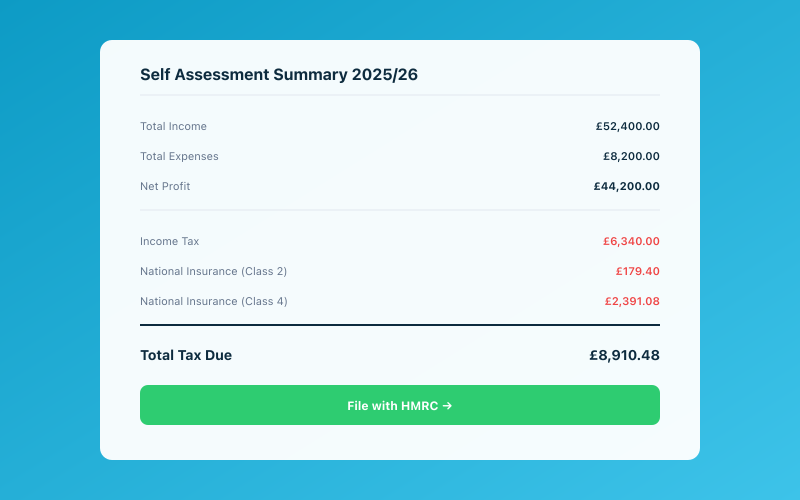 Your Accounted dashboard shows your real-time tax position
- Total income: Everything you've earned from your self-employment during the year.
- Total expenses: All allowable business costs you've incurred.
- Net profit (or loss): Income minus expenses. This is the figure your income tax and National Insurance are calculated on.
Unlike limited companies, sole traders don't need to produce formal financial statements like a balance sheet or profit and loss account for HMRC. However, you do need accurate figures to complete the self-employment section of your Self Assessment return. And if HMRC ever asks to see your records, you'll need to show how you arrived at those figures.
Step 1: Gather Your Records
Before you can prepare anything, you need all your source documents in one place. This includes:
- Bank statements for all accounts used for business transactions (ideally a separate business account).
- Invoices you've issued to clients.
- Receipts for business expenses — digital or physical.
- Mileage logs if you claim vehicle expenses.
- Records of any cash transactions.
- Details of any assets you've bought or sold.
If you've been using Accounted throughout the year, most of this will already be recorded and categorised. If you haven't, this is the part that takes the most time — but it's essential to get right.
HMRC requires you to keep these records for at least five years after the 31 January filing deadline for the relevant tax year. So for the 2025/26 tax year (return due 31 January 2027), you'd need to keep records until at least 31 January 2032.
Step 2: Reconcile Your Bank Account
Reconciliation means checking that every transaction in your bank account matches an entry in your bookkeeping records. It's the single most effective way to catch errors, missing transactions, and duplicates.
Go through your bank statements month by month and tick off each transaction against your records. If something doesn't match, investigate it. Common issues include:
- Transactions you forgot to record.
- Payments categorised under the wrong heading.
- Personal expenses mixed in with business ones.
- Bank fees or interest you haven't accounted for.
If you're using Accounted with a connected bank feed, reconciliation is largely automated. Penny flags unmatched transactions so you can deal with them quickly rather than hunting through statements manually.
Step 3: Categorise Your Income
Add up all your business income for the year. This should include:
- Sales and fees from your main business activity.
- Any other business income, such as interest on a business savings account, rental of business equipment, or income from selling business assets.
- Grants or support payments, if you received any.
Make sure you're recording income on the correct basis. Most sole traders use the cash basis, which means you record income when you receive it and expenses when you pay them. This is the default for sole traders with qualifying income under £150,000.
The alternative is traditional accounting (also called the accruals basis), where you record income when it's earned and expenses when they're incurred, regardless of when money actually changes hands. If you use this method, you'll need to account for debtors (money owed to you) and creditors (money you owe).
For a full overview of the deadlines involved, see our Self Assessment deadlines for 2025/26.
Step 4: Review and Categorise Your Expenses
This is where careful preparation pays off — literally. Every legitimate business expense you claim reduces your taxable profit and therefore your tax bill.
Common categories of allowable expenses for sole traders include:
- Cost of goods sold: Raw materials, stock, direct costs.
- Office costs: Stationery, printing, postage, phone, internet.
- Travel: Fuel, public transport, parking, accommodation for business trips.
- Professional fees: Accountancy, legal advice, professional body memberships.
- Marketing: Website hosting, advertising, business cards.
- Software and subscriptions: Tools you use for your business, including bookkeeping software.
- Insurance: Professional indemnity, public liability, etc.
- Use of home: If you work from home, you can claim a proportion of household costs (heating, electricity, broadband) or use HMRC's simplified expenses flat rate.
- Training: Courses and qualifications that update existing skills (not those that teach entirely new ones).
- Capital allowances: For equipment, vehicles, and other assets. The Annual Investment Allowance (AIA) lets you deduct the full cost of qualifying assets up to £1,000,000 per year.
Go through each expense and make sure it's categorised correctly. If you're not sure whether something is allowable, HMRC's guidance on business expenses is the place to check. Or ask Penny — it can give you a quick steer on common expense queries.
Step 5: Account for Capital Items
If you've bought any significant assets during the year — a computer, a vehicle, specialist equipment — you may need to handle them differently from day-to-day expenses.
Under the cash basis, you can generally deduct the cost of most business assets as an expense in the year you buy them, with some exceptions (notably cars, which are subject to capital allowances rules).
Under traditional accounting, you'd typically claim capital allowances instead. The main options are:
- Annual Investment Allowance (AIA): 100% deduction on qualifying assets, up to £1,000,000 per year.
- Writing Down Allowance (WDA): For assets that don't qualify for AIA, you can claim a percentage of the remaining value each year (typically 18% or 6%, depending on the asset type).
If you've sold or disposed of a business asset during the year, you may also need to account for any balancing charge or capital gain.
Step 6: Calculate Your Net Profit
Once you've totalled your income and expenses, the calculation is straightforward:
Total income - Total allowable expenses = Net profit
This net profit figure is what you'll enter on your Self Assessment return, and it's the basis for calculating your income tax and Class 4 National Insurance contributions.
If your expenses exceed your income, you've made a loss. Losses can usually be carried forward to set against future profits, or in some cases, set against other income in the same year.
Step 7: Review and Sense-Check
Before you submit anything, take a step back and review your figures. Ask yourself:
- Does the total income figure look right based on what you know you earned?
- Are there any unusually large or small expense categories that might warrant a closer look?
- Have you claimed for everything you're entitled to?
- Have you accidentally included any personal expenses?
- Does your net profit feel roughly in line with what you'd expect?
If something doesn't look right, investigate it now rather than after you've filed. Amending a return after submission is possible but creates extra work.
Accounted's summary reports can help here — you can see your income and expenses broken down by category and month, making it easy to spot anomalies.
Step 8: Prepare for Your Tax Return
With your year-end accounts prepared, you're ready to complete your Self Assessment return. The self-employment pages ask for your total turnover, total expenses (broken into categories), and your net profit or loss.
If your total turnover is below £85,000, you can report summarised figures. Above this threshold, you'll need to provide a more detailed breakdown.
Remember, you can file your return as soon as the tax year ends on 5 April — you don't have to wait until January. Filing early gives you certainty about what you owe and time to plan for the payment. See our year-end tax checklist for 2025/26 for a summary of everything else to consider.
Related reading:
Accounted helps UK sole traders stay on top of their bookkeeping and tax. Start your free 30-day trial at getaccounted.co.uk.
Related Reading
Start your free trial and let Penny handle your bookkeeping automatically.
Accounted files your Self Assessment directly to HMRC, with your return pre-populated from your records. See Self Assessment filing →
Tax & Compliance Specialists
Our tax specialists have decades of combined experience in UK sole trader and small business taxation, MTD compliance, and HMRC submissions. All content is reviewed against current HMRC guidance before publication and updated quarterly to reflect legislative changes.
Ready to try Accounted?
Join UK sole traders who are simplifying their bookkeeping and tax.
Start your 14-day free trial