HMRC's Connect System — How They Catch Tax Evaders
HMRC isn't relying on guesswork when it comes to catching people who underreport their income or overclaim expenses. They've got a powerful piece of technology called Connect, and it's been quietly revolutionising tax enforcement since it launched back in 2010.
If you've ever wondered how HMRC seems to know things about your finances that you haven't told them, Connect is almost certainly the answer. Here's how it works, what data it pulls in, and what it means for you as a sole trader.
What Is Connect?
Connect is HMRC's data analytics platform — a massive, sophisticated system that draws in information from a huge range of sources and cross-references it to spot inconsistencies, patterns, and potential tax fraud.
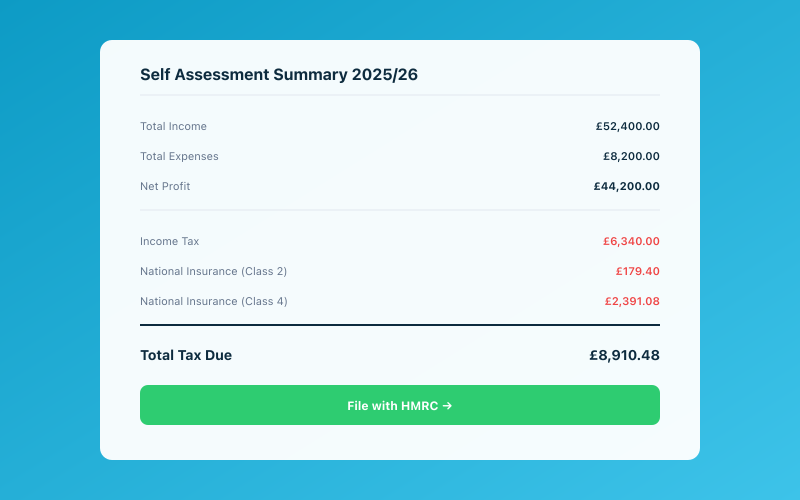 Your Accounted dashboard shows your real-time tax position
Think of it as a giant jigsaw puzzle. Each data source provides pieces, and Connect fits them together to build a picture of your financial life. When the picture your data paints doesn't match what you've declared on your tax return, a flag goes up.
HMRC has invested heavily in Connect — reportedly over £100 million — and it's paid for itself many times over. The system is credited with helping HMRC recover billions in underpaid tax since its launch. It processes roughly one billion items of data per year, making it one of the most powerful tax analytics tools in the world.
Where Does Connect Get Its Data?
This is the part that surprises most people. Connect doesn't just look at your tax return and bank statements. It pulls in data from an extraordinarily wide range of sources:
Banks and financial institutions. HMRC receives data from UK banks about account holders, including details of accounts held, interest earned, and in some cases, transaction patterns. Since the Common Reporting Standard (CRS) came into effect, HMRC also receives information about accounts held overseas in over 100 jurisdictions.
Employers and pension providers. Every employer reports what they've paid you through PAYE in real time. Pension providers report pension income. If you've declared employment income of £30,000 but your employer reported paying you £35,000, Connect will spot the discrepancy.
Property records. Land Registry data tells HMRC about property purchases and sales. If you bought a £400,000 house whilst declaring income of £20,000, that's going to raise questions. Stamp duty records provide another layer of property transaction data.
Online marketplaces. Since 2024, platforms like eBay, Amazon, Etsy, Vinted, and Airbnb are required to report seller and host income to HMRC. If you're earning £15,000 a year selling on eBay but haven't declared a penny of it, Connect knows.
Social media. Yes, really. HMRC's officers can and do look at social media profiles. If you're posting about your luxury lifestyle whilst declaring modest earnings, that's a data point Connect can use. It's not that HMRC is trawling through every Instagram post — but if other data flags you as a potential risk, your social media presence might be examined as part of the wider picture.
Credit reference agencies. Data from agencies like Experian, Equifax, and TransUnion gives HMRC insight into your credit history, outstanding debts, and financial commitments — all of which help build a picture of your true financial position.
DVLA records. Vehicle registrations tell HMRC what cars you own. If you've registered a brand new Range Rover on a declared income of £18,000, that's going to look odd.
Companies House. Information about company directorships, shareholdings, and company accounts is all accessible through Connect.
Overseas data. Through international data-sharing agreements, HMRC receives information about offshore bank accounts, investments, and property holdings. The days of hiding money overseas are essentially over for most people.
Other government departments. DWP, DVLA, passport records, and other government databases can all feed into Connect's analysis.
How Does Connect Actually Work?
Connect uses a combination of data matching, network analysis, and risk profiling:
Data matching is the most straightforward element. It simply compares what you've declared with what other sources say. If your bank received £80,000 in deposits last year but you declared turnover of £50,000, there's a £30,000 gap that needs explaining.
Network analysis looks at connections between people and entities. It can identify that you're connected to someone else who's being investigated, or that a network of companies shares common directors or addresses in a pattern that suggests fraud.
Risk profiling uses algorithms to assess how likely it is that a particular return is inaccurate. Returns are scored based on various risk factors — industry, declared profit margins, expense ratios, previous compliance history, and more. High-scoring returns are flagged for further investigation.
The clever part is that Connect can spot patterns that would be invisible to a human reviewer looking at individual returns. It might notice, for example, that a particular accountant's clients consistently claim unusually high motor expenses, suggesting systemic overclaiming rather than individual errors.
What Connect Means for Sole Traders
If you're a sole trader who declares all your income honestly and claims only legitimate expenses, Connect is nothing to worry about. In fact, it should reassure you — it helps level the playing field by catching competitors who gain an unfair advantage by cheating the system.
But there are a few practical implications worth knowing about:
Declare everything. This has always been the rule, but Connect makes it non-negotiable. If you earn money from any source — whether it's your main business, a side hustle, rental income, or investment returns — HMRC probably already knows about it through one of their data feeds. Failing to declare it isn't just dishonest; it's futile.
Be consistent. If your lifestyle and your declared income don't match, Connect may flag you. That doesn't mean you need to live frugally, but large purchases on a small declared income will attract attention. If you have a legitimate explanation — perhaps you received an inheritance or sold a property — make sure you can evidence it.
Keep good records. If HMRC does ask questions based on Connect data, you need to be able to explain your finances clearly. Good records make this straightforward. A mess of unsorted receipts and unreconciled bank statements makes it much harder. For a practical guide, see our article on how to keep business records for HMRC.
Don't underestimate cash transactions. Even if you deal primarily in cash, the money has to go somewhere. If you're depositing cash into your bank account, Connect can see it. If you're spending cash without banking it, your lifestyle might not match your declared income. Cash is not invisible.
Common Misconceptions
There are quite a few myths about Connect floating around. Let's address a few:
"HMRC reads all my emails and messages." No, they don't. Connect analyses structured data from official sources. HMRC doesn't have the power to intercept your private communications without a warrant, and they don't need to — the data they already receive is more than sufficient.
"If I'm under the VAT threshold, HMRC won't notice me." Wrong. Connect monitors sole traders of all sizes. A plumber earning £40,000 is just as visible as a consultant earning £400,000.
"I only need to worry if I'm evading tax." Not entirely. Connect also flags genuine errors and honest mistakes. If you accidentally omitted a source of income, Connect might pick it up. The consequences of an innocent mistake are far less severe than deliberate evasion, but you'll still need to correct it and possibly pay interest.
"Using cash means HMRC can't track me." As mentioned above, this is outdated thinking. Bank deposits, lifestyle indicators, and third-party reporting all create a trail, even for cash-heavy businesses.
How to Stay on the Right Side of Connect
The advice is remarkably simple:
- Declare all your income. Every source, every amount.
- Claim only legitimate expenses. With evidence to back them up.
- Keep thorough records. Digital records are ideal — they're easier to search, back up, and produce if asked.
- File on time. Late filing is itself a risk factor that can increase your Connect score.
- Be honest. If you've made a mistake, correct it voluntarily rather than hoping it won't be noticed. HMRC treats voluntary disclosures far more leniently than discoveries they make themselves.
Using Accounted makes all of this easier. Your transactions are pulled in automatically, Penny helps you categorise them correctly, and your records are maintained in real time. If HMRC ever has questions, you've got a clean, complete digital record that tells the full story.
The Bigger Picture
Connect represents a fundamental shift in how tax compliance works. In the past, HMRC relied heavily on random audits and tip-offs. Today, they can proactively identify the highest-risk cases using data that they receive automatically from hundreds of sources.
For honest taxpayers, this is a good thing. It means the tax gap is shrinking, public services are better funded, and honest businesses aren't undercut by competitors who cheat. For those who are tempted to cut corners, it means the risk of getting caught has never been higher.
The message is clear: in the age of Connect, transparency isn't just good ethics — it's good strategy.
Related reading:
Accounted helps UK sole traders stay on top of their bookkeeping and tax. Start your free 30-day trial at getaccounted.co.uk.
Related Reading
- How to Close Your Self Assessment Account with HMRC
- January Self Assessment Rush — How to Avoid the Panic
Start your free trial and let Penny handle your bookkeeping automatically.
Accounted files your Self Assessment directly to HMRC, with your return pre-populated from your records. See Self Assessment filing →
Tax & Compliance Specialists
Our tax specialists have decades of combined experience in UK sole trader and small business taxation, MTD compliance, and HMRC submissions. All content is reviewed against current HMRC guidance before publication and updated quarterly to reflect legislative changes.
Ready to try Accounted?
Join UK sole traders who are simplifying their bookkeeping and tax.
Start your 14-day free trial