Accruals and Prepayments — What They Are and Why They Matter
If you've ever looked at your accounts and thought the numbers don't quite reflect reality, accruals and prepayments might be the missing piece. These are two of the most important concepts in accounting, and once you understand them, your financial picture becomes a lot clearer.
Don't worry — this isn't going to be a dry textbook explanation. We'll break it down in plain English, with real examples, so you can see exactly how accruals and prepayments work and why they matter for your business.
Cash vs Accrual Accounting and Why Timing Matters
Before we get into accruals and prepayments specifically, it helps to understand the two main ways of recording income and expenses.
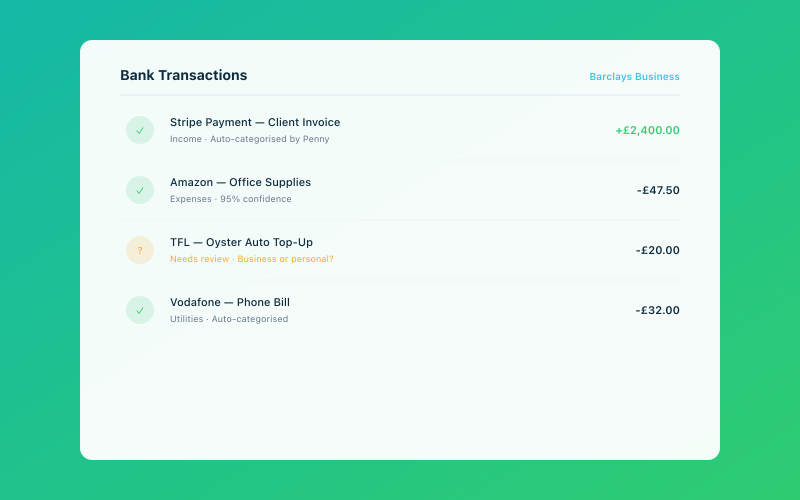 Penny auto-categorises your bank transactions with 95%+ accuracy
Cash basis accounting records transactions when money actually changes hands. You record income when the cash hits your account and expenses when the money leaves. Simple.
Accrual basis accounting records transactions when they're earned or incurred, regardless of when the cash moves. You record income when you've delivered the work (even if the client hasn't paid yet) and expenses when you've received the goods or services (even if you haven't paid the bill yet).
Most sole traders in the UK can use the cash basis for tax purposes, which is simpler. But if your turnover exceeds £150,000, or if you're a limited company, you'll need to use accrual accounting. And even if you use the cash basis for your tax return, understanding accruals and prepayments helps you see how your business is really performing.
For a deeper dive into the differences, have a look at our guide on cash basis vs accrual accounting.
At their heart, accruals and prepayments exist to make sure your accounts match reality. The technical term is the matching principle — the idea that income and expenses should be recorded in the period they relate to, not just when cash happens to move.
This matters for several reasons. It ensures accurate profitability — if you're trying to work out whether your business made a profit in a particular month, quarter, or year, you need to match the income you earned with the expenses you incurred to earn it. It supports better decision-making — if your accounts show a great month because a client paid a big invoice early, but you've also got a stack of unpaid bills coming, you might make decisions based on a false sense of security. And for many businesses, compliance requires it — if you're required to prepare accounts on an accrual basis, getting these adjustments right isn't optional.
What Are Accruals?
An accrual is an expense you've incurred but haven't yet paid for, or income you've earned but haven't yet received. The work has happened, the service has been provided, or the goods have been delivered — but the cash hasn't moved yet.
Example — expense accrual:
Your accounting year runs from 1 April to 31 March. On 31 March, you receive your electricity bill covering the quarter January to March. The bill is £450, but you don't actually pay it until 15 April.
Under accrual accounting, you record the £450 as an expense in the year ending 31 March — because that's when the electricity was used, even though you paid for it in the next accounting period.
Example — income accrual:
You're a consultant and you completed a project on 28 March. You sent the invoice for £2,000 on 30 March, but the client doesn't pay until 20 April.
Under accrual accounting, you record the £2,000 as income in the year ending 31 March — because that's when you earned it, even though the cash arrived in the next period.
Without accruals, your accounts would understate your expenses in one year and overstate them in the next (or vice versa for income). That gives a misleading picture of your profitability in each period.
What Are Prepayments?
A prepayment is the opposite of an accrual. It's a payment you've made in advance for something you haven't yet received or used.
Example — expense prepayment:
On 1 February, you pay your annual insurance premium of £1,200 covering the period 1 February to 31 January. Your accounting year ends on 31 March.
You've paid £1,200, but only two months of that insurance (February and March) relate to the current accounting year. The remaining ten months (April to January) relate to the next year.
Under accrual accounting, you'd record £200 as an expense this year (2/12 of £1,200) and carry forward £1,000 as a prepayment — an asset on your balance sheet that gets released as an expense in the following year.
Example — income prepayment (deferred income):
You're a personal trainer and a client pays £600 upfront for a 12-session package. By your year end, they've completed 8 sessions.
You'd record income of £400 (8 sessions) this year and carry forward £200 as deferred income — a liability on your balance sheet — because you still owe the client 4 sessions.
Without prepayments, you'd overstate expenses in the year you paid the insurance (or overstate income in the year the client paid upfront). The accounts wouldn't accurately reflect the period they relate to.
Understanding where these sit on your balance sheet helps make sense of the overall picture. Prepayments appear as current assets — they represent something you've paid for but haven't yet received. Accruals appear as current liabilities — they represent costs you've incurred but haven't yet paid. Deferred income also appears as a current liability. If you're not sure how to read a balance sheet, our guide on how to read a profit and loss statement covers the fundamentals of understanding your financial statements.
How to Calculate Accruals and Prepayments
The maths is straightforward. For an accrual, identify the cost that relates to the current period but hasn't been invoiced or paid yet, and record that amount as an expense and a corresponding liability. For a prepayment, work out how much of a payment relates to a future period, remove that amount from the current period's expenses, and record it as an asset.
Let's work through a detailed example. Your year end is 31 March 2026. You pay rent quarterly in advance — £3,000 on 1 January, 1 April, 1 July, and 1 October.
On 1 January 2026, you paid £3,000 covering January to March. That's fully within your accounting year — no adjustment needed.
But what if you paid on 1 March 2026 for March to May (£3,000)? Only one month (March) falls within your accounting year. So you'd record £1,000 as rent expense for the current year and carry forward £2,000 as a prepayment.
Now imagine your landlord hasn't sent the March quarter's bill by 31 March, but you know you owe £3,000 for January to March. You'd accrue £3,000 — recording it as an expense for the year and a liability on the balance sheet.
Here are the expenses and income sources where accruals and prepayments most commonly come up:
Typical accruals: utility bills (often billed in arrears), accountancy fees (usually invoiced after the year end), bonus or commission payments, and interest on loans.
Typical prepayments: insurance premiums (usually paid annually in advance), rent (often paid quarterly or annually in advance), software subscriptions (annual plans paid upfront), professional memberships, and domain and hosting fees.
If you're using Accounted to manage your bookkeeping, Penny can help flag transactions that might need year-end adjustments — like annual insurance payments or subscriptions that span your year end. It won't make the adjustments automatically (your accountant will want to review those), but having them flagged saves time and reduces the chance of something being missed.
Do Sole Traders Need to Worry About This?
If you're a sole trader using the cash basis for your tax return, you generally don't need to make accrual or prepayment adjustments for tax purposes. The cash basis records income when received and expenses when paid — no timing adjustments needed.
However, there are situations where it still matters. Even if your tax return is on a cash basis, you might want to prepare management accounts on an accrual basis to get a true picture of profitability. If your turnover grows beyond the cash basis threshold, you'll need to switch to accrual accounting — understanding these concepts beforehand makes the transition smoother. And banks and investors typically want to see accrual-based accounts for loan applications or investor conversations, as they give a more accurate view of your financial position.
If you're a limited company, you're required to prepare your accounts on an accrual basis. Accruals and prepayments are part of every set of year-end accounts.
Here are some practical tips to make it manageable. Keep a schedule of items that regularly need adjusting at year end — insurance, rent, subscriptions, utility bills. Don't overcomplicate it — for very small amounts, the adjustment might not be worth the effort (accountants often apply a materiality threshold). Communicate with your accountant — if you know about an expense that's been incurred but not yet invoiced, flag it. And review prior year adjustments — last year's prepayments become this year's expenses, and last year's accruals should have been paid this year.
Accruals and prepayments are the accounting adjustments that make sure your numbers tell the truth. They match income and expenses to the periods they belong to, giving you an accurate picture of your business's financial health. If you're using the cash basis as a sole trader, you can largely set this aside for tax purposes. But if you're a limited company, or if you want management accounts that genuinely reflect how your business is performing, understanding these concepts is essential.
Related reading:
- Cash Basis vs Accrual Accounting — Which Should You Use?
- How to Read a Profit and Loss Statement
- Double-Entry Bookkeeping Explained
Accounted helps UK sole traders stay on top of their bookkeeping and tax. Start your free 30-day trial at getaccounted.co.uk.
Related Reading
- Bad Debts — How to Write Them Off for Tax
- ISAs for Self-Employed People — Which Type Is Best?
- Understanding Your Bank Statement — A Guide for New Business Owners
Try Accounted free for 30 days — no credit card required.
Accounted makes bookkeeping simple — Penny categorises your transactions automatically so you don't have to. See how →
Tax & Compliance Specialists
Our tax specialists have decades of combined experience in UK sole trader and small business taxation, MTD compliance, and HMRC submissions. All content is reviewed against current HMRC guidance before publication and updated quarterly to reflect legislative changes.
Ready to try Accounted?
Join UK sole traders who are simplifying their bookkeeping and tax.
Start your 14-day free trial