Depreciation Explained — How Assets Lose Value for Tax
If you've ever bought something expensive for your business — a laptop, a van, a piece of machinery — and wondered how it affects your tax bill, you've stumbled into the world of depreciation. It's one of those accounting concepts that sounds more complicated than it actually is, and once you understand it, you'll see why it matters.
In this guide, we'll explain what depreciation is, how it works in practice, and — crucially for anyone running a business in the UK — how it connects to capital allowances and your tax bill.
What Depreciation Is and How It Works
Depreciation is the process of spreading the cost of an asset over its useful life. Instead of recording the full cost as an expense in the year you buy it, you spread that cost across the years you expect to use it.
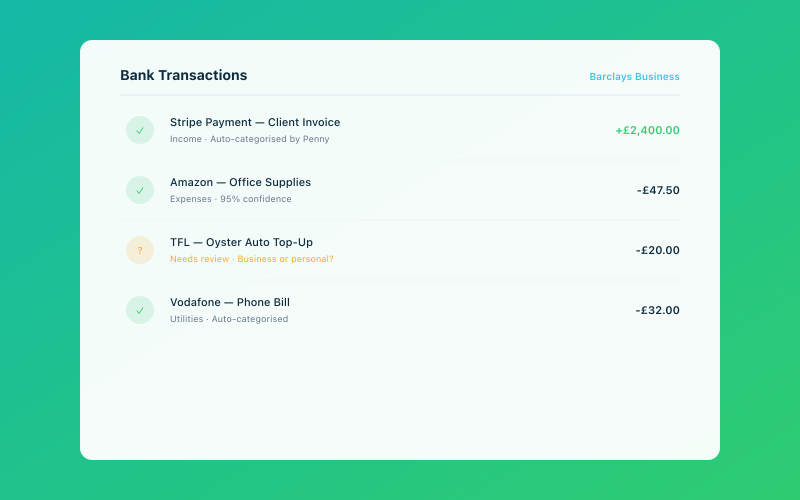 Penny auto-categorises your bank transactions with 95%+ accuracy
The logic is simple: if you buy a van for £20,000 and expect to use it for five years, it doesn't make sense to record the entire £20,000 as an expense in year one. The van benefits your business across all five years, so the cost should be spread across all five years too.
Each year, you record a portion of the cost as a depreciation expense. This reduces the value of the asset on your balance sheet and reduces your profit on your profit and loss statement.
Important distinction: Depreciation is an accounting concept, not a tax one. In the UK, HMRC doesn't use depreciation to calculate your tax bill — they use capital allowances instead (more on that in a moment). But depreciation still matters for your management accounts and financial statements.
Straight-line depreciation is the simplest and most widely used method. You divide the cost of the asset (minus any estimated residual value) by its useful life.
Example: You buy a laptop for £1,500. You expect to use it for three years, after which it'll be worth roughly £300.
Depreciable amount = £1,500 - £300 = £1,200 Annual depreciation = £1,200 / 3 = £400 per year
Each year, you record £400 as a depreciation expense, and the laptop's value on your balance sheet reduces by £400.
| Year | Opening Value | Depreciation | Closing Value | |------|--------------|--------------|---------------| | 1 | £1,500 | £400 | £1,100 | | 2 | £1,100 | £400 | £700 | | 3 | £700 | £400 | £300 |
Reducing balance depreciation applies a fixed percentage to the remaining balance each year. This front-loads the depreciation, with higher charges in the early years and lower charges later.
Example: Same £1,500 laptop, but using 40% reducing balance:
| Year | Opening Value | Depreciation (40%) | Closing Value | |------|--------------|---------------------|---------------| | 1 | £1,500 | £600 | £900 | | 2 | £900 | £360 | £540 | | 3 | £540 | £216 | £324 |
This method better reflects assets that lose value quickly in the early years — technology and vehicles, for example.
Not everything you buy is depreciated. The key distinction is between capital expenditure (assets providing benefit over multiple years — vehicles, computers, machinery, furniture) and revenue expenditure (day-to-day spending consumed in the current period — rent, utilities, supplies). We've written a more detailed guide on the difference between capital and revenue expenditure if you want to dig deeper.
Different types of assets are typically depreciated over different periods: computers and laptops over 3 years, office furniture over 5–10 years, vehicles over 4–5 years, machinery and equipment over 5–10 years, and buildings over 25–50 years. These are guidelines, not rules — choose useful lives that reflect how long you genuinely expect to use the asset.
Depreciation vs Capital Allowances
Here's where UK tax gets interesting. When you prepare your accounts, you calculate depreciation as an expense. But when you calculate your taxable profit, you add back the depreciation and replace it with capital allowances.
Capital allowances are the tax equivalent of depreciation — they're HMRC's way of giving you tax relief on capital spending. But the rates and rules are set by HMRC, not by you or your accountant. If businesses could set their own depreciation rates for tax, everyone would write off expensive assets in year one to minimise their tax bill. Capital allowances standardise the process.
The main types of capital allowances are:
Annual Investment Allowance (AIA). This lets you deduct the full cost of qualifying assets in the year you buy them, up to £1 million per year. For most small businesses, this means you can write off the entire cost of equipment, machinery, and vehicles (excluding cars) in year one.
Writing Down Allowance (WDA). For expenditure that exceeds the AIA, or for items not eligible for the AIA, you can claim WDA at 18% (main rate pool) or 6% (special rate pool) per year on a reducing balance basis.
First Year Allowances (FYA). Some assets qualify for 100% first-year allowances, meaning you can deduct the full cost in the year of purchase. This includes new zero-emission vehicles and certain energy-efficient equipment.
Structures and Buildings Allowance (SBA). A 3% annual allowance for the cost of constructing or renovating non-residential buildings.
For a comprehensive look at the AIA and how to claim it, see our guide on capital allowances and the Annual Investment Allowance.
If you're a sole trader using the cash basis, you generally don't need to worry about depreciation at all for tax purposes. You simply deduct the cost of equipment when you pay for it (with some exceptions for cars). However, under the cash basis, you can't claim capital allowances on most items — the cost is simply treated as an expense when paid. Cars are the exception, where you still use capital allowances. If you use accrual accounting, you'll calculate depreciation in your accounts and then adjust for capital allowances on your tax return.
For many sole traders, the cash basis keeps things simple. But if you're making significant capital purchases, it's worth checking with your accountant whether the accrual basis and capital allowances might give you a better tax result.
Depreciation in Your Financial Statements and Asset Disposals
Even if depreciation doesn't directly affect your tax bill (because capital allowances take over), it's still important for your financial statements.
On your profit and loss statement, depreciation appears as an operating expense, reducing your reported profit. This gives a more realistic picture of profitability than ignoring the wear and tear on your assets. On your balance sheet, assets are shown at their net book value — the original cost minus accumulated depreciation. For management decisions, depreciation helps you understand the true cost of running your business. If you ignore it, your profit looks artificially high, which can lead to poor decisions about spending, pricing, or growth.
If you use Accounted, you can track your assets and Penny can help remind you when assets are approaching the end of their useful life — which is useful for planning replacements and managing cash flow.
When you sell, scrap, or give away an asset, you need to account for the disposal. If you sell for more than the net book value, you've made a profit on disposal (recorded as income). If you sell for less, you've made a loss on disposal (recorded as an expense).
Example: You bought a machine for £5,000, depreciated it to £2,000, then sold it for £3,000. You've made a £1,000 profit on disposal. But if you sold it for £1,000, you've made a £1,000 loss.
For tax purposes, disposals affect your capital allowances computation. If you sell an asset from the main pool, the proceeds reduce the pool balance. If the pool goes negative (because you received more than the written-down value), you have a balancing charge — effectively, HMRC claws back some of the allowances you've already claimed.
Practical Tips for Getting It Right
Keep an asset register. Maintain a list of all your capital assets, including purchase date, cost, depreciation method, useful life, and current net book value. This makes year-end accounts preparation much faster.
Review useful lives regularly. If a laptop you expected to last three years is still going strong after four, adjust the remaining depreciation accordingly.
Don't confuse depreciation with cash flow. Depreciation is a non-cash expense — it doesn't involve any money leaving your account. It's purely an accounting entry. This is important when looking at cash flow: your business can show a depreciation expense but still have the cash available.
Talk to your accountant about capital allowances. The AIA and other allowances can significantly reduce your tax bill in the year you make a big purchase. Planning the timing of purchases around your year end can make a real difference.
Depreciation is simply the process of spreading the cost of an asset over the years you use it. It keeps your accounts accurate and your profit figures honest. For UK tax purposes, capital allowances replace depreciation — HMRC's own set of rules for giving you tax relief on capital spending. Whether you're a sole trader on the cash basis (where it's largely automatic) or a limited company preparing full accounts (where it's a key part of your year-end process), understanding depreciation helps you make better financial decisions and plan more effectively.
Related reading:
- Capital Allowances and the Annual Investment Allowance
- The Difference Between Capital and Revenue Expenditure
- What Is Bookkeeping and Why Does It Matter?
Accounted helps UK sole traders stay on top of their bookkeeping and tax. Start your free 30-day trial at getaccounted.co.uk.
Related Reading
Try Accounted free for 30 days — no credit card required.
Accounted makes bookkeeping simple — Penny categorises your transactions automatically so you don't have to. See how →
Tax & Compliance Specialists
Our tax specialists have decades of combined experience in UK sole trader and small business taxation, MTD compliance, and HMRC submissions. All content is reviewed against current HMRC guidance before publication and updated quarterly to reflect legislative changes.
Ready to try Accounted?
Join UK sole traders who are simplifying their bookkeeping and tax.
Start your 14-day free trial