Break-Even Analysis — How to Calculate Yours
There's a number in every business that separates working for free from working for profit. It's the point where your income exactly covers all your costs — not a penny more, not a penny less. That's your break-even point, and knowing what it is might be one of the most practically useful things you ever do for your business.
Break-even analysis sounds academic, but it's anything but. It answers a simple, urgent question: how much do I need to sell before I actually start making money? Whether you're setting prices, planning a new service, deciding whether to take on a lease, or just trying to understand why your bank balance never seems to grow, break-even analysis gives you clarity.
Let's work through it step by step.
What Is the Break-Even Point?
Your break-even point is the level of sales at which your total revenue equals your total costs. Below that point, you're making a loss. Above it, you're making a profit.
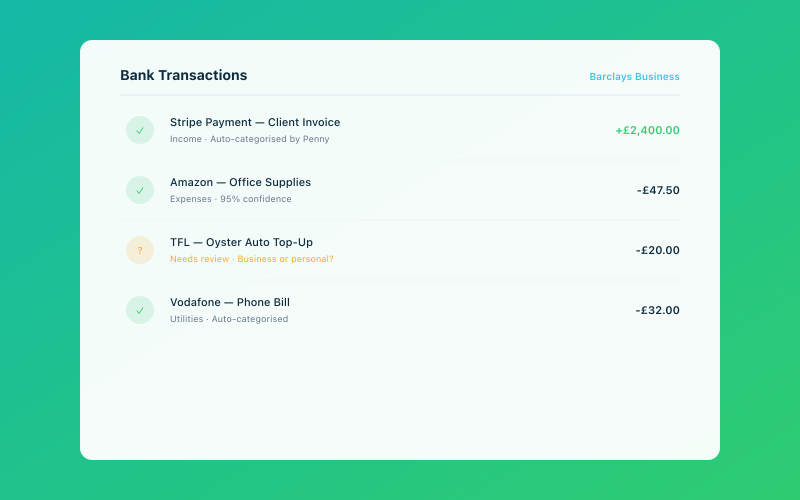 Penny auto-categorises your bank transactions with 95%+ accuracy
It can be expressed in different ways:
- In units: How many products you need to sell (e.g., 500 candles per month)
- In revenue: How much turnover you need to generate (e.g., £4,000 per month)
- In time: How many billable hours or days you need to work (e.g., 15 days per month)
For many sole traders who sell services rather than physical products, the revenue or time-based version is most useful. But the principle is the same regardless.
Understanding Your Costs: Fixed vs Variable
Before you can calculate your break-even point, you need to separate your costs into two categories: fixed costs and variable costs. This distinction is the foundation of the whole analysis.
Fixed costs are expenses that stay the same regardless of how much work you do or how many products you sell. They're the costs you incur even if you don't make a single sale. Common examples include:
- Rent or co-working space fees
- Insurance premiums
- Software subscriptions
- Loan repayments
- Phone contracts
- Professional memberships
- Accountancy fees
Variable costs are expenses that change in proportion to your sales or output. The more you sell, the higher these costs are. Examples include:
- Materials and supplies
- Subcontractor costs
- Postage and packaging
- Payment processing fees (e.g., Stripe or PayPal charges)
- Travel costs directly tied to specific jobs
- Commission payments
Some costs are semi-variable — they have a fixed element and a variable element. Your electricity bill might have a standing charge (fixed) plus usage (variable). For break-even analysis, you'll need to estimate how these split, or simply assign them to whichever category they more closely resemble.
If you're using Accounted to track your expenses, Penny's categorisation makes it much easier to see which costs are fixed and which vary with your output. Having clean expense categories is half the battle.
The Break-Even Formula
Once you've separated your costs, the formula is straightforward:
Break-Even Point (in units) = Fixed Costs / (Selling Price per Unit - Variable Cost per Unit)
The bit in brackets — selling price minus variable cost — is called the contribution margin. It's how much each sale contributes towards covering your fixed costs and, eventually, generating profit.
Let's say you make and sell handmade ceramics:
- Fixed costs: £1,500 per month (studio rent, insurance, kiln costs, software)
- Selling price per item: £35
- Variable cost per item: £10 (clay, glazes, packaging, postage)
Contribution margin = £35 - £10 = £25
Break-even point = £1,500 / £25 = 60 items per month
You need to sell 60 items each month to cover all your costs. Item 61 is where profit begins.
Break-Even Point (in revenue) = Fixed Costs / Contribution Margin Ratio
The contribution margin ratio is the contribution margin expressed as a percentage of the selling price:
Contribution margin ratio = £25 / £35 = 71.4%
Break-even revenue = £1,500 / 0.714 = £2,101 per month
So you need to generate at least £2,101 in monthly sales to break even.
Break-Even for Service-Based Sole Traders
If you sell your time rather than physical products, the calculation works slightly differently but the principle is identical.
Let's say you're a freelance graphic designer:
- Fixed costs: £800 per month (software, insurance, phone, accounting software, professional membership)
- Day rate: £350
- Variable costs per working day: £15 (travel, printing, miscellaneous)
Contribution margin per day = £350 - £15 = £335
Break-even point = £800 / £335 = 2.39 days per month
That's remarkably low — which tells you that your business model has low fixed costs and healthy margins. Everything beyond roughly two and a half days of billable work per month is profit.
But wait — that's only accounting for direct business costs. As a sole trader, you also need to cover your personal living expenses, tax, and National Insurance from your business profits. So a more realistic break-even calculation might include a "salary" target:
- Fixed costs: £800 per month
- Personal income target: £3,000 per month
- Tax and NI provision: £800 per month
- Total to cover: £4,600 per month
Break-even point = £4,600 / £335 = 13.73 days per month
That's a much more meaningful number. You need about 14 billable days per month to cover your costs and pay yourself a reasonable income. In a month with 22 working days, that leaves 8 days for admin, marketing, holidays, and sick days.
This kind of analysis helps you understand whether your pricing is sustainable and whether your business can genuinely support the lifestyle you want. For more on understanding what your business is really earning, our turnover vs profit vs income guide breaks down the different layers.
Using Break-Even Analysis for Pricing Decisions
One of the most powerful uses of break-even analysis is testing pricing scenarios. What happens if you raise your prices? What happens if you lower them to win more volume?
Scenario 1: Raising prices by 10%
Using our ceramics example, if you increase the price from £35 to £38.50:
New contribution margin = £38.50 - £10 = £28.50 New break-even point = £1,500 / £28.50 = 52.6 items
By raising prices 10%, you need to sell 7 fewer items per month to break even. Even if the price increase causes you to lose a few sales, you might still come out ahead.
Scenario 2: Reducing prices to increase volume
If you drop the price to £30:
New contribution margin = £30 - £10 = £20 New break-even point = £1,500 / £20 = 75 items
Now you need to sell 75 items — 15 more than before — just to cover costs. That's a 25% increase in volume needed for a 14% price reduction. In most cases, a price cut needs to generate a disproportionate increase in sales to be worthwhile.
Break-even analysis makes these trade-offs concrete. Instead of guessing whether a pricing change makes sense, you can see exactly how many additional sales you'd need to compensate.
Break-Even Analysis for New Projects and Investments
Break-even analysis isn't just for your overall business — it's incredibly useful for evaluating specific decisions:
Should you rent a studio or work from home? If renting a studio adds £500 per month to your fixed costs, how many extra sales or billable hours do you need to cover it?
Should you hire a subcontractor? If bringing in help costs £200 per day but allows you to take on more work, how many additional days of revenue do you need to break even on the cost?
Should you invest in new equipment? If a new piece of equipment costs £3,000 and saves you £100 per month in outsourcing costs, it'll take 30 months to break even on the investment.
Should you launch a new product line? Calculate the fixed costs of development and the variable costs per unit, then work out how many you need to sell to recoup the investment.
Each of these decisions has a break-even point, and calculating it in advance takes the guesswork out of the decision.
Limitations of Break-Even Analysis
Break-even analysis is a brilliant tool, but it has its limits:
It assumes costs are neatly fixed or variable. In reality, some costs are a mix, and the fixed/variable split can change as your business scales.
It assumes a constant selling price. If you offer discounts, do project-based pricing, or have a range of products at different price points, you'll need to use averages or run separate analyses for different lines.
It doesn't account for time. The formula tells you how much you need to sell, but not how long it'll take. Selling 60 ceramics might take a month or it might take six months — the break-even calculation doesn't distinguish.
It's a snapshot. Your costs and prices change over time. A break-even analysis done in January might not be accurate by June. Review it regularly.
It ignores cash flow timing. You might break even on paper but still have cash flow problems if clients pay late or if you have to pay for materials upfront. Understanding the difference between profit and cash flow is essential.
Despite these limitations, break-even analysis remains one of the simplest and most effective financial planning tools available. It doesn't need to be perfect to be useful — even a rough break-even figure is far better than flying blind.
Getting Started with Your Own Break-Even Analysis
Here's a simple action plan:
-
List all your fixed costs for a typical month. If you're tracking expenses in Accounted, you can pull this directly from your records.
-
Calculate your average variable cost per unit or per job. Look at the last few months of direct costs and divide by the number of units sold or jobs completed.
-
Determine your average selling price. Again, look at actual data from your records.
-
Plug the numbers into the formula. Calculate your break-even point in units, revenue, or days.
-
Sense-check the result. Does the number feel right? Are you currently above or below break-even? If you're below, that explains a lot about your cash position.
-
Run scenarios. What if costs go up? What if you raise prices? What if you add a new expense? Playing with the numbers helps you make better decisions.
Break-even analysis isn't a one-off exercise. Make it a regular part of how you review your business, and you'll always have a clear view of what it takes to keep the lights on — and what it takes to thrive.
Related Reading
-
Accruals and Prepayments — What They Are and Why They Matter
-
Getting a Mortgage When You're Self-Employed — The 2026 Guide
Try Accounted free for 30 days — no credit card required.
Accounted helps UK sole traders stay on top of their bookkeeping and tax. Start your free 30-day trial at getaccounted.co.uk.
Accounted makes bookkeeping simple — Penny categorises your transactions automatically so you don't have to. See how →
Tax & Compliance Specialists
Our tax specialists have decades of combined experience in UK sole trader and small business taxation, MTD compliance, and HMRC submissions. All content is reviewed against current HMRC guidance before publication and updated quarterly to reflect legislative changes.
Ready to try Accounted?
Join UK sole traders who are simplifying their bookkeeping and tax.
Start your 14-day free trial