How to Read a Profit and Loss Statement
A profit and loss statement — often shortened to P&L — is one of those financial documents that sounds more complicated than it actually is. At its heart, it answers a single, rather important question: is your business making money or losing it?
If you've ever totted up your earnings and expenses on the back of an envelope to see whether you're ahead or behind, you've already done a basic version of a P&L. The formal version is just more structured, more detailed, and considerably more useful.
Whether you're a sole trader filing your Self Assessment, a freelancer trying to understand your finances, or a small business owner preparing for a meeting with your bank, knowing how to read a P&L is an essential skill. Let's walk through it together.
What Is a Profit and Loss Statement?
A profit and loss statement is a financial report that summarises your business's income, costs, and expenses over a specific period — usually a month, a quarter, or a full tax year. It shows whether you made a profit (income exceeded expenses) or a loss (expenses exceeded income) during that period.
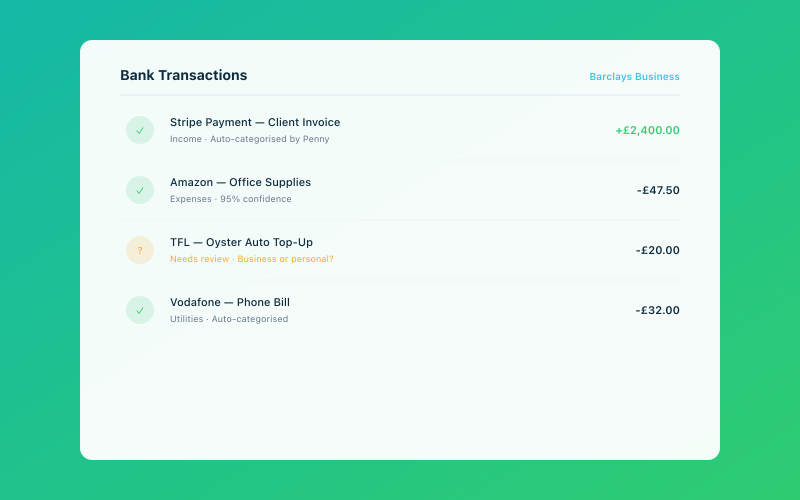 Penny auto-categorises your bank transactions with 95%+ accuracy
It's one of three key financial statements, alongside the balance sheet and the cash flow statement. While the balance sheet shows your financial position at a single point in time, the P&L shows your performance over a period.
For sole traders, the P&L is particularly important because it directly feeds into your Self Assessment tax return. The profit figure on your P&L is essentially your taxable income from self-employment.
The Structure of a P&L
Every P&L follows the same basic structure, from the simplest sole trader to a multinational corporation. Here's how it flows:
Revenue (Turnover)
This is the very first line — your total sales or income from your business activities during the period. If you're a freelance consultant who billed £52,000 in the tax year, that's your revenue.
Revenue doesn't include VAT you've collected (that belongs to HMRC), personal income from employment or investments, or money you've borrowed.
For a clear explanation of how revenue relates to other financial terms, see our guide on the difference between turnover, profit, and income.
Cost of Sales (Direct Costs)
These are costs directly tied to delivering your products or services. For a business selling physical goods, this includes the cost of buying or manufacturing those goods. For a service-based sole trader, this might include:
- Materials used on specific jobs
- Subcontractor costs
- Direct labour costs
Many service-based sole traders don't have significant cost of sales, which is perfectly normal. If you're a freelance writer, your cost of sales might be essentially zero — your "product" is your time and expertise.
Gross Profit
Gross Profit = Revenue - Cost of Sales
This shows how much money you're making from your core business activity before you account for overheads and running costs. It's a useful measure of how profitable your actual work is.
If your gross profit margin (gross profit as a percentage of revenue) is declining over time, it might mean your prices are too low, your costs are rising, or you're spending too much on materials.
Operating Expenses (Overheads)
These are the day-to-day costs of running your business that aren't directly tied to specific sales. Common categories include:
- Rent and rates — if you have business premises
- Insurance — public liability, professional indemnity, etc.
- Office costs — stationery, postage, printing
- Phone and internet — the business portion
- Software and subscriptions — tools and apps you use
- Marketing and advertising — website, social media ads, business cards
- Travel and transport — fuel, public transport, parking for business journeys
- Professional fees — accountant, legal advice
- Bank charges — fees on your business account
- Depreciation — the gradual reduction in value of assets like equipment and vehicles (if using accrual accounting)
Each of these categories appears as a separate line on your P&L, which lets you see exactly where your money is going.
Net Profit (or Net Loss)
Net Profit = Gross Profit - Operating Expenses
This is the bottom line — quite literally. It's the figure that tells you whether your business is making money after all costs are accounted for. This is the number that matters most for your tax calculation and for understanding your business's financial health.
For the 2025/26 tax year, if your net profit exceeds the personal allowance of £12,570, you'll pay income tax at the basic rate of 20% on the portion between £12,571 and £50,270. Profits above £50,270 are taxed at the higher rate of 40%.
A Worked Example
Let's look at a sample P&L for a fictional sole trader — Tom, a self-employed carpenter — for the 2025/26 tax year:
| | Amount | |---|---| | Revenue (Turnover) | £68,000 | | | | | Cost of Sales | | | Timber and materials | £14,500 | | Subcontractor costs | £4,200 | | Total Cost of Sales | £18,700 | | | | | Gross Profit | £49,300 | | | | | Operating Expenses | | | Van running costs | £3,800 | | Insurance | £1,200 | | Tools and equipment | £2,100 | | Phone and internet | £720 | | Software and subscriptions | £480 | | Accountancy fees | £600 | | Marketing | £350 | | Office supplies | £180 | | Bank charges | £95 | | Total Operating Expenses | £9,525 | | | | | Net Profit | £39,775 |
Tom's business generated £68,000 in revenue. After materials and subcontractors (£18,700), his gross profit was £49,300. After all other business expenses (£9,525), his net profit — the money he actually keeps before tax — was £39,775.
That's a healthy picture. His gross profit margin is about 72%, meaning he keeps 72p of every pound billed after direct costs. His net profit margin is about 58%, which is strong for a trades business.
What to Look for When Reading a P&L
Trends Over Time
A single P&L tells you how one period went. But the real value comes from comparing P&Ls across multiple periods. Look at:
- Is revenue growing? If not, why not? Are you losing clients, or has the market shifted?
- Are costs rising faster than revenue? This squeezes your margins and reduces profitability.
- Is net profit stable or improving? A growing business should ideally see profit growth alongside revenue growth.
Monthly or quarterly P&Ls help you spot seasonal patterns too. A gardener might have very different figures in July versus January, and knowing this helps with cash flow planning.
Expense Categories
Your P&L breaks expenses into categories for a reason. Look at where your money is going:
- Are any expense categories disproportionately large?
- Are there costs you could reduce without hurting your business?
- Are there categories where you're spending nothing but perhaps should be (like marketing)?
Gross Profit Margin
Your gross profit margin tells you how efficiently you're delivering your core service or product. If it's declining, you might need to raise your prices, negotiate better rates with suppliers, or find more efficient ways of working.
Unusual Items
Look for anything unexpected — a spike in travel costs, an unusually large professional fee, or a drop in income that you can't explain. These could be one-offs, or they could signal a developing problem.
Common Mistakes When Reading a P&L
Confusing Profit with Cash
This is perhaps the most important point. Your P&L might show a healthy profit, but that doesn't mean you have that money in the bank. Some of your income might still be owed by clients, and you may have already spent money on things that haven't appeared as expenses yet. For more on this distinction, see our guide on profit vs cash flow.
Ignoring Non-Cash Expenses
If you're using accrual accounting, your P&L will include depreciation — a non-cash expense that reflects the declining value of your assets. This reduces your profit on paper but doesn't represent an actual cash outflow in the current period.
Not Comparing Like With Like
Comparing a three-month P&L with a twelve-month P&L isn't particularly useful. Make sure you're comparing the same time periods when looking at trends.
Only Looking at the Bottom Line
Net profit is important, but it's not the only number that matters. A healthy net profit can mask problems — perhaps revenue is falling but you've cut costs aggressively to compensate. That's not sustainable long-term.
How Often Should You Review Your P&L?
For most sole traders, a monthly review is ideal. It only takes a few minutes if your bookkeeping is up to date, and it keeps you connected to the financial reality of your business.
If monthly feels like too much, at least review quarterly. This gives you four checkpoints during the year to assess performance, adjust your approach, and plan ahead.
With Accounted, your P&L updates automatically as you categorise transactions, so there's no additional work required. Penny keeps your numbers current so you can check in whenever you like — no end-of-year panic needed.
Using Your P&L to Make Better Decisions
Your P&L isn't just a historical record — it's a decision-making tool. Here are some practical ways to use it:
- Pricing decisions — If your margins are too thin, your P&L will show you. Consider raising prices or reducing costs.
- Investment decisions — Wondering whether you can afford new equipment or a training course? Your P&L shows whether the business can support it.
- Tax planning — Knowing your likely profit before the year ends gives you time to make tax-efficient decisions, such as bringing forward allowable expenses.
- Loan applications — Lenders want to see profitable trading. A healthy P&L strengthens your application.
Wrapping Up
A profit and loss statement isn't just a document for your accountant or HMRC. It's a window into how your business is really performing — and once you know how to read one, you'll find it invaluable.
The key points to remember: revenue at the top, expenses in the middle, profit (or loss) at the bottom. Compare periods to spot trends. And never confuse profit with cash — they're related, but they're not the same.
Start reviewing yours regularly, and you'll be making smarter, more informed decisions about your business in no time.
Accounted helps UK sole traders stay on top of their bookkeeping and tax. Start your free 30-day trial at getaccounted.co.uk
Related reading:
- What Is a Balance Sheet and Why Should You Care?
- The Difference Between Turnover, Profit, and Income
- Profit vs Cash Flow — Why Profitable Businesses Go Bust
Related Reading
Try Accounted free for 30 days — no credit card required.
Accounted makes bookkeeping simple — Penny categorises your transactions automatically so you don't have to. See how →
Tax & Compliance Specialists
Our tax specialists have decades of combined experience in UK sole trader and small business taxation, MTD compliance, and HMRC submissions. All content is reviewed against current HMRC guidance before publication and updated quarterly to reflect legislative changes.
Ready to try Accounted?
Join UK sole traders who are simplifying their bookkeeping and tax.
Start your 14-day free trial