The Difference Between Capital and Revenue Expenditure
If you've ever wondered whether a business purchase counts as a tax-deductible expense or whether it needs to be treated differently, you've bumped into one of the most fundamental distinctions in accounting: capital expenditure versus revenue expenditure.
Getting this right matters because it affects when and how you get tax relief on your spending. Classify something incorrectly, and you could end up overpaying tax — or, worse, underpaying it and facing a correction from HMRC. Let's break it down.
The Basic Distinction and Why It Matters for Tax
Revenue expenditure is spending on the day-to-day running of your business. It covers costs that are consumed in the current accounting period and don't create a lasting asset. Revenue expenditure is deducted from your income as an expense, reducing your taxable profit in the year you incur it. Examples include rent and utility bills, staff wages, office supplies and stationery, marketing and advertising, insurance premiums, repairs and maintenance, professional fees, stock purchases, and travel and subsistence.
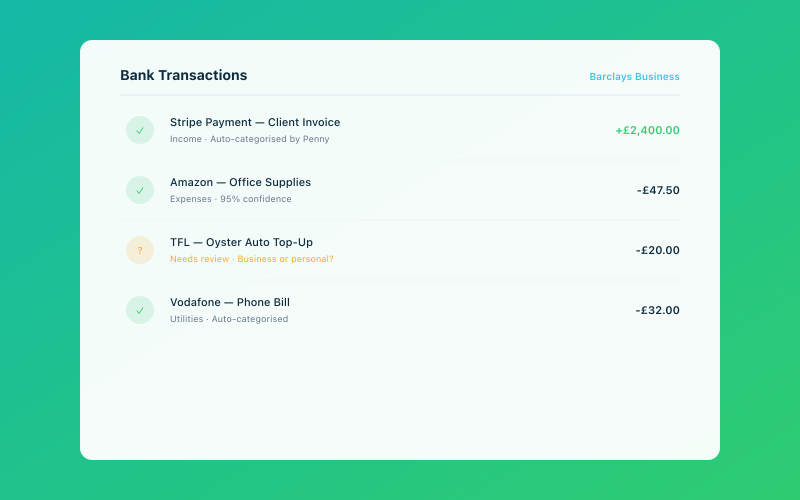 Penny auto-categorises your bank transactions with 95%+ accuracy
Capital expenditure is spending on assets that provide benefit over multiple years. Rather than being deducted as an expense in one go, capital expenditure is spread over the asset's useful life through depreciation (in your accounts) or claimed via capital allowances (for tax). Examples include buying a vehicle, purchasing machinery or equipment, buying computers and laptops, acquiring property or land, building improvements and renovations, and purchasing patents or trademarks.
The key question is: does the spending create or enhance an asset that will benefit the business for more than one year? If yes, it's likely capital. If it's consumed within the current period, it's revenue.
The classification directly affects your tax bill. Revenue expenditure is deducted in full against your income in the year it's incurred — £1,000 on advertising reduces your taxable profit by £1,000 this year. Capital expenditure is not deducted as a revenue expense. Instead, you claim tax relief through capital allowances — HMRC's system for giving you tax relief on capital spending. Depending on the type of asset and the allowance available, you might get full relief in year one (through the Annual Investment Allowance) or spread relief over several years (through writing-down allowances).
For sole traders on the cash basis, the distinction is slightly more relaxed. Most capital items are treated as expenses when paid for, effectively giving you immediate tax relief without needing to claim formal capital allowances. The main exception is cars, which still follow the capital allowances rules. For anyone on the accrual basis, or for limited companies, getting the classification right is essential.
Our guide on capital allowances and the Annual Investment Allowance explains how capital expenditure is treated for tax in more detail.
The Grey Area: Repairs vs Improvements
The trickiest area is distinguishing between repairs (revenue expenditure) and improvements (capital expenditure). This is where most classification disputes with HMRC occur.
Repairs and maintenance = revenue expenditure. Restoring an asset to its original condition is a repair. You're maintaining what you already have, not creating something new. Examples: replacing a broken window with a like-for-like window, repairing a leak in the roof, repainting walls that have become worn, replacing a worn clutch in your van, fixing a broken fence.
Improvements and enhancements = capital expenditure. Making an asset better, more efficient, or fundamentally different from its original state is an improvement. You're creating additional value that lasts beyond the current period. Examples: replacing single-glazed windows with double-glazing, adding an extension to a property, installing a new heating system where there wasn't one before, upgrading a van engine to a more powerful model, converting a storage room into a usable office.
The "like-for-like" test is a useful rule of thumb: if you're replacing something with a modern equivalent that does the same job, it's usually a repair. If you're replacing something with a superior version that enhances functionality, it's likely an improvement. Technology complicates this — if you replace an old boiler with a modern condensing boiler, you could argue it's a like-for-like replacement because you can't buy the old type anymore. HMRC generally accepts this reasoning.
The "entirety" test considers whether you're repairing part of an asset or replacing the whole thing. Replacing a few broken tiles is a repair. Replacing the entire roof might be capital expenditure, especially if the new roof is substantially different or better.
The "initial repair" rule applies when you buy a property or asset in disrepair and then fix it up. HMRC may argue the repairs are capital in nature because the purchase price reflected the poor condition.
Real-World Examples and Mixed Expenditure
Let's work through some scenarios that commonly trip people up:
New laptop (£1,200). Capital expenditure — it's an asset that will benefit you for several years. Under the cash basis, you can deduct the full cost when paid. Under the accrual basis, you'd claim capital allowances.
Software subscription (£30/month). Revenue expenditure — you're paying for ongoing access, not buying an asset. Deductible in full.
Website design (£3,000). Generally capital expenditure — the website is an asset lasting several years. But ongoing hosting, domain fees, and minor updates are revenue expenditure.
Van service and MOT (£405). Revenue expenditure — routine maintenance to keep the van in working order.
Kitchen refit in a rental property. If the new kitchen is broadly the same standard (similar cabinets, worktops, appliances), HMRC generally treats this as a repair (revenue). If you've significantly upgraded — granite worktops replacing laminate, integrated appliances replacing freestanding — the upgrade element could be capital.
Adding a room to your shop. Clearly capital expenditure — you've created a new asset that didn't exist before.
Redecorating your office. Revenue expenditure — maintenance and restoration to the original condition.
Sometimes a single project involves both capital and revenue elements. For example, a shop renovation might include repainting (revenue), replacing a broken door (revenue), installing new lighting throughout (potentially capital), and building a new partition wall (capital). In these cases, you need to split the cost between components. Keep itemised invoices wherever possible — a single lump-sum invoice for "renovation work" makes it much harder to separate the elements.
If you use Accounted, Penny can help you categorise transactions correctly as you go. When you buy something significant, it's worth pausing to consider whether it's a capital or revenue item rather than lumping everything together. Catching it at the point of entry saves time and confusion at year end.
Record-Keeping and Common Mistakes
Good records make classification easier and protect you if HMRC asks questions. Keep itemised invoices that break down work into individual line items. Photograph before and after, especially for property work — photos showing the condition before and after help demonstrate whether work was a repair or improvement. Note the purpose of each purchase when recording it. Separate small tools from equipment — many businesses treat items under £500 or £1,000 as revenue expenditure for practicality, even if they technically last more than a year (check with your accountant for a suitable threshold). Maintain an asset register listing all capital items with purchase date, cost, supplier, and expected useful life.
For an understanding of the bookkeeping principles behind all of this, our guide on double-entry bookkeeping explained covers how debits and credits work. Understanding how these items flow through your accounts is also part of reading your financial statements confidently — our guide on how to read a profit and loss statement covers the fundamentals.
The most common mistakes to avoid: treating everything as revenue expenditure (this understates profit and could attract HMRC attention), treating improvements as repairs (if HMRC reclassifies, you'll lose the immediate deduction and potentially face an additional tax bill plus interest), inconsistency (treating similar items differently in different years looks suspicious), and ignoring the distinction on the cash basis (even though most capital items are expenses, understanding the distinction is useful for financial reporting and for when your business grows beyond the cash basis threshold).
The distinction between capital and revenue expenditure is one of the most important concepts in business accounting. It determines when you get tax relief on your spending, how your profits are reported, and how your balance sheet looks. For most everyday spending, the classification is obvious. Where it gets tricky — repairs versus improvements, mixed projects, technology upgrades — a bit of thought and good record-keeping goes a long way. And when in doubt, ask your accountant. Getting it right from the start is much easier than correcting it later.
Related reading:
- Capital Allowances and the Annual Investment Allowance
- How to Read a Profit and Loss Statement
- Double-Entry Bookkeeping Explained
Accounted helps UK sole traders stay on top of their bookkeeping and tax. Start your free 30-day trial at getaccounted.co.uk.
Related Reading
Try Accounted free for 30 days — no credit card required.
Accounted makes bookkeeping simple — Penny categorises your transactions automatically so you don't have to. See how →
Tax & Compliance Specialists
Our tax specialists have decades of combined experience in UK sole trader and small business taxation, MTD compliance, and HMRC submissions. All content is reviewed against current HMRC guidance before publication and updated quarterly to reflect legislative changes.
Ready to try Accounted?
Join UK sole traders who are simplifying their bookkeeping and tax.
Start your 14-day free trial