Capital Allowances Explained — Annual Investment Allowance
When you buy something for your business that's going to last more than a year — a laptop, a van, a piece of machinery, office furniture — you can't simply deduct it as a day-to-day expense. Instead, you claim capital allowances, which is HMRC's way of letting you write off the cost of long-lasting assets against your taxable profits.
The most important capital allowance for sole traders is the Annual Investment Allowance (AIA), which lets you deduct 100% of the cost of qualifying assets in the year you buy them. In this guide, we'll explain how capital allowances work, what the AIA covers, the current limits, and how to make the most of them.
What Are Capital Allowances?
Capital allowances are tax deductions that let you claim the cost of business assets over time. They replace the accounting concept of depreciation (which isn't allowed for tax purposes) with a system that HMRC controls.
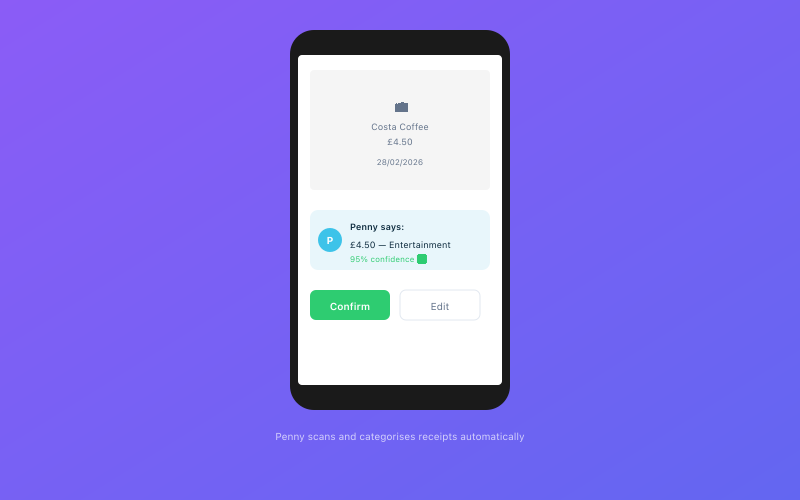 Penny scans and categorises your receipts automatically via WhatsApp
When you buy a qualifying asset, you don't reduce your taxable profit by the full cost in one go (unless you use the AIA). Instead, you add the asset to a "pool" and claim a percentage of the pool's value each year — this is the writing-down allowance (WDA).
However, for most sole traders, the AIA means you can claim 100% of the cost upfront. The WDA only comes into play if you exceed the AIA limit or if the asset doesn't qualify for the AIA.
The Annual Investment Allowance (AIA)
The AIA is the headline capital allowance for small businesses. Here's what you need to know.
Current Limit: £1,000,000
The AIA allows you to claim 100% tax relief on the first £1,000,000 of qualifying capital expenditure per year. This limit has been set at £1,000,000 since January 2019 and was made permanent in the Spring Budget 2023.
For the vast majority of sole traders, this limit is more than sufficient. Even if you buy a vehicle, kits out an entire workshop, and invest in new technology all in the same year, you're unlikely to spend more than £1,000,000 on qualifying assets.
What Qualifies for the AIA?
The AIA covers plant and machinery, which is a broad category that includes:
- Computing equipment — laptops, desktops, tablets, servers, monitors, printers
- Office furniture — desks, chairs, shelving, filing cabinets
- Tools and equipment — hand tools, power tools, specialist machinery
- Vehicles — vans and commercial vehicles (cars have separate rules — see below)
- Fixtures and fittings — lighting, heating systems, kitchen equipment in business premises
- Signage and display equipment
- Security systems — CCTV, alarms, safes
The list is extensive. If an item is used in your business and has lasting value, it almost certainly qualifies as plant and machinery.
What Doesn't Qualify?
There are some notable exceptions:
- Cars — these don't qualify for the AIA (but they do qualify for writing-down allowances or, in some cases, first-year allowances for zero-emission vehicles)
- Land and buildings — the purchase price of property and land isn't covered (though some integral features and fixtures within a building may qualify)
- Items given to you — you can only claim for items you've purchased, not gifts
- Items not used for business — the asset must be used for the purposes of your trade
Cars are the most common source of confusion. While vans, lorries, and motorcycles qualify for the AIA, cars do not. Instead, cars go into either the main rate pool (18% WDA) or the special rate pool (6% WDA), depending on their CO2 emissions. The exception is zero-emission cars (fully electric), which qualify for 100% first-year allowances — effectively the same as the AIA but through a different mechanism.
How to Claim the AIA on Your Tax Return
If you file a Self Assessment tax return, you claim capital allowances on the self-employment pages (SA103). There's a specific box for capital allowances, separate from your regular business expenses.
Here's the process in simplified terms:
- Identify your qualifying purchases during the tax year (6 April to 5 April).
- Add up the total cost of qualifying items.
- Claim the AIA — enter the total (up to £1,000,000) as your Annual Investment Allowance.
- Deduct business use percentage if any items are used partly for personal purposes.
If you use Accounted, the process is largely automated. When you record a purchase and Penny identifies it as a capital asset, she'll flag it for capital allowances and include it in the correct section of your tax return. You don't need to manually navigate the capital allowances boxes — Penny handles the calculations and placement.
Mixed Business and Personal Use
If you use an asset for both business and personal purposes, you claim the business proportion only. For example, if you buy a laptop for £1,000 and use it 80% for business, you claim £800 through the AIA.
There's no fixed rule about what percentage is acceptable. HMRC expects you to make a reasonable estimate based on actual usage. Keep a note of how you arrived at your percentage — "I use the laptop approximately 8 hours a day for work and 2 hours for personal use, so 80% business use" is the kind of simple record that supports your claim.
The Writing-Down Allowance (WDA)
If you spend more than £1,000,000 on qualifying assets in a year (unlikely for most sole traders) or if you have assets that don't qualify for the AIA (mainly cars), the excess goes into a capital allowances pool and is written down at a fixed percentage each year.
Main Rate Pool — 18% Per Year
Most plant and machinery falls into the main rate pool. You claim 18% of the pool's value each year on a reducing-balance basis.
Example: An asset worth £10,000 in the main rate pool.
- Year 1: Claim £1,800 (18% of £10,000). Pool value: £8,200.
- Year 2: Claim £1,476 (18% of £8,200). Pool value: £6,724.
- Year 3: Claim £1,210 (18% of £6,724). Pool value: £5,514.
And so on, until the pool value is small enough to claim in full using the small pools allowance (currently £1,000).
Special Rate Pool — 6% Per Year
Certain assets go into the special rate pool, which is written down at just 6% per year. This includes:
- Cars with CO2 emissions above 50g/km
- Integral features of buildings (electrical systems, cold water systems, lifts, etc.)
- Long-life assets (expected useful life of 25+ years)
- Thermal insulation added to business premises
The special rate pool is slow to write down, which is why the AIA is so valuable — it lets you claim 100% immediately instead of spreading relief over many years.
First-Year Allowances
In addition to the AIA and WDA, there are some first-year allowances (FYAs) that give 100% relief in the first year for specific types of assets:
- Zero-emission cars — fully electric cars qualify for 100% FYA
- Zero-emission goods vehicles — electric vans, for example
- Electric vehicle charge points — installing charging infrastructure
- Energy-saving and water-saving equipment — certain items on HMRC's approved lists
These FYAs are separate from the AIA and don't count towards the £1,000,000 limit. If you're buying a fully electric car for your business, this is particularly valuable since cars otherwise don't qualify for the AIA.
Disposing of Assets
When you sell, scrap, or give away a business asset, there are capital allowances implications. The disposal value (usually the amount you sell it for) is deducted from your capital allowances pool.
If this creates a negative pool balance (i.e., you sold the asset for more than the remaining pool value), you have a balancing charge — effectively, you've claimed too much allowance and need to pay some back. If the pool balance is still positive, you carry on claiming WDA on the remaining amount.
For assets claimed entirely through the AIA, a sale in a later year means the sale proceeds are treated as a balancing charge. For example, if you claimed £1,000 AIA on a laptop and later sell it for £300, the £300 is added back to your taxable profits.
Practical Tips
Time Your Purchases
Capital allowances are claimed in the tax year you incur the expenditure. If you're near the end of the tax year (5 April) and planning a significant purchase, buying before year-end brings the tax relief forward by a full year.
Keep Records
For every capital asset, keep:
- The purchase invoice or receipt
- A description of the asset and its business purpose
- The date of purchase
- The business-use percentage (with your reasoning)
- Disposal records if you later sell or scrap the item
Don't Overlook Small Items
Not everything needs to go through capital allowances. Small items with a short useful life — stationery, cleaning supplies, basic tools under £100 or so — are generally treated as revenue expenses and claimed directly. There's no strict threshold, but HMRC accepts that low-value, short-life items are revenue costs.
The Bottom Line
Capital allowances, and the AIA in particular, are one of the most valuable tax reliefs available to sole traders. With a £1,000,000 annual limit, you can claim 100% of the cost of virtually any business equipment in the year you buy it. The key is to identify your qualifying purchases, record the business-use proportion accurately, and include the claim on your tax return.
For most sole traders, the AIA covers everything. Cars are the main exception, and zero-emission vehicles have their own generous relief. If you're unsure whether something qualifies, err on the side of claiming and keep good records — Accounted and Penny can help you categorise purchases correctly and ensure nothing falls through the cracks.
For more on what you can claim, see our complete guide to sole trader expenses.
Related Reading
Start your free trial and let Penny handle your bookkeeping automatically.
Accounted helps UK sole traders stay on top of their bookkeeping and tax. Start your free 30-day trial at getaccounted.co.uk
Accounted categorises your expenses automatically using AI, with confidence scores on every transaction. See how expenses work →
Tax & Compliance Specialists
Our tax specialists have decades of combined experience in UK sole trader and small business taxation, MTD compliance, and HMRC submissions. All content is reviewed against current HMRC guidance before publication and updated quarterly to reflect legislative changes.
Ready to try Accounted?
Join UK sole traders who are simplifying their bookkeeping and tax.
Start your 14-day free trial