The Simplified Expenses Method — Is It Better for You?
HMRC offers sole traders a choice when it comes to claiming certain expenses: you can either track your actual costs in detail, or you can use a simpler flat-rate system known as simplified expenses. It's designed to reduce the record-keeping burden, and for some people it can actually result in a higher deduction than the actual cost method.
In this guide, we'll explain how simplified expenses work, cover the three areas they apply to, run through the numbers, and help you decide which method is better for your situation.
What Are Simplified Expenses?
Simplified expenses (sometimes called "flat-rate expenses") are fixed amounts set by HMRC that you can claim instead of working out your actual business costs. They're available to sole traders and business partnerships — not limited companies.
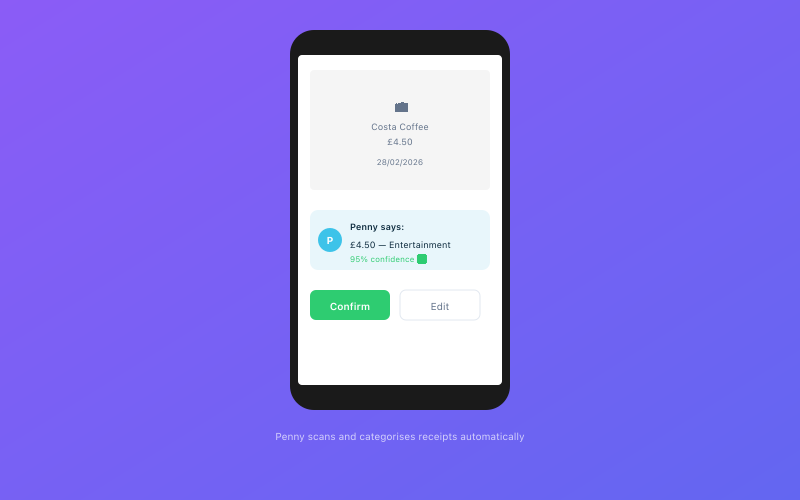 Penny scans and categorises your receipts automatically via WhatsApp
The scheme covers three specific areas:
- Business use of vehicles (cars and vans)
- Working from home
- Living at your business premises
You can choose to use simplified expenses for one, two, or all three of these areas. You don't have to use the same method for everything — you could use simplified expenses for your vehicle but actual costs for your home office, for example.
Once you choose a method for a particular area, you'll generally stick with it for the life of that asset or arrangement. For vehicles, there are specific rules about switching that we'll cover below.
1. Simplified Expenses for Vehicles
This is the most commonly used part of the simplified expenses scheme. Instead of tracking every penny of fuel, insurance, road tax, servicing, repairs, and depreciation, you simply record your business miles and multiply them by HMRC's flat rate.
The Flat Rates
| Miles per year | Rate per mile | |---------------|---------------| | First 10,000 | 45p | | Over 10,000 | 25p |
These are the same rates used for mileage allowances in employment, and they've been unchanged for several years.
Worked Example
You drive 8,000 business miles in the 2025/26 tax year.
Claim: 8,000 × 45p = £3,600
If you drove 14,000 business miles:
Claim: (10,000 × 45p) + (4,000 × 25p) = £4,500 + £1,000 = £5,500
When Is the Flat Rate Better?
The flat rate tends to work well if:
- You drive a relatively cheap, fuel-efficient car
- Your actual running costs are low (e.g., you own the car outright with no finance payments, and it's reliable)
- You do a moderate to high number of business miles
The flat rate tends to be less advantageous if:
- You drive an expensive car with high insurance and maintenance costs
- You have significant finance or lease payments
- You're VAT-registered and could reclaim VAT on actual fuel costs
As a rough guide, if your actual vehicle costs (including depreciation or finance) are more than 45p per mile, you're better off claiming actual costs. If they're less, the flat rate gives you a bigger deduction.
Important: You Can't Switch Back
If you use simplified expenses for a car you already own, you cannot then switch to actual costs and claim capital allowances on that vehicle. Once you've used the flat rate for a car, you're locked in for the life of that car. If you buy a new car, you get a fresh choice.
This is a crucial point. If you have a relatively new or expensive car, it may be better to claim actual costs (including capital allowances) from the start. Penny in Accounted can help you compare both methods before you commit.
2. Simplified Expenses for Working From Home
If you work from home, you can claim a flat-rate monthly amount based on the number of hours you work from home each month.
The Flat Rates
| Hours worked from home per month | Flat rate per month | |----------------------------------|-------------------| | 25 to 50 | £10 | | 51 to 100 | £18 | | 101 or more | £26 |
If you work from home less than 25 hours in a month, you can't claim for that month.
Worked Example
You work from home 30 hours a week, which comes to roughly 130 hours a month.
Monthly claim: £26 Annual claim: £26 × 12 = £312
When Is the Flat Rate Better?
The flat rate is simple and requires minimal record-keeping. But it's often less generous than the actual cost method, especially if you have significant home costs.
Under the actual cost method, you calculate the proportion of your household bills (rent or mortgage interest, council tax, electricity, gas, water, broadband, insurance) that relates to business use. For many sole traders working from home full-time, this can easily exceed £1,000-£2,000 per year.
The flat rate maxes out at £312 per year, which doesn't come close for most people. The main advantage of the flat rate is simplicity — you don't need to gather all your utility bills and calculate percentages.
We've written a detailed comparison in our guide to the two methods for calculating business use of home, which is well worth reading before you decide.
No Capital Gains Implications
One advantage of the flat rate that's often overlooked: because you're not claiming a proportion of actual household costs, there's no risk of a capital gains tax charge if you later sell your home. When you claim actual costs and dedicate a room exclusively to business, HMRC could argue that part of your home has been used wholly for business, potentially affecting your principal private residence relief. The flat rate avoids this issue entirely.
3. Simplified Expenses for Living at Business Premises
This is the least commonly used part of the scheme, but it's relevant if you live at the same address as your business premises — for example, if you run a B&B, a pub, or a shop with a flat above.
Instead of working out the personal-use proportion of your business premises costs, you deduct a flat monthly amount based on the number of people living there.
The Flat Rates
| Number of occupants | Monthly amount | |-------------------|---------------| | 1 | £350 | | 2 | £500 | | 3 or more | £650 |
This amount is deducted from your business expenses to account for personal use. So if your total premises costs are £12,000 per year and you live there with one other person, you'd deduct £6,000 (£500 × 12) and claim the remaining £6,000 as business expenses.
Practical Details
Recording simplified expenses is straightforward. You don't need individual receipts for every fuel purchase or utility bill — instead, you need:
- For vehicles: A mileage log showing each business journey (date, destination, purpose, miles). This is essential and HMRC can ask to see it.
- For home office: A record of hours worked from home each month. A simple spreadsheet or note is fine.
- For living at business premises: A note of how many people lived at the premises during each month.
Accounted makes this easy. You can log business miles directly in the app, and it automatically calculates your simplified expenses claim at the year-end. For home office hours, you can set a default weekly pattern and adjust it month by month as needed.
Can I Mix and Match Methods?
Yes. You can use simplified expenses for one category and actual costs for another. For example, many sole traders use:
- Flat-rate mileage for vehicle costs (simple and often generous)
- Actual costs for working from home (usually gives a bigger deduction)
This is perfectly allowed and is often the optimal combination. The only restriction is that you need to be consistent within each category — you can't use flat-rate mileage for some months and actual vehicle costs for others within the same tax year.
VAT and Simplified Expenses
If you're VAT-registered, simplified expenses add a slight complication. The flat rates already include an element for VAT, so you don't reclaim VAT separately on top.
However, if your actual VAT-reclaimable costs are significant (for example, if you buy a lot of fuel and could reclaim the VAT), you might find that the actual cost method gives you a better overall result once VAT recovery is factored in.
This is another area where it's worth running the numbers both ways before committing, especially for vehicle costs where the difference can be substantial.
The Bottom Line
Simplified expenses are a useful option that can save you time and, in some cases, money. The vehicle flat rate is often generous for sole traders with moderate running costs. The home office flat rate, on the other hand, is usually less generous than claiming actual costs — but it's much simpler and avoids any capital gains complications.
The best approach is to compare both methods for your specific situation. Run the numbers for a typical year, see which gives you the bigger deduction, and choose accordingly. And remember, you can mix and match — flat rate for one category, actual costs for another.
For the full picture on home office claims, see our guide on business use of home calculation. And for a comprehensive overview of everything you can claim, visit our complete guide to sole trader expenses.
Related Reading
Start your free trial and let Penny handle your bookkeeping automatically.
Accounted helps UK sole traders stay on top of their bookkeeping and tax. Start your free 30-day trial at getaccounted.co.uk
Accounted categorises your expenses automatically using AI, with confidence scores on every transaction. See how expenses work →
Tax & Compliance Specialists
Our tax specialists have decades of combined experience in UK sole trader and small business taxation, MTD compliance, and HMRC submissions. All content is reviewed against current HMRC guidance before publication and updated quarterly to reflect legislative changes.
Ready to try Accounted?
Join UK sole traders who are simplifying their bookkeeping and tax.
Start your 14-day free trial