Can I Claim My Gym Membership as a Business Expense?
If you're a sole trader who relies on physical fitness for work — or you simply want to stay healthy while running your business — you've probably wondered whether your gym membership counts as a legitimate business expense. It's one of the most common questions we see, and the answer isn't quite as straightforward as you might hope.
In this guide, we'll walk you through what HMRC says about gym memberships, when you might be able to claim, and what alternatives exist for getting some tax relief on keeping fit.
The General Rule: Personal Expenses Are Not Deductible
Let's get the headline out of the way first. In most cases, you cannot claim a gym membership as a business expense if you're a sole trader.
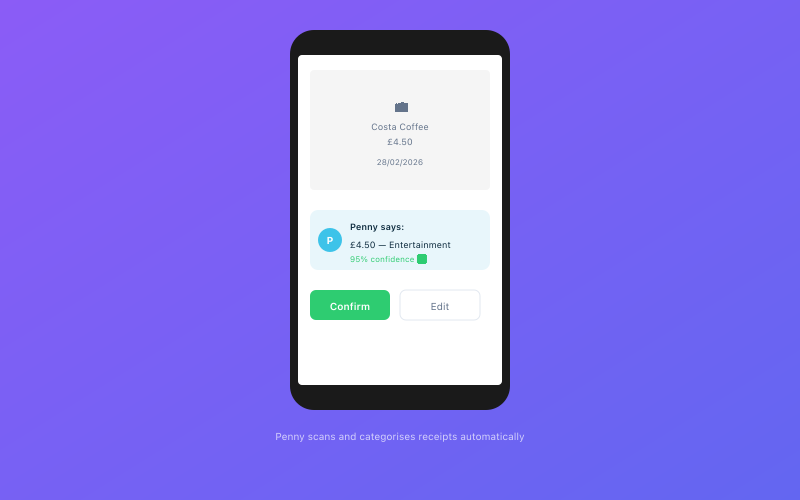 Penny scans and categorises your receipts automatically via WhatsApp
HMRC's overriding principle is that an expense must be incurred "wholly and exclusively" for the purposes of your trade. A gym membership, for the vast majority of people, is a personal expense. You go to the gym to stay healthy, feel good, and look after yourself — all perfectly reasonable goals, but none of them are exclusively business-related.
Even if you argue that being fit makes you better at your job (and it probably does), HMRC doesn't see it that way. The "wholly and exclusively" test is strict. If there's any personal benefit to the expense — and there clearly is with a gym membership — the cost generally fails the test.
This applies whether you pay £20 a month for a budget gym or £200 a month for a premium health club. The amount doesn't matter; it's the nature of the expense that counts.
When a Gym Membership Might Be Claimable
There are a handful of narrow exceptions where fitness-related costs could pass HMRC's test. These are genuinely rare, but worth knowing about.
You're a Fitness Professional
If you're a personal trainer, fitness instructor, gym owner, or sports coach, then gym access is arguably essential to delivering your services. You need to train in order to demonstrate exercises, maintain your own fitness to a professional standard, and stay current with equipment and techniques.
In this scenario, a gym membership has a strong case for being "wholly and exclusively" for business purposes — particularly if you use the gym solely for work-related training and client sessions. Even here, though, HMRC might argue there's a dual purpose if you also enjoy personal workouts. Keeping a log of your gym visits and noting which sessions are business-related can help support your claim.
You're a Performer or Actor
Actors, dancers, models, and other performers who need to maintain a specific physique for their work may also have a case. If your agent or employer requires you to meet certain physical standards, and you can demonstrate that your gym use is directly linked to fulfilling professional contracts, the expense becomes more defensible.
Medical or Rehabilitation Requirement
If a medical professional has prescribed exercise as part of a treatment plan for a work-related injury or condition, there may be grounds to claim the cost. This is a grey area, and you'd want to keep detailed records and ideally get professional tax advice before claiming.
The Dual-Purpose Problem
The reason most gym memberships fail the deductibility test comes down to what HMRC calls the "duality of purpose" rule. If an expense serves both a business and a personal purpose, it's not deductible — even if the business purpose is the main reason you're spending the money.
This is different from some other expenses where you can apportion costs. For example, if you use your mobile phone for both business and personal calls, you can claim the business percentage. But HMRC treats gym memberships differently because the personal health benefit is inherent and inseparable from any business benefit.
It's worth noting that this rule catches out quite a few expenses that people assume are claimable. Clothing is another classic example — you can't claim ordinary clothes even if you only wear them for work, because they also keep you warm and decent. You can read more about this in our guide to claiming clothing expenses.
What About Employer-Provided Gym Memberships?
If you operate through a limited company (rather than as a sole trader), the rules are slightly different — though still not generous.
A company-paid gym membership for a director or employee is treated as a benefit in kind. The company can deduct the cost as a business expense, but the individual will pay income tax and National Insurance on the value of the benefit. So while there's a corporation tax saving, the employee or director ends up paying tax on it anyway.
There is one workaround for limited companies: if you provide on-site gym facilities that are available to all employees, this is exempt from benefit-in-kind charges. However, for most sole traders and small limited companies, building an on-site gym is obviously not practical.
Alternatives Worth Considering
Even though gym memberships are generally off the table, there are other health and wellbeing expenses that might be more defensible.
Occupational Health Assessments
If your work involves physical demands — construction, manual labour, driving long distances — you may be able to claim for occupational health checks. These are directly related to your ability to perform your trade safely.
Ergonomic Equipment
If you work from home, investing in a proper desk, chair, or standing desk setup is a legitimate business expense. These items help you work effectively and can prevent health problems. You can read more about home office costs in our guide to working from home expenses for 2025/26.
Professional Memberships
While not fitness-related, memberships of professional bodies relevant to your trade are fully deductible. If you're a personal trainer, for example, your membership of the Register of Exercise Professionals (REPs) or similar body is a valid business expense.
Record-Keeping and How Accounted Can Help
If you're using Accounted to manage your bookkeeping, our AI assistant Penny is trained to spot expenses that might not be allowable. If you categorise a gym membership as a business expense, Penny will flag it and explain why it's unlikely to be accepted by HMRC. This kind of gentle nudge can save you from making an honest mistake on your Self Assessment — and potentially avoid an enquiry down the line.
If you're in one of the rare situations where a gym membership is genuinely claimable, make sure you keep thorough records.
- Keep receipts and invoices for every payment.
- Maintain a log of your gym visits, noting which sessions were for business purposes (e.g., client training, rehearsal, demonstration).
- Document the business connection — for example, keep copies of contracts that require you to maintain a certain fitness level.
- Separate personal and business use where possible. If you sometimes use the gym for personal workouts, be honest about it and only claim the business proportion.
Good record-keeping is essential for all your business expenses, not just contentious ones. HMRC expects you to keep records for at least five years after the 31 January submission deadline for the relevant tax year. For a full overview, take a look at our guide on how to keep business records for HMRC.
The Bottom Line
For most sole traders, a gym membership is a personal expense and cannot be claimed against your tax bill. The "wholly and exclusively" rule is clear, and HMRC is unlikely to accept a gym membership unless your trade genuinely requires physical fitness as a core component of the service you provide.
If you're a fitness professional, performer, or have a specific medical reason linked to your work, you may have a case — but tread carefully, keep excellent records, and consider getting advice from a qualified accountant.
For everyone else, the best approach is to accept that the gym is a personal cost and focus your energy on claiming the many expenses that are legitimately available to sole traders. There's a comprehensive list in our complete guide to sole trader expenses.
Related Reading
Start your free trial and let Penny handle your bookkeeping automatically.
Accounted helps UK sole traders stay on top of their bookkeeping and tax. Start your free 30-day trial at getaccounted.co.uk
Accounted categorises your expenses automatically using AI, with confidence scores on every transaction. See how expenses work →
Tax & Compliance Specialists
Our tax specialists have decades of combined experience in UK sole trader and small business taxation, MTD compliance, and HMRC submissions. All content is reviewed against current HMRC guidance before publication and updated quarterly to reflect legislative changes.
Ready to try Accounted?
Join UK sole traders who are simplifying their bookkeeping and tax.
Start your 14-day free trial