Co-Living and Co-Working Spaces — Can You Claim the Costs?
Co-working spaces have gone from niche to mainstream in the space of a few years. What started as a handful of shared desks in converted warehouses has become a global industry, with thousands of spaces across the UK and abroad catering to freelancers, sole traders, and remote workers of every description.
Co-living is the newer cousin — purpose-built or managed spaces where you live and work under one roof, often with shared kitchens, social areas, and dedicated workspaces. They're particularly popular with digital nomads and remote workers who want community without the commitment of a long-term lease.
But here's the question every self-employed person eventually asks: can I claim any of this on my tax return?
The answer, as with most tax questions, is "it depends." Let's break it down.
Co-Working Space Memberships and Day Passes
If you're a sole trader and you use a co-working space for your business, the cost is generally an allowable business expense. This applies whether you're paying for a hot desk, a dedicated desk, a private office, or just buying day passes when you need them.
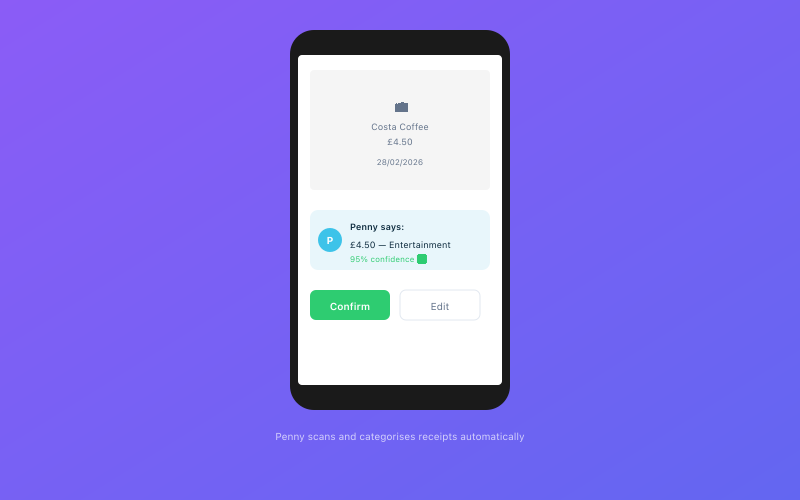 Penny scans and categorises your receipts automatically via WhatsApp
The key principle is that the expense must be "wholly and exclusively" for business purposes. If you're using a co-working space solely to do your work, this test is straightforward to meet.
Here's what you can typically claim:
- Monthly or annual membership fees for co-working spaces
- Day passes or pay-as-you-go desk hire
- Meeting room hire within a co-working space
- Additional services that are part of your membership (mail handling, printing credits, etc.)
If your co-working membership includes perks that are clearly personal — gym access, social events, meals — you should only claim the business portion. In practice, if these extras are bundled into the membership fee and you can't separate them out, HMRC is unlikely to challenge a reasonable claim. But if a significant chunk of what you're paying for is personal use, you'll need to apportion the cost.
It's worth noting that if you also have a home office and claim simplified expenses for working from home, you can still claim co-working costs on top. The two aren't mutually exclusive — you're simply claiming the actual cost of each workspace you use for business.
What About Co-Living Spaces?
This is where things get more interesting — and more complicated.
Co-living spaces blend accommodation with workspace. You might pay a single monthly fee that covers your bedroom, shared living areas, Wi-Fi, and access to a co-working area within the building. The question is: how much of that fee is a business expense?
The honest answer is that only the portion relating to your business use is claimable. Your rent — the cost of having somewhere to sleep — is a personal expense. It doesn't become a business expense just because the building also has a desk in it.
However, if you can identify a distinct business element in what you're paying, you may be able to claim that portion. For example:
- If the co-living space charges separately for accommodation and co-working, you can claim the co-working element.
- If there's a single bundled fee, you'd need to make a reasonable apportionment. This might be based on the proportion of space dedicated to working vs living, or the proportion of time you spend working vs personal use.
HMRC doesn't publish specific guidance on co-living, but the general principle of "wholly and exclusively for business" still applies. If you're going to claim a portion, make sure your reasoning is defensible and keep a record of how you calculated the split.
If you're travelling and using co-living spaces as temporary business accommodation — rather than as your permanent home — the rules around travel and subsistence may also come into play. We'll cover that next.
Claiming Costs When Travelling for Business
If you're a sole trader who travels for work — whether that's visiting clients, attending conferences, or working from another location temporarily — your travel, accommodation, and subsistence costs can be allowable expenses.
This is where co-living and co-working costs for travelling sole traders can become more straightforwardly claimable. If you're away from your normal base of operations on a temporary work trip, the cost of your accommodation (including a co-living space) may qualify as a business expense.
The crucial word here is "temporary." HMRC generally considers a work location to be temporary if you're there for a limited period — typically less than 24 months. If a co-living space becomes your permanent home, you can't claim the accommodation portion as a business expense.
For sole traders who are genuinely on the move — spending a month here, two months there — the case for claiming temporary accommodation as a business expense can be stronger. But you need to be able to show that you have a permanent base elsewhere (even if that's a family home in the UK) and that your travels are driven by business purposes.
Our guide on working abroad temporarily and UK tax goes into more detail on how temporary work locations interact with your tax position.
The Home Office Overlap
Many sole traders who use co-working spaces also work from home some of the time. This raises the question of whether you can claim both.
The short answer is yes. You can claim your co-working costs as a direct business expense and also claim for your home office use. For home office costs, you have two options:
Simplified expenses — You can claim a flat rate based on the hours you work from home each month (currently £10 per month for 25-50 hours, £18 for 51-100 hours, or £26 for 101+ hours).
Actual costs — You can calculate the actual proportion of your household bills (rent or mortgage interest, council tax, utilities, broadband) that relates to your business use of the home.
Either way, there's no rule that says using a co-working space prevents you from also claiming home office expenses. You're simply claiming the cost of each workspace for the periods you use it.
For a deeper dive into home office expense claims, have a look at our guide to work from home expenses for 2025/26.
Record-Keeping Tips for Workspace Expenses
Whatever workspace arrangement you use, solid record-keeping is essential. Here's what to hold on to:
- Invoices and receipts for all co-working and co-living payments
- Membership agreements showing what's included in your fee
- A log of your usage — particularly important if you're apportioning costs between business and personal use
- Bank or card statements showing the payments
If you're using Accounted, Penny can help you categorise these expenses correctly as they come in. Rather than trying to remember three months later whether that £250 payment was for co-working or a personal subscription, tagging it at the point of transaction makes everything simpler — especially when Self Assessment rolls around.
It's also worth keeping a brief note of your reasoning if you're making an apportionment. Something like "co-living fee £1,200/month — estimated 30% business use based on dedicated workspace area as proportion of total space = £360 claimed" is the kind of thing that would satisfy an HMRC enquiry.
VAT Considerations
If you're VAT registered, you can reclaim the VAT on co-working costs that are business expenses. Most UK co-working spaces will charge VAT on their fees, and this should be shown on your invoice.
For co-living costs, you can only reclaim VAT on the business portion — the same apportionment rules apply.
If you're using co-working spaces abroad, there's no UK VAT to reclaim (since the supply is outside the UK). However, depending on the country, you might be charged local VAT or equivalent taxes. Reclaiming foreign VAT is possible in some cases but it's a separate and often fiddly process.
Common Scenarios
Let's run through a few typical situations to make this more concrete:
Freelance designer who works from home three days a week and uses a co-working space two days a week. You can claim the co-working day passes or membership as a business expense, plus simplified expenses (or actual costs) for your home office days. Straightforward.
Digital nomad spending two months in Lisbon in a co-living space, with a permanent home back in the UK. If the trip is temporary and business-related, you can likely claim the full co-living cost as temporary business accommodation and subsistence. If it's primarily a holiday with some work on the side, you'd need to be more cautious and only claim the directly business-related portion.
Sole trader who gives up their flat and moves into a co-living space permanently. The accommodation portion is personal — it's your home. The co-working portion (if separately identifiable) is a business expense. If the fee is bundled, you'll need to apportion.
Consultant who hires a meeting room in a co-working space for client meetings. Fully claimable as a business expense. No ambiguity here.
What HMRC Might Question
HMRC is unlikely to challenge a straightforward co-working membership claim. Where questions tend to arise is with co-living arrangements, particularly when:
- The business and personal elements aren't clearly separated
- The sole trader is claiming the full cost of what is essentially their home
- There's no clear record of how an apportionment was calculated
- The claimed expenses seem disproportionate to the business income
The best defence against any enquiry is good records and reasonable claims. Don't try to claim your entire living costs as a business expense just because your flat has a desk in it. Be honest, be reasonable, and keep evidence of everything.
Making the Most of Your Workspace Costs
Co-working and co-living costs can represent a significant expense, especially in London and other major cities. Making sure you claim everything you're entitled to is important — but so is making sure the expense is genuinely worthwhile for your business.
Before committing to an expensive co-working membership, ask yourself whether you actually need it. If you work perfectly well from home and only need a meeting room occasionally, a pay-as-you-go arrangement might be more cost-effective than a monthly membership.
On the other hand, if working from home is killing your productivity and a co-working space gives you the focus and professional environment you need, the cost could pay for itself many times over.
Related reading:
- Work From Home Expenses 2025/26
- Working Abroad Temporarily — UK Tax
- Digital Nomad Tax Rules — Working Abroad as a UK Sole Trader
Accounted helps UK sole traders stay on top of their bookkeeping and tax. Start your free 30-day trial at getaccounted.co.uk.
Related Reading
Start your free trial and let Penny handle your bookkeeping automatically.
Accounted categorises your expenses automatically using AI, with confidence scores on every transaction. See how expenses work →
Tax & Compliance Specialists
Our tax specialists have decades of combined experience in UK sole trader and small business taxation, MTD compliance, and HMRC submissions. All content is reviewed against current HMRC guidance before publication and updated quarterly to reflect legislative changes.
Ready to try Accounted?
Join UK sole traders who are simplifying their bookkeeping and tax.
Start your 14-day free trial