Working Abroad Temporarily — UK Tax Implications
The rise of remote working has made it easier than ever to pack up your laptop and work from another country for a while. Whether it's a few weeks in Portugal, a couple of months in Thailand, or a six-month stint in Canada, temporary overseas work is increasingly common among freelancers, sole traders, and remote employees.
But just because you can work from anywhere doesn't mean the tax implications disappear. Working abroad — even temporarily — can affect your UK tax position, your National Insurance contributions, and your obligations in the country you're working from. Getting it wrong can mean unexpected tax bills, penalties, or complications with HMRC.
Here's what you need to know before you set off.
UK Tax Residency — The Foundation of Everything
Your UK tax obligations hinge on one crucial question: are you a UK tax resident? If you're only going abroad temporarily, the answer is almost certainly yes — but it's worth understanding the rules properly.
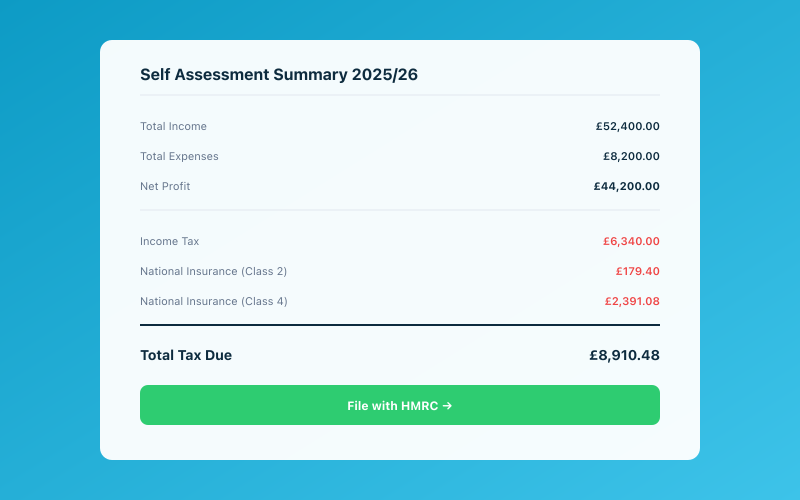 Your Accounted dashboard shows your real-time tax position
The UK uses the Statutory Residence Test (SRT) to determine tax residency. The SRT has three parts:
The Automatic Overseas Test. You're automatically non-resident if you meet any of these conditions:
- You were UK resident in none of the previous three tax years and spend fewer than 46 days in the UK
- You were UK resident in one or more of the previous three tax years and spend fewer than 16 days in the UK
- You work full-time overseas with no significant breaks and spend fewer than 91 days in the UK (with no more than 30 days working in the UK)
The Automatic UK Test. You're automatically UK resident if:
- You spend 183 days or more in the UK during the tax year
- Your only home is in the UK for at least 91 consecutive days (with at least 30 of those days falling in the tax year)
- You work full-time in the UK for any period of 365 days
The Sufficient Ties Test. If neither automatic test applies, your residency depends on a combination of the number of days you spend in the UK and the number of UK ties you have (such as family, accommodation, work, a 90-day tie, and a country tie).
For most people going abroad temporarily — say, three to six months — you'll remain UK tax resident. You'll still have your UK home, your ties to the country, and you'll likely spend more than half the tax year in the UK. This means you'll continue to be taxed on your worldwide income, including anything you earn while overseas.
Income Tax While Working Abroad Temporarily
If you remain UK tax resident (which is the most likely scenario for temporary stays), all your income remains subject to UK income tax. The 2025/26 tax rates and bands are:
- Personal Allowance: £12,570
- Basic rate (20%): £12,571 to £50,270
- Higher rate (40%): £50,271 to £125,140
- Additional rate (45%): over £125,140
However, you might also become liable for tax in the country where you're working. Many countries have rules that trigger a tax obligation after a certain number of days — often 183 days, but some countries have shorter thresholds or different criteria.
If you end up paying tax in both the UK and the overseas country, you can usually claim double taxation relief to avoid being taxed twice on the same income. The UK has treaties with over 130 countries for this purpose. Check our guide to double taxation agreements for the full picture.
Practical example: You're a UK sole trader who spends three months working from Spain. You remain UK tax resident and declare all your income on your UK Self Assessment return as normal. Spain is unlikely to consider you tax resident for such a short stay, and under the UK-Spain DTA, your self-employment profits would generally be taxable only in the UK. No drama — but you should still check Spain's domestic rules to be sure.
National Insurance Contributions
National Insurance is separate from income tax and has its own rules for working abroad. If you're a sole trader going overseas temporarily, you'll generally want to continue paying UK National Insurance to protect your entitlement to the State Pension and other contributory benefits.
For short-term work in the EU, EEA, or Switzerland, the UK-EU Trade and Cooperation Agreement includes social security coordination provisions. You can apply for a Certificate of Coverage (form CA3837 or through HMRC's online service) that confirms you remain in the UK National Insurance system. This prevents you from having to pay social security contributions in the other country.
For work outside the EU, the position depends on whether the UK has a bilateral social security agreement with that country. Agreements exist with countries including the USA, Canada, Australia, Japan, and South Korea, among others. Without an agreement, you might end up liable for social security in both countries.
As a self-employed person, you'd normally continue to pay Class 2 National Insurance (£3.45 per week for 2025/26) and Class 4 National Insurance (6% on profits between £12,570 and £50,270, plus 2% above £50,270) while working abroad temporarily, provided you're ordinarily self-employed in the UK.
Tax in the Country You're Working From
This is the bit that people most often overlook. Just because you're temporarily abroad doesn't mean the host country will ignore your presence. Each country has its own rules, and some are stricter than others.
Common triggers for a tax obligation in the host country include:
- Spending more than 183 days in the country during a calendar or tax year (this is the most common threshold, but it's not universal)
- Having a fixed place of business — renting a co-working desk long-term could potentially count in some jurisdictions
- Working for local clients — some countries distinguish between remote work for overseas clients and work performed for local businesses
- Registering as self-employed in the host country
Some popular destinations for remote workers have introduced specific digital nomad visas that may come with tax obligations or exemptions. Portugal, Spain, Greece, Croatia, and several other countries offer these schemes, each with different tax treatments. It's essential to check the specific rules for your destination.
The key point is: don't assume. Even a short stay can create complications if you're not aware of the local rules. For more on how this plays out for people with mobile lifestyles, see our guide to tax for digital nomads.
Practical Steps Before You Go
Check the local tax rules. Research whether the country you're visiting has a tax obligation for short-term workers. Look at the time threshold, the types of income covered, and any exemptions that might apply.
Review the relevant DTA. If the UK has a double taxation agreement with your destination, check what it says about self-employment income, employment income, and other relevant categories.
Apply for a Certificate of Coverage if you're working in the EU, EEA, or a country with a bilateral social security agreement. This should be done before you leave, as it can take several weeks to process.
Notify your clients if necessary. Some contracts or client agreements may have provisions about where work can be performed. Check before you go.
Keep detailed records. Track the dates you're in each country, the income you earn while abroad, and any local taxes you pay. Accounted makes it straightforward to tag income by location and keep everything categorised for your Self Assessment return.
Consider travel insurance and healthcare. While not strictly a tax issue, UK residents working abroad temporarily should make sure they have appropriate insurance cover. A UK Global Health Insurance Card (GHIC) provides some cover in the EU, but it's not a substitute for comprehensive travel insurance.
When You Return to the UK
If you've remained UK tax resident throughout your time abroad (which, as we've discussed, is the most likely outcome for temporary stays), your tax return will look largely the same as if you'd stayed put. You'll declare your worldwide income and claim double taxation relief if you've paid tax overseas.
If you've been abroad for longer and there's any question about your residency status, you may need to complete the Residence, remittance basis etc pages (SA109) of your Self Assessment return. This involves working through the SRT to confirm your residency position.
Make sure you have all your records in order: dates of travel, income earned in each location, foreign taxes paid, and any correspondence with overseas tax authorities. Penny inside Accounted can prompt you to categorise these transactions correctly, which takes the guesswork out of it when January comes around.
The Bottom Line
Working abroad temporarily is achievable and increasingly common, but it's not tax-free. For most UK sole traders, a temporary overseas stay means you remain UK tax resident and continue to pay UK tax on your worldwide income as normal. The main risks come from accidentally triggering a tax obligation in the host country or failing to claim double taxation relief when you're entitled to it.
Plan ahead, keep good records, and don't assume that working from a beach means your tax position is any simpler. If anything, it's a little more complex — but entirely manageable with the right preparation.
Related Reading
Start your free trial and let Penny handle your bookkeeping automatically.
Accounted helps UK sole traders stay on top of their bookkeeping and tax. Start your free 30-day trial at getaccounted.co.uk.
Penny, your AI bookkeeper, tracks your tax position in real time and flags opportunities to reduce your bill. Meet Penny →
Tax & Compliance Specialists
Our tax specialists have decades of combined experience in UK sole trader and small business taxation, MTD compliance, and HMRC submissions. All content is reviewed against current HMRC guidance before publication and updated quarterly to reflect legislative changes.
Ready to try Accounted?
Join UK sole traders who are simplifying their bookkeeping and tax.
Start your 14-day free trial