Double Taxation Agreements — How They Protect You
Nobody wants to pay tax on the same income twice. Yet if you earn money in one country while being a tax resident in another, that's exactly what could happen — unless a double taxation agreement steps in to sort things out.
For UK-based sole traders and freelancers who work with international clients, receive overseas rental income, or have investments abroad, understanding double taxation agreements (DTAs) isn't just a nice-to-have. It's essential knowledge that could save you a significant amount of money.
Let's break down how these agreements work, what relief is available, and how to actually claim it.
What Is a Double Taxation Agreement?
A double taxation agreement — sometimes called a double taxation treaty or convention — is a legal agreement between two countries that sets out rules for how income is taxed when it crosses borders. The core purpose is straightforward: to make sure you don't get taxed twice on the same income.
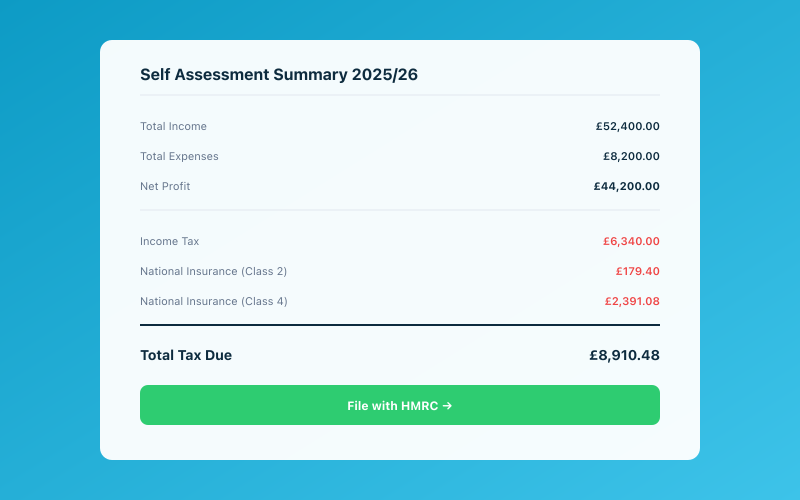 Your Accounted dashboard shows your real-time tax position
The UK currently has DTAs with over 130 countries, making it one of the most extensive treaty networks in the world. These agreements cover countries across Europe, North America, Asia, Africa, and beyond. Major trading partners like the United States, Germany, France, Australia, Canada, and India all have comprehensive treaties with the UK.
Each DTA is a bilateral agreement, meaning the terms can vary from one treaty to another. The income types covered, the rates of withholding tax, and the specific relief mechanisms can all differ depending on which country you're dealing with. That said, most UK treaties follow a broadly similar structure based on the OECD Model Tax Convention.
A DTA typically covers:
- Income from employment — which country can tax your salary
- Business profits — where self-employment and trading income is taxed
- Dividends, interest, and royalties — reduced withholding tax rates
- Capital gains — which country can tax the sale of assets
- Pensions — where pension income is taxable
- Government service income — special rules for public sector workers
How Double Taxation Relief Works in Practice
There are two main ways DTAs prevent double taxation: the credit method and the exemption method. Most UK treaties use the credit method, but some provisions use exemption.
The Credit Method
This is the most common approach. Here's how it works:
- You earn income in a foreign country (let's say you receive £10,000 from a client in Australia)
- Australia may withhold tax on that payment — say 10%, so £1,000
- You declare the full £10,000 on your UK Self Assessment return
- You calculate the UK tax due on that £10,000 (let's say £2,000 at the basic rate)
- You claim a Foreign Tax Credit for the Australian tax paid (£1,000)
- Your UK tax liability on that income is reduced to £1,000
The credit is always limited to the lower of the foreign tax paid or the UK tax due on that income. So if the foreign tax rate is higher than the UK rate, you won't get a full credit — but you won't owe anything extra in the UK either.
The Exemption Method
Under some treaty provisions, certain income is only taxable in one country. For example, many DTAs state that government pensions are only taxable in the country that pays them. If you receive a government pension from France while living in the UK, the DTA might exempt that income from UK tax entirely.
Unilateral Relief
What if there's no DTA between the UK and the country where your income originates? You're not necessarily out of luck. The UK offers unilateral relief, which works similarly to the credit method. You can claim credit for foreign tax paid against your UK tax bill, even without a treaty. The relief is more limited, but it still prevents full double taxation in most cases.
Who Benefits Most from DTAs?
DTAs are relevant to a surprisingly wide range of people. You might benefit if you're:
- A freelancer or sole trader working for overseas clients
- A remote worker employed by a foreign company
- A property owner with rental income from abroad
- An investor receiving dividends or interest from overseas
- A digital nomad splitting time between the UK and other countries — our guide to tax for narrowboat, van, and digital nomad lifestyles covers some of the related residency questions
- Someone who has moved to the UK and still has income from their home country
If you're a sole trader receiving payments from international clients, the DTA situation is generally quite straightforward. Most treaties state that business profits are only taxable in the country where the business is based — so if you're UK-based, your freelance income from overseas clients is taxable in the UK, not in the client's country. The main complication arises when there's withholding tax applied at source.
How to Claim Double Taxation Relief
Claiming relief is done through your Self Assessment tax return. You'll need to complete the Foreign pages (SA106), specifically the section on double taxation relief. Here's what you'll need:
- Details of the foreign income — amount, source country, and type of income
- Evidence of foreign tax paid — a tax certificate, withholding statement, or equivalent documentation from the overseas tax authority
- The relevant DTA — you should know which treaty applies and what relief it provides
On the SA106, you'll enter the foreign income, the foreign tax paid, and the relief you're claiming. HMRC will then calculate your UK tax liability with the credit applied.
A few important points to keep in mind:
- You must claim the relief — it's not applied automatically
- The deadline for claiming is four years from the end of the tax year in which the income was received
- You need to keep records for at least five years after the filing deadline
Using bookkeeping software that tracks foreign transactions properly makes this much easier. Accounted lets you categorise overseas income and record associated taxes as they happen, so you're not scrambling to piece everything together at year end.
Common Pitfalls and Misconceptions
"I've paid tax abroad, so I don't need to declare it in the UK." Wrong. UK tax residents must declare worldwide income on their Self Assessment return, even if tax has already been paid overseas. The DTA provides relief, but you still need to report the income.
"The DTA means I won't pay any tax." Not necessarily. DTAs prevent double taxation — they don't eliminate taxation. You'll still pay the higher of the two countries' tax rates on most income types. The treaty just ensures you don't pay both in full.
"All DTAs are the same." They're not. Each treaty is negotiated individually, and the terms can differ significantly. The UK-US treaty, for instance, has different provisions from the UK-Germany treaty. Always check the specific DTA that applies to your situation.
"Withholding tax is always refundable." Sometimes a foreign country applies withholding tax at a higher rate than the DTA allows. In those cases, you may be able to reclaim the excess from the foreign tax authority. But this requires a separate claim in that country — it's not something HMRC handles for you.
"I only need to worry about this if I earn a lot abroad." Even small amounts of foreign income need to be declared. A few hundred pounds of interest from a foreign bank account still goes on your tax return. HMRC receives data from overseas tax authorities through the Common Reporting Standard, so they'll know about it regardless.
Checking Which DTA Applies to You
HMRC publishes the full text of every DTA the UK has signed. You can find these on the GOV.UK website, listed alphabetically by country. Each treaty document sets out the specific provisions for different types of income.
If you're dealing with a straightforward situation — like receiving freelance payments from an EU country — the relevant provisions are usually easy to identify. For more complex arrangements involving multiple countries or unusual income types, it may be worth speaking to a tax adviser who specialises in international tax.
For those who have recently moved to the UK and are starting a business, understanding DTAs early on can help you structure your finances efficiently from day one. And if you're dealing with VAT on foreign transactions, that adds another layer to consider alongside income tax treaties.
Related Reading
Start your free trial and let Penny handle your bookkeeping automatically.
Accounted helps UK sole traders stay on top of their bookkeeping and tax. Start your free 30-day trial at getaccounted.co.uk.
Penny, your AI bookkeeper, tracks your tax position in real time and flags opportunities to reduce your bill. Meet Penny →
Tax & Compliance Specialists
Our tax specialists have decades of combined experience in UK sole trader and small business taxation, MTD compliance, and HMRC submissions. All content is reviewed against current HMRC guidance before publication and updated quarterly to reflect legislative changes.
Ready to try Accounted?
Join UK sole traders who are simplifying their bookkeeping and tax.
Start your 14-day free trial