How to Handle VAT on Foreign Transactions
Doing business across borders adds a layer of complexity to your VAT affairs. Whether you're importing materials from Europe, exporting goods to the US, or buying services from an overseas supplier, the VAT treatment depends on what you're trading, who you're trading with, and where they're based.
Since the UK left the EU on 31 December 2020, the rules for trade with EU countries have changed significantly. EU transactions now follow a different process than they did when the UK was a member state — though some simplifications remain. This guide covers how VAT works on foreign transactions for UK businesses, with practical advice for getting it right.
Importing Goods into the UK
When you import goods into the UK from any country (whether EU or non-EU), import VAT is generally due. The rate is usually the same rate that would apply if you bought the goods domestically — 20% standard rate, 5% reduced rate, or 0% zero rate.
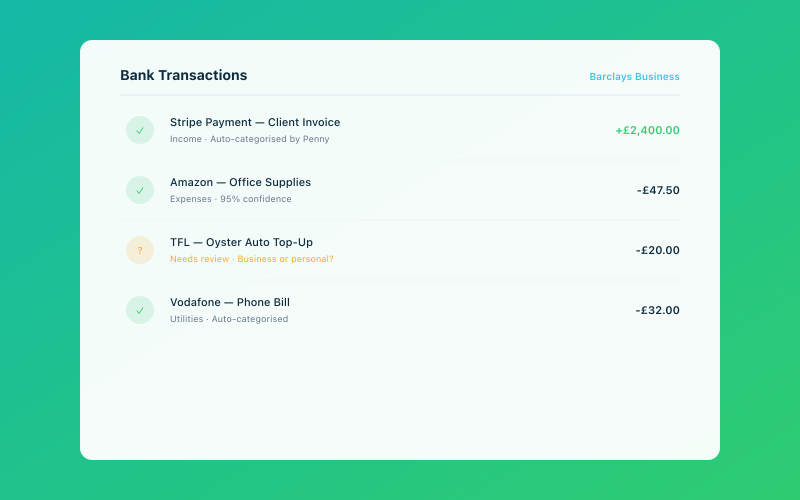 Penny auto-categorises your bank transactions with 95%+ accuracy
How Import VAT Is Charged
Since January 2021, most VAT-registered businesses importing goods use postponed VAT accounting (PVA). This means you don't actually pay the import VAT at the border. Instead, you account for it on your VAT return — declaring it as both output tax (Box 1) and input tax (Box 4) in the same period. The effect is that the VAT washes through your return with no net cost, provided you can reclaim input tax in full.
PVA is optional — you can still pay import VAT at the point of importation and reclaim it later. But PVA is simpler and much better for cash flow, so most businesses use it.
To use PVA, you need to:
- Select "account for import VAT on your VAT return" when making customs declarations
- Access your monthly postponed import VAT statements via your Government Gateway account
- Include the figures on your VAT return
Import Duty
Import VAT is separate from customs duty. Depending on what you're importing and where it's from, you may also owe customs duty. This is a cost to your business — it's not reclaimable through your VAT return.
The UK Global Tariff sets out the duty rates for different product categories. Some goods from certain countries benefit from reduced or zero duty rates under free trade agreements.
Low-Value Consignments
For goods valued at £135 or less being sold directly to UK consumers, the overseas seller is generally responsible for charging and collecting UK VAT at the point of sale. This mainly affects e-commerce sellers and online marketplaces rather than businesses importing stock.
Exporting Goods from the UK
Goods exported from the UK are zero-rated for VAT purposes — meaning you charge 0% VAT. This is one of the genuine advantages of being a VAT-registered exporter: you don't charge your overseas customers any UK VAT, but you can still reclaim all the input tax on your UK business expenses.
Conditions for Zero-Rating
To zero-rate an export, you need to:
- Have evidence that the goods have physically left the UK
- Export the goods within a specified time frame (usually three months of supply)
- Keep documentary evidence of the export
Acceptable evidence includes shipping documents, customs declarations, airway bills, and courier tracking records. If you can't prove the goods left the UK, you'll need to charge UK VAT at the appropriate rate.
Selling to EU Customers Post-Brexit
Since the UK left the EU, sales to EU customers are now treated as exports rather than intra-EU dispatches. The goods are zero-rated from the UK side, but your EU customer may face import VAT and potentially customs duty when the goods arrive in their country.
This is a significant change from the pre-Brexit position, where goods moved freely between EU member states under the intra-EU supply rules. If you sell to EU businesses, make sure your customers understand they may face import charges.
Services — The Place of Supply Rules
Services are treated differently from goods. The key question is: where is the place of supply? This determines which country's VAT applies.
The General B2B Rule
For most services supplied to a business customer, the place of supply is where the customer belongs. So if you provide consultancy services to a German business, the place of supply is Germany. You don't charge UK VAT — the service is outside the scope. Your German customer accounts for VAT under the reverse charge mechanism.
This general rule covers most professional and business services: consultancy, IT services, marketing, legal services, accounting, and so on.
The General B2C Rule
For most services supplied to a non-business customer (a consumer), the place of supply is where the supplier belongs — i.e., in the UK. So you'd charge UK VAT.
There are exceptions for specific services like digital services (covered in our VAT on digital services guide), which follow the customer's location even for B2C supplies.
Special Rules
Some services have their own place-of-supply rules regardless of whether the customer is a business or consumer:
- Land-related services — taxed where the land is. If you're a UK builder working on a property in France, French VAT applies.
- Passenger transport — taxed where the transport takes place.
- Events and entertainment — generally taxed where the event takes place (for admission services).
- Restaurant and catering — taxed where the services are physically performed.
The Reverse Charge on Services
When you receive services from an overseas supplier, you may need to apply the reverse charge. This means you account for VAT as if you'd supplied the service to yourself.
How It Works
If you buy marketing services from a US company for £5,000:
- You receive an invoice for £5,000 with no VAT
- On your VAT return, you declare £1,000 output tax (20% of £5,000) in Box 1
- If you can reclaim input tax in full, you also declare £1,000 input tax in Box 4
- The net effect is nil — no VAT cost to you
The reverse charge ensures that services consumed in the UK bear UK VAT, even when supplied from abroad. It applies to most B2B service imports.
You also need to include the value of reverse charge services in Box 6 (total value of sales) and Box 7 (total value of purchases) of your VAT return. Many businesses get this wrong — it's one of the common VAT return mistakes we see.
Currency and Exchange Rates
When dealing with foreign transactions, you'll often receive invoices in foreign currencies. For VAT purposes, you need to convert these to sterling.
HMRC accepts several methods:
- HMRC's own exchange rates — published monthly on GOV.UK
- Market exchange rates — from a reputable source at the time of the transaction
- The rate from your bank or payment provider — as shown on your bank statement
Whichever method you choose, be consistent. Accounted can handle multi-currency transactions and apply the correct exchange rate automatically, which takes the hassle out of this.
Practical Record-Keeping
Foreign transactions require more detailed records than domestic ones. You'll need to keep:
- Import documentation — customs declarations, shipping documents, postponed VAT statements
- Export evidence — proof of export, shipping records, customer details
- Reverse charge calculations — showing how you've accounted for VAT on imported services
- Currency conversion records — the exchange rate used and the source
- Customer/supplier location evidence — especially for services, to support your place-of-supply determination
Your VAT return under MTD needs to accurately reflect all these transactions, with the figures in the correct boxes.
Common Mistakes with Foreign VAT
Charging UK VAT on B2B Service Exports
If you provide services to a business customer abroad, the general rule is that the place of supply is where they are — not the UK. Don't charge UK VAT. Issue a VAT-exclusive invoice and note that the customer should account for VAT under the reverse charge.
Forgetting the Reverse Charge on Purchases
When you buy services from abroad, remember to apply the reverse charge. It's easy to overlook, especially for software subscriptions and online services that just appear on your credit card statement. If you're using overseas SaaS tools, cloud hosting, or advertising platforms, check whether the reverse charge applies.
Not Keeping Export Evidence
Zero-rating exports is great for cash flow, but you must have the evidence to support it. If HMRC asks to see proof that goods left the UK and you can't produce it, they can assess you for VAT on those sales at 20%.
Getting Postponed VAT Accounting Wrong
PVA is a brilliant simplification, but you need to check your monthly statements carefully and include the correct figures on your return. The statements are available on your Government Gateway account — don't forget to download them.
Ignoring Overseas Registration Obligations
Depending on what you sell and where, you might need to register for VAT (or its equivalent) in other countries. This is particularly relevant for businesses selling goods to EU consumers, or providing digital services to overseas consumers. Ignoring these obligations doesn't make them go away — it just creates problems down the line.
Getting Help
International VAT is genuinely complex, and the rules vary by country. If you're doing significant cross-border trade, it's worth getting specialist advice — particularly around overseas registration obligations and the correct treatment of unusual transactions.
For straightforward imports and exports, the rules outlined here should cover most situations. Keep good records, use postponed VAT accounting for imports, zero-rate your exports with proper evidence, and apply the reverse charge on imported services.
If you're looking for a deeper understanding of which costs you can reclaim VAT on, our input tax recovery rules guide is a useful companion to this one.
Accounted helps UK sole traders stay on top of their bookkeeping and tax. Start your free 30-day trial at getaccounted.co.uk
Related reading:
- VAT on Digital Services — The Rules for UK Sellers
- VAT Return Common Mistakes
- Input Tax Recovery Rules
Related Reading
See how Accounted handles MTD and start your free trial.
Accounted handles VAT returns and MTD for VAT with direct HMRC filing built in. See VAT features →
Tax & Compliance Specialists
Our tax specialists have decades of combined experience in UK sole trader and small business taxation, MTD compliance, and HMRC submissions. All content is reviewed against current HMRC guidance before publication and updated quarterly to reflect legislative changes.
Ready to try Accounted?
Join UK sole traders who are simplifying their bookkeeping and tax.
Start your 14-day free trial