VAT Input Tax Recovery: What You Can and Can't Reclaim
If your business is VAT-registered, one of the most valuable benefits is the ability to reclaim the VAT you pay on business purchases and expenses. This is known as input tax recovery. However, the rules about what you can and cannot reclaim are not always straightforward. Certain items are blocked entirely, partial exemption rules may restrict recovery if you make exempt supplies, and there are specific time limits for reclaiming VAT on purchases made before registration. This guide walks you through the key rules.
The General Rule
The basic principle is simple: you can reclaim VAT on goods and services that are used for the purposes of your taxable business. Taxable supplies include those charged at the standard rate (20%), the reduced rate (5%), and the zero rate (0%). If your purchases are used to make taxable supplies, the input tax is recoverable.
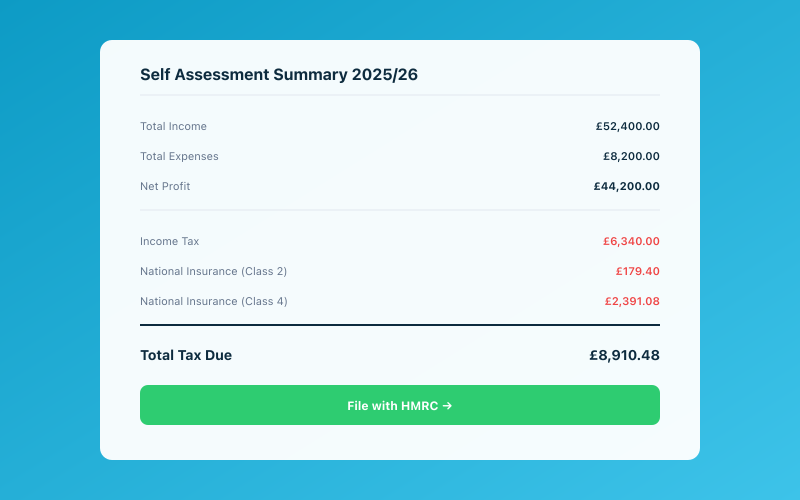 Your Accounted dashboard shows your real-time tax position
To reclaim input tax, you must hold a valid VAT invoice from your supplier. For purchases of £250 or more (including VAT), this must be a full VAT invoice showing the supplier's VAT registration number, the date, a description of the goods or services, the net amount, the VAT amount, and the gross total. For smaller purchases, a simplified VAT invoice or even a till receipt showing the supplier's VAT number is sufficient.
Blocked Items: What You Cannot Reclaim
Certain categories of expenditure are blocked from input tax recovery regardless of how they are used in the business. The main blocked items are as follows.
Business Entertainment
VAT on business entertainment costs cannot be recovered. This includes meals, drinks, hospitality, and events provided to clients, potential clients, or other non-employees. The block applies even if the entertainment has a clear business purpose, such as taking a client to lunch to discuss a contract.
However, there is an important exception: staff entertainment is not blocked. VAT on events and hospitality provided to employees, such as a staff Christmas party or team-building event, is recoverable, provided the event is principally for employees. If the event includes both employees and non-employee guests, the VAT attributable to the non-employees is blocked.
Cars
VAT on the purchase of a car is blocked unless the car is used exclusively for business purposes with no private use whatsoever, or the car is purchased for resale (for example, by a car dealer) or for use in a taxi, driving school, or self-drive hire business.
In practice, HMRC takes a very strict view of "exclusively for business purposes." If the car is ever available for private use, even if private use does not actually occur, the input tax is blocked. This means that for most businesses, VAT on company cars cannot be reclaimed.
VAT on commercial vehicles (vans, lorries, and so on) is not blocked and can be reclaimed in full, provided the vehicle is used for business purposes.
Car Fuel for Private Use
If you reclaim VAT on fuel used in a company car and the car is also used for private journeys, you must either restrict the claim to business use only or apply the fuel scale charge. The fuel scale charge is a flat quarterly amount that HMRC treats as the VAT on private fuel, which you must account for as output tax.
Other Blocked Items
VAT on goods and services used for non-business purposes cannot be recovered. If something is used partly for business and partly for non-business purposes, you must apportion the VAT and only claim the business element.
Partial Exemption
If your business makes both taxable supplies and exempt supplies (such as insurance, finance, education, or health services), you are partly exempt and cannot recover all of your input tax. The rules for partly exempt businesses are among the most complex areas of VAT.
The Standard Method
Under the standard partial exemption method, you separate your input tax into three categories. First, input tax that is directly attributable to taxable supplies, which is fully recoverable. Second, input tax that is directly attributable to exempt supplies, which is not recoverable. Third, residual input tax that cannot be directly attributed to either taxable or exempt supplies, which must be apportioned.
The residual input tax is apportioned based on the proportion of your taxable supplies to your total supplies. For example, if 80% of your supplies are taxable and 20% are exempt, you can recover 80% of your residual input tax.
The De Minimis Rule
There is an important simplification. If the total of your irrecoverable input tax (the exempt-attributable input tax plus the exempt portion of residual input tax) is no more than £625 per month on average, and no more than 50% of your total input tax, you can recover all of your input tax as if you were fully taxable. This is known as the de minimis limit.
Many businesses with small amounts of exempt income, such as a trading business that also earns a small amount of bank interest (which is exempt), fall within the de minimis limit and can therefore recover all their input tax.
Special Methods
If the standard method does not produce a fair result for your business, you can agree a special partial exemption method with HMRC. Special methods must be approved in advance and are tailored to the specific circumstances of the business. Common special methods include ones based on transaction counts, headcount, floor area, or a combination of factors.
Pre-Registration VAT Recovery
When you register for VAT, you can reclaim the VAT on certain purchases made before your registration date. The rules are different for goods and services.
Goods
You can reclaim VAT on goods purchased up to four years before your VAT registration date, provided the goods are still on hand (or have been used to make other goods that are still on hand) at the date of registration, and the goods are used or intended to be used for your taxable business.
In practice, this means you can reclaim VAT on stock, equipment, and other goods that you still own at the point of registration. You cannot reclaim VAT on goods that have already been sold, consumed, or disposed of before registration.
Services
You can reclaim VAT on services received up to six months before your VAT registration date, provided the services were supplied for the purposes of your business. This is more generous in one sense (the services do not need to be "on hand") but more restrictive in another (the six-month window is much shorter than the four-year window for goods).
Common pre-registration service claims include accountancy fees, legal fees, website development, and marketing services received in the six months before registration.
Documentation
To make a pre-registration claim, you need valid VAT invoices for the purchases. If you did not ask suppliers for VAT invoices before you were registered, you may need to contact them and request them retrospectively. Without a valid VAT invoice, HMRC can refuse the claim.
Common Mistakes
Claiming VAT on Non-Vatable Supplies
Not all invoices include VAT. Some suppliers are not VAT-registered, and some supplies are exempt or zero-rated. Check each invoice carefully and only claim the VAT that has actually been charged. Claiming VAT where none has been charged is a common error that HMRC picks up during compliance checks.
Missing the Time Limit
You must reclaim input tax within four years of the due date of the VAT return on which the claim could first have been made. After four years, the claim is time-barred. If you discover unclaimed input tax from several years ago, act quickly to make the claim before the deadline passes.
Not Keeping VAT Invoices
HMRC can disallow input tax claims if you cannot produce a valid VAT invoice to support the claim. Keep all VAT invoices and receipts for at least six years (the standard VAT record-keeping requirement). Digital copies are acceptable, provided they are legible and complete.
Overclaiming on Mixed-Use Items
If an expense has both a business and personal element, such as a mobile phone used for both business and personal calls, you should only claim the business proportion. Claiming 100% of the VAT on mixed-use items is a red flag for HMRC.
Flat Rate Scheme Considerations
If you are on the VAT Flat Rate Scheme, you generally cannot reclaim input tax on your purchases. The flat rate percentage is designed to account for input tax in a simplified way. The only exception is for capital assets costing £2,000 or more including VAT, where you can reclaim the input tax outside the flat rate scheme.
Let Accounted and Penny Help
Getting your VAT input tax recovery right is essential for your cash flow and for staying compliant. Accounted makes VAT tracking straightforward by automatically recording the VAT on every transaction and flagging items that may be blocked or restricted. Penny, your AI bookkeeper, categorises expenses with VAT treatment in mind, helping you maximise your legitimate claims while avoiding errors. Start your free trial today and take the guesswork out of VAT recovery.
Related Reading
-
Can I Claim Clothing as a Business Expense? HMRC Rules Explained
-
Overlap Relief Explained: What Happens When Basis Periods Change
Start your free trial and let Penny handle your bookkeeping automatically.
Penny, your AI bookkeeper, tracks your tax position in real time and flags opportunities to reduce your bill. Meet Penny →
Tax & Compliance Specialists
Our tax specialists have decades of combined experience in UK sole trader and small business taxation, MTD compliance, and HMRC submissions. All content is reviewed against current HMRC guidance before publication and updated quarterly to reflect legislative changes.
Ready to try Accounted?
Join UK sole traders who are simplifying their bookkeeping and tax.
Start your 14-day free trial