How to Handle a Client Who Does Their Own Bookkeeping Badly
The Dreaded Carrier Bag of Receipts
Every accountant has experienced it. You ask a client for their records, and what arrives is... questionable. Maybe it's a literal carrier bag stuffed with crumpled receipts. Maybe it's a spreadsheet with categories like "stuff" and "misc." Maybe it's a bank statement with highlighter marks and cryptic annotations like "Steve — cash" and "NOT SURE."
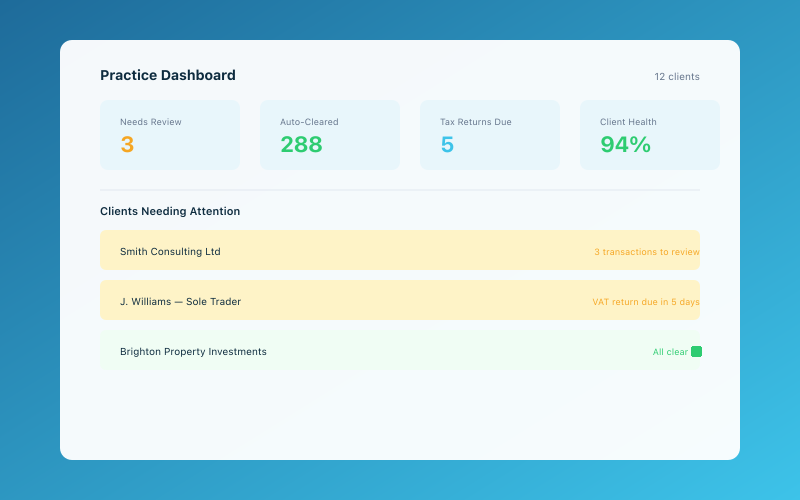 The Accounted practice dashboard — manage all your clients in one place
Or perhaps the client uses bookkeeping software but uses it so badly that it would have been better if they'd done nothing at all. Duplicate entries, personal expenses mixed with business ones, VAT on everything regardless of whether VAT was actually charged, and a chart of accounts that looks like it was designed by a particularly creative toddler.
This is one of the most common — and most delicate — challenges in practice management. The client thinks they're doing you a favour by "doing their own bookkeeping." In reality, they're creating hours of extra work that you either absorb (write-offs) or charge for (awkward conversations).
So how do you handle it?
Common Bookkeeping Mistakes Clients Make
Before you can have the conversation, it helps to understand what's going wrong. Most DIY bookkeeping problems fall into a few categories.
Categorisation Chaos
The most frequent issue. Clients put expenses in the wrong categories, create categories that don't make sense, or lump everything into "general expenses." A meal with a potential client gets categorised as "food." The client's personal Netflix subscription appears in "office expenses." Motor expenses include both business mileage and personal use without any apportionment.
This matters because incorrect categorisation leads to wrong tax calculations, missed allowable deductions, and accounts that don't give a true picture of the business.
Missing Transactions
Clients forget to record cash payments, don't capture all their income (particularly cash-in-hand work), or miss direct debits that come out of their account. Bank reconciliation reveals the gaps, but reconciling a year's worth of unexplained transactions is time-consuming and often impossible to do accurately.
Personal and Business Mixed Together
This is epidemic among sole traders. The client uses one bank account for everything — business income, personal spending, the weekly shop, their partner's gym membership. Untangling personal from business transactions across 12 months of bank statements is one of the most time-consuming tasks in accounting.
VAT Errors
Clients who are VAT-registered make all sorts of VAT mistakes: claiming VAT on exempt items, not claiming VAT they're entitled to, applying the wrong rate, recording the gross amount instead of net plus VAT, and completely forgetting about reverse charge VAT on certain services.
Timing Mistakes
Recording income when the invoice is sent rather than when the money is received (or vice versa, depending on whether they're on cash basis or accruals). Recording expenses in the wrong tax year. Not understanding the difference between the date of a transaction and the date it clears the bank.
Simply Not Doing It
Perhaps the most honest mistake. The client intends to do their bookkeeping but doesn't get around to it. By year-end, there are 12 months of unreconciled transactions, unfiled receipts, and unrecorded income. They send you everything in a rush and hope for the best.
The Diplomatic Conversation
This is where most accountants struggle. You need to tell a client that their bookkeeping is creating problems without making them feel stupid, defensive, or inclined to find another accountant. Here are some approaches that work.
Lead with Empathy
"I completely understand — bookkeeping isn't what you went into business to do, and it's hard to keep on top of everything when you're busy running your actual business."
This immediately positions you as understanding rather than critical. The client needs to feel that you're on their side, not judging them.
Focus on Consequences, Not Blame
Instead of: "Your bookkeeping is wrong and it's creating problems."
Try: "I've noticed some issues with the records that could affect your tax position. Some expenses haven't been categorised correctly, which means you might be paying more tax than you need to. And there are some gaps in the records that could be a problem if HMRC ever asks to see them."
This shifts the conversation from "you've done a bad job" to "there's a risk to you that we should address."
Use Specific Examples
Vague feedback is hard to act on. Instead of "your records are messy," point to specific issues:
"For example, I noticed your Netflix and Amazon Prime subscriptions are listed as business expenses. Unless you genuinely use these for business purposes, HMRC wouldn't consider these allowable. There are also about 30 transactions I can't identify — they might be business expenses you could claim, but without receipts or descriptions, we can't include them."
Specific examples help the client understand the scope of the problem without feeling overwhelmed.
Quantify the Impact
If possible, put a number on it:
"The way things are currently recorded, I think you might be missing around £1,200 in legitimate deductions because they're either miscategorised or not recorded at all. That's potentially £240-£480 in unnecessary tax, depending on your rate."
Nothing focuses the mind like money. When clients see that bad bookkeeping is costing them, they're much more motivated to fix it.
Offering Bookkeeping Services as a Solution
Once you've had the honest conversation about the state of their records, the natural next step is to offer a solution. This is where the conversation becomes productive rather than just critical.
Option 1: You Take Over the Bookkeeping
"Would it be helpful if we handled the bookkeeping for you? We could do it monthly or quarterly — you'd just need to send us your receipts and we'd take care of the rest. Your records would always be up to date, and year-end would be straightforward."
Pricing: Monthly bookkeeping for a straightforward sole trader typically ranges from £50-£150/month depending on transaction volume and complexity. This is a significant revenue opportunity if you have multiple clients who need it — and you almost certainly do.
Option 2: Better Tools with Your Support
Not every client wants to (or can afford to) hand over their bookkeeping entirely. For these clients, recommending better tools is a pragmatic middle ground.
"There are some really good tools now that make bookkeeping much easier. Accounted, for example, has an AI bookkeeper called Penny that categorises most transactions automatically — you just need to review them rather than entering everything manually. It connects to your bank account, so transactions come in automatically, and you can photograph receipts on your phone."
This approach works well because:
- The client keeps some ownership of their bookkeeping (which many prefer)
- AI handles the categorisation (eliminating the biggest source of errors)
- Your year-end work is much faster because the records are cleaner
- The client gets real-time visibility of their finances
You can position yourself as providing oversight: "If you used a tool like this, I could check in quarterly to make sure everything's on track. It would cost you less than full bookkeeping support, and the quality of your records would be much better."
Option 3: Training
Some clients genuinely want to do their own bookkeeping properly — they just don't know how. Offering a training session (either one-to-one or a small group workshop) can be a good option.
Cover the basics:
- What categories to use and what goes in each one
- How to record different types of transactions
- The importance of separating personal and business spending
- How to handle VAT (if applicable)
- What records HMRC requires under Making Tax Digital
A 2-hour training session priced at £150-£250 is good value for the client and can prevent months of cleanup work for you.
Training vs Taking Over — How to Decide
The right solution depends on the client. Consider:
Take over bookkeeping when:
- The client has no interest in learning
- Their business is complex enough to warrant professional bookkeeping
- They consistently fail to maintain records despite training
- The cleanup cost each year exceeds what monthly bookkeeping would cost
Recommend tools when:
- The client is willing but using the wrong tools (or no tools)
- Their business is relatively straightforward
- Budget is a concern
- They want real-time visibility of their numbers
Train the client when:
- They're enthusiastic and capable but uninformed
- Their bookkeeping errors are due to lack of knowledge rather than lack of effort
- They have the time and inclination to do it properly
- Their business is simple enough that DIY bookkeeping is realistic
Pricing for Cleanup Work
When records need significant correction, you need to charge for the cleanup — absorbing these costs as write-offs erodes your practice's profitability. Three pricing approaches work well:
- Hourly with an estimate: "Cleanup will take approximately 6-8 hours at £85/hour. I'll update you as we progress."
- Fixed project fee: "£650 to bring your records into proper order, including categorising all transactions and reconciling your bank account."
- Graduated pricing: "Records in good order: £500. Moderate sorting needed: £700. Significant cleanup: £950."
The graduated approach is particularly effective — it creates a clear incentive for clients to improve. Always pair the cleanup cost with a solution for preventing future problems. You're not just billing for mistakes; you're helping them move forward.
Preventing Problems Going Forward
Once you've addressed the immediate problem, put measures in place to prevent recurrence. Monthly or quarterly check-ins catch errors early — a 30-minute quarterly review is far less costly than an annual cleanup. Provide clients with clear, written guidelines about what to record, how, and when to send it to you.
Modern bookkeeping software with AI categorisation reduces human error considerably. When Penny categorises a transaction as "office supplies," the client simply confirms rather than choosing between "office supplies," "equipment," "stationery," or "sundries." And set specific deadlines — "Please send your Q3 receipts by 15 October" is actionable; "send me your records when you get a chance" guarantees you'll receive nothing until January.
When the Client's Bookkeeping Creates Professional Risk
There's a serious side beyond inconvenience and write-offs. If a client's bookkeeping is so poor it affects the accuracy of their tax return, you have a professional and ethical obligation to address it. You must exercise professional scepticism, make reasonable enquiries, refuse to submit returns you believe to be materially incorrect, and document your concerns.
If a client consistently provides records so poor that you cannot produce accurate accounts — and refuses to improve despite your efforts — disengagement may be your only responsible option. Document everything, then disengage professionally: explain the issues, confirm you've raised them previously, and offer to recommend alternative firms. It's a last resort, and rare, but knowing it's an option protects you professionally.
Turning a Problem into an Opportunity
A client who does their own bookkeeping badly isn't just a problem — they're an opportunity. They need help, and you're perfectly positioned to provide it. Whether that's taking over their bookkeeping, recommending better software, training them to do it properly, or some combination of all three, you're adding value to their business while growing your practice.
The key is handling the conversation with empathy, specificity, and solutions. Don't just tell them what's wrong — show them a path forward. Most clients will thank you for it.
Related Reading
-
Building an Accountancy Practice From Scratch — Year One Guide
-
Tax Investigation Insurance — Should You Offer It to Clients?
Learn about our free accountant portal and how it saves your practice time.
Accounted gives accountants a free practice portal — manage all your clients, file to HMRC, and let Penny handle the routine work. See the accountant portal →
Editorial & Research
The Accounted editorial team covers software comparisons, technology, and the tools UK sole traders need to run their businesses efficiently. All software comparisons are based on independent research and publicly available pricing.
Ready to try Accounted?
Join UK sole traders who are simplifying their bookkeeping and tax.
Start your 14-day free trial