How to Position Your Practice for the MTD Wave
The Biggest Shift in Tax Compliance in a Generation
Making Tax Digital for Income Tax Self Assessment (MTD for ITSA) is no longer something on the horizon — it's here. From April 2026, self-employed individuals and landlords with annual gross income over £50,000 must keep digital records and submit quarterly updates to HMRC. Those earning over £30,000 follow from April 2027.
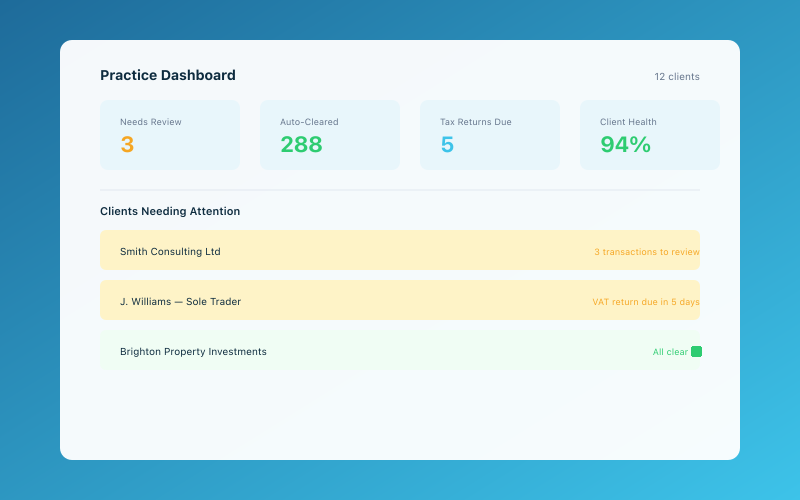 The Accounted practice dashboard — manage all your clients in one place
For accountancy practices, this represents both a challenge and a once-in-a-generation opportunity. Millions of sole traders who've been happily filing a single self-assessment return each year will suddenly need to submit quarterly. Many of them will need help, and they'll be looking for accountants who understand MTD, use the right software, and can make the transition painless.
The practices that position themselves now will capture these clients. The ones that wait will be scrambling to catch up.
The MTD Timeline — Where We Stand
Let's get the key dates straight:
April 2026
- MTD for ITSA mandatory for self-employed individuals and landlords with gross income over £50,000
- Digital record keeping required from the start of the 2026/27 tax year
- Quarterly updates must be submitted to HMRC via MTD-compatible software
- End-of-period statement and final declaration replace the traditional self-assessment return
April 2027
- Threshold drops to £30,000 gross income
- A much larger pool of sole traders and landlords are brought into scope
Beyond 2027
- The government has signalled intentions to lower the threshold further, potentially to £20,000 or below
- Partnerships are expected to be included in due course
This staggered rollout means the demand for MTD services will grow year on year. It's not a one-off spike — it's a sustained wave.
Why Many Sole Traders Will Need Your Help
It's easy to assume that sole traders will simply sign up for MTD-compatible software and handle it themselves. Some will. But the reality is that a significant proportion won't, for several reasons:
Digital Skills Gaps
Not every sole trader is tech-savvy. Many are tradespeople, market traders, childminders, and others who've been doing their books in a notebook or a basic spreadsheet for years. The jump to digital record keeping and quarterly submissions is daunting.
Time Constraints
Sole traders are busy running their businesses. Learning new software and understanding quarterly submission requirements takes time they don't have. They'd rather pay someone to handle it than spend evenings figuring it out.
Fear of Getting It Wrong
The MTD penalty system is points-based — each late submission adds a point, and accumulating too many points triggers financial penalties. Sole traders who are anxious about getting penalised will seek professional help for peace of mind.
Complexity
Some sole traders have genuinely complex affairs — multiple income sources, rental properties, foreign income, CIS deductions. For these clients, professional support isn't optional; it's essential.
Marketing to MTD-Anxious Clients
There's a growing pool of sole traders who know MTD is coming but don't know what to do about it. Here's how to reach them.
Content Marketing
Create content that addresses their fears and questions directly:
- "What is MTD and does it affect me?"
- "How to prepare for MTD if you're self-employed"
- "MTD penalties explained — what happens if you're late"
- "The simplest way to comply with MTD"
Publish this on your website, share it on social media, and send it to existing clients (who'll share it with their self-employed friends). Position yourself as the calm, knowledgeable voice amidst the confusion.
Local Networking
Many of the sole traders who need MTD help are local businesses — plumbers, electricians, hairdressers, tutors, dog walkers. They're in local Facebook groups, at networking events, and in trade associations. A short talk at a local business group about "What MTD means for your business" is an excellent way to generate enquiries.
Referral Programmes
Your existing clients know other self-employed people. A simple referral incentive — a discount on their next bill, a free tax review, or even a gift card — can generate a steady stream of new MTD clients.
Partnerships
Partner with businesses that serve sole traders: business banks, insurance brokers, co-working spaces, and software providers like Accounted. These partnerships can provide access to audiences of sole traders who are actively looking for help.
Pricing MTD Services
Pricing MTD services is one of the most discussed topics in practice management forums right now. Here's how to think about it.
What's Included in an MTD Service?
At minimum, an MTD service should cover:
- Setting up MTD-compatible software for the client
- Quarterly review and submission of digital records
- End-of-period statement preparation
- Final declaration (replacing the traditional self-assessment return)
- Ongoing support for queries and issues
Pricing Models
Per-quarter pricing: Charge a fee for each quarterly submission. Typically £75-£150 per quarter for straightforward sole traders, more for complex affairs. This is simple for clients to understand and gives you regular income.
Annual package pricing: Bundle everything into an annual fee — four quarterly submissions, end-of-period statement, and final declaration. Typically £400-£800 for straightforward clients, £800-£1,500+ for complex affairs. This provides predictable revenue and can be positioned as better value than per-quarter pricing.
Tiered packages:
- MTD Basic (£40/month) — digital record keeping, quarterly submissions, year-end filing
- MTD Plus (£65/month) — everything in Basic, plus tax planning review and ad-hoc support
- MTD Premium (£100/month) — everything in Plus, plus monthly management accounts and proactive advisory
Monthly fees work well because they smooth cash flow for both you and the client, and they make the cost feel more manageable than a lump sum.
Don't Undercharge
There's a temptation to price MTD services cheaply to win volume. Resist this. Quarterly submissions require regular attention, and underpricing leads to either poor service or write-offs — neither of which is sustainable. Price based on the value you provide and the time the work genuinely takes, factoring in technology costs and overheads.
Your Software Stack for MTD Compliance
The right software makes MTD compliance efficient and scalable. Here's what you need:
MTD-Compatible Record Keeping
Your clients need software that maintains digital records and can submit quarterly updates to HMRC via their API. The major options include Xero, QuickBooks, FreeAgent, Sage, and newer platforms like Accounted.
When evaluating software for your practice, consider:
- Client experience — how easy is it for non-accountants to use?
- Automation level — does it auto-categorise transactions, or does everything need manual input?
- Practice tools — can you manage multiple clients from a single dashboard?
- HMRC integration — is it confirmed as MTD-compatible by HMRC?
- Cost — per client? Per practice? What's the total cost at scale?
Accounted is worth a look here, particularly for sole trader clients. Penny, the AI bookkeeper, handles most of the categorisation and reconciliation automatically, which means less work for you at quarter-end. The WhatsApp-based interface also means clients actually engage with their bookkeeping rather than ignoring it until you chase them.
Practice Management
Tools like Senta, Karbon, or TaxCalc Practice Management help you track client deadlines, automate reminders, and manage your team's workload. With quarterly deadlines multiplied across your client base, practice management becomes essential rather than optional.
Communication
Set up efficient communication channels for MTD queries. A shared inbox, a client portal, or even a dedicated WhatsApp Business number can handle the increased volume of client questions without overwhelming individual team members.
Training Your Team
MTD affects every level of your practice, and your team needs to be prepared.
Technical Training
Everyone who handles MTD work needs to understand:
- How digital record keeping requirements differ from traditional bookkeeping
- The quarterly submission process and deadlines
- The end-of-period statement and final declaration
- The penalty regime and how to help clients avoid points
- The specific MTD-compatible software your practice uses
Client-Facing Skills
Your team will field a lot of questions from confused or anxious clients. They need to be able to explain MTD clearly, calmly, and without jargon. Role-playing common client conversations can be surprisingly helpful here.
Workflow Changes
Quarterly submissions mean regular touchpoints with every MTD client. Your team needs to understand the new workflows, timelines, and quality review processes. Document everything — standard operating procedures ensure consistency as you scale.
Scaling Your Practice for Volume
The MTD opportunity is only valuable if you can handle the volume. Here's how to scale without burning out your team or compromising quality.
Standardise Your Processes
Create a repeatable process for each stage of the MTD client journey:
- Onboarding — set up software, connect bank feeds, train the client
- Quarterly preparation — automated reminders, data review, exception handling
- Quarterly submission — review, approve, submit
- Year-end — end-of-period statement, tax review, final declaration
The more standardised these processes are, the more clients each team member can handle.
Leverage Technology
Use AI-powered bookkeeping tools that do most of the heavy lifting. If your software auto-categorises 90% of transactions correctly, your team only needs to review exceptions — which is dramatically faster than manual processing.
Consider Your Team Structure
You may need to restructure your team for MTD volume:
- MTD administrators — handle routine quarterly processing
- Reviewers — check work before submission
- Advisors — handle client relationships and complex queries
- Tech support — help clients with software issues
This lets you hire for different skill levels rather than needing every team member to be a qualified accountant.
Capacity Planning
Do the maths. If each MTD client requires approximately 2 hours per quarter (including review and submission), one full-time team member can handle roughly 200 MTD clients. How many MTD clients do you want? How many team members do you need? What's the revenue per client? Build your growth plan around these numbers.
Partnership Opportunities
The MTD wave is creating interesting partnership opportunities for practices.
Software Partnerships
Many MTD software providers offer partner programmes with benefits like discounted licences, co-marketing, training, and sometimes revenue sharing. If you're recommending software to clients anyway, a formal partnership can provide additional value.
Referral Networks
Build relationships with complementary professionals who serve sole traders: mortgage brokers, business coaches, insurance advisors. They encounter sole traders who need MTD help and can refer them your way (and vice versa).
White-Label Services
If you have capacity, consider offering white-label MTD processing services to smaller practices that don't have the systems or staff to handle quarterly submissions themselves. This can be a significant revenue stream.
Act Now, Not Later
The April 2026 deadline is imminent. If you haven't already started preparing, here's what to do this month:
- Audit your client base — how many clients will be affected by MTD in April 2026? How many in April 2027?
- Choose your software — if you haven't already, evaluate and select your MTD-compatible software stack
- Set your pricing — decide on your MTD service packages and pricing before clients start asking
- Train your team — make sure everyone understands the requirements and your processes
- Start marketing — let existing clients know you're MTD-ready, and start reaching new prospects
The practices that move first will capture the most clients. Don't be the one trying to set up systems in March 2026 when you should be onboarding clients.
The MTD wave isn't something to survive — it's something to ride. Position yourself well and it could be the biggest growth driver your practice has seen in years.
Related Reading
Learn about our free accountant portal and how it saves your practice time.
Accounted gives accountants a free practice portal — manage all your clients, file to HMRC, and let Penny handle the routine work. See the accountant portal →
Editorial & Research
The Accounted editorial team covers software comparisons, technology, and the tools UK sole traders need to run their businesses efficiently. All software comparisons are based on independent research and publicly available pricing.
Ready to try Accounted?
Join UK sole traders who are simplifying their bookkeeping and tax.
Start your 14-day free trial