Reducing Write-Offs in Your Accounting Practice
The Silent Profit Killer
Every accountancy practice has them — write-offs. Those hours that get logged on timesheets but never make it onto an invoice. That extra work you did for a client because it seemed easier than having the conversation about additional fees. The job that took twice as long as quoted because the client's records were a disaster.
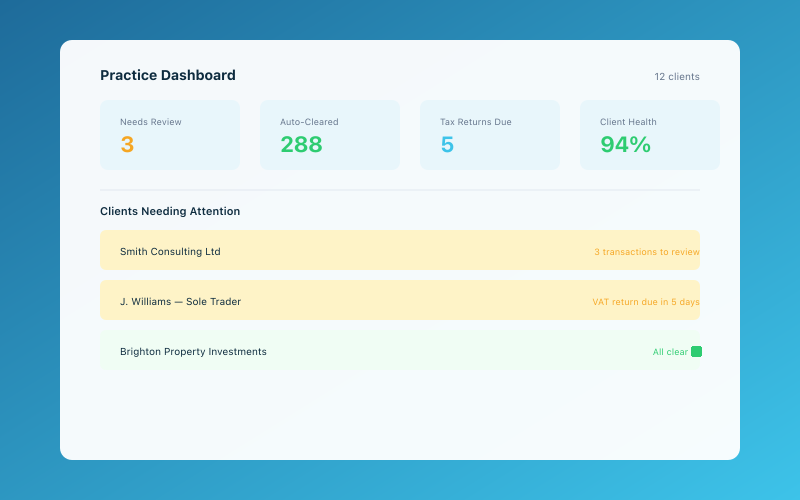 The Accounted practice dashboard — manage all your clients in one place
Write-offs are the silent killer of practice profitability. A practice with £500,000 in revenue and a 15% write-off rate is leaving £75,000 on the table every year. That's not a rounding error — that's a salary. Maybe two salaries.
The first step to reducing write-offs is understanding why they happen. The second is doing something about it.
Why Write-Offs Happen
Scope Creep
This is the biggest culprit. You quote a client £800 for their self-assessment. Then they ask if you can "just quickly" look at something else. Then they send you a box of receipts to sort through. Then they want advice on whether to register for VAT. Before you know it, you've done £1,400 worth of work for £800.
Scope creep happens because:
- The original scope wasn't clearly defined
- The client doesn't understand what's included and what isn't
- Nobody on your team feels comfortable saying "that's outside the scope"
- Small additions seem too trivial to invoice separately
- You worry that charging extra will upset the client
Poor Scoping
If you quote a job without properly understanding its complexity, you'll inevitably underquote. This is particularly common with new clients, where you don't yet know the state of their records.
"Self-assessment for a sole trader" could mean anything from a straightforward return that takes 90 minutes to a nightmare that takes 8 hours, depending on the quality of the client's records, the complexity of their affairs, and how responsive they are to queries.
Not Tracking Time
You can't manage what you don't measure. If your team isn't tracking time against clients and jobs, you have no idea where write-offs are occurring. You might assume they're spread evenly across your client base, but in reality, write-offs tend to be concentrated in a small number of problematic clients.
Perfectionism
Some team members spend far longer on a job than it warrants because they want it to be perfect. There's a difference between thorough and perfectionist, and the latter often results in hours of work that the client neither sees nor benefits from.
Reluctance to Have Difficult Conversations
Many write-offs exist simply because someone didn't want to have an awkward conversation. "The client will complain if we charge for that." "They'll leave if we put our prices up." "It's easier to just absorb it." These assumptions are often wrong, and even when they're right, the alternative — working for free — isn't sustainable.
Fixed-Fee vs Time-Based Billing
The billing model you use has a significant impact on write-offs.
Time-Based Billing
In theory, time-based billing means no write-offs because you bill for every hour. In practice, clients push back on invoices they consider too high, team members don't record all their time, and partners write off time to keep clients happy.
Time-based billing also creates a perverse incentive: the less efficient you are, the more you bill. This doesn't sit well with clients who are increasingly price-sensitive and expect to know what they'll pay upfront.
Fixed-Fee Billing
Fixed-fee billing eliminates the client's fear of an unpredictable bill, which makes them easier to sell to and more satisfied with the service. But it shifts the risk to you — if a job takes longer than expected, you absorb the cost.
The key to profitable fixed-fee billing is accurate scoping. You need to understand the complexity of each job before you price it, and your price needs to reflect realistic time estimates plus a margin for the unexpected.
The Best Approach
Many successful practices use a hybrid model:
- Fixed fees for standard, repeatable work — self-assessment for straightforward sole traders, bookkeeping packages, MTD quarterly submissions. You know how long these take and can price them accurately.
- Time-based billing (with caps) for complex or unpredictable work — tax investigations, restructuring advice, complex tax planning. Quote a fee range and provide regular updates on where you are within it.
- Project pricing for one-off work — company formations, VAT registrations, specific advisory projects. Defined scope, defined price, defined deliverables.
Engagement Letters That Protect You
Your engagement letter is your first line of defence against scope creep and write-offs. Most practice engagement letters are too vague about what's included.
What a Good Engagement Letter Covers
Specific services included: Don't just write "preparation of self-assessment return." Write:
- Preparation and filing of self-assessment tax return for the year ended 5 April 2026
- Based on information and records provided by the client
- Includes one review meeting of up to 30 minutes
- Includes up to 2 rounds of amendments based on additional information
Specific services excluded: Be equally clear about what you're not doing:
- Bookkeeping services and record keeping
- VAT returns and MTD quarterly submissions
- Tax planning and advisory work
- Payroll services
- Dealing with HMRC enquiries or investigations
What happens if the scope changes: "If additional work is required beyond the scope described above, we will discuss this with you in advance and provide a separate fee quotation before proceeding."
Client responsibilities: "The client is responsible for providing complete and accurate records by [date]. If records are incomplete or received after this date, additional fees may apply."
The Records Quality Clause
This is a game-changer for reducing write-offs. Include a clause in your engagement letter that differentiates pricing based on the quality of records received:
"Our fee of £X is based on receiving complete, organised records. If records are incomplete, disorganised, or require significant sorting, we reserve the right to charge additional fees at our standard hourly rate of £Y, which will be agreed with you in advance."
This incentivises clients to provide decent records and gives you a clear basis for charging extra when they don't.
Technology to Reduce Manual Work
One of the most effective ways to reduce write-offs is to reduce the time each job actually takes. Technology is your biggest lever here.
AI-Powered Bookkeeping
Tools like Accounted, where Penny the AI bookkeeper handles transaction categorisation, receipt matching, and bank reconciliation, mean your team spends less time on manual data processing. If a job that used to take 4 hours now takes 2 hours because the software did half the work, you've halved your write-off risk.
When you recommend AI-powered bookkeeping tools to your clients, you're not just helping them — you're helping yourself. Clients who use decent bookkeeping software provide better records, which means your team spends less time cleaning up and more time on chargeable work.
Automated Workflows
Practice management software can automate client reminders, deadline tracking, and task assignments. Every hour your team doesn't spend chasing clients for information or manually tracking deadlines is an hour available for billable work.
Template Libraries
Standardised templates for common letters, emails, and documents reduce the time spent on routine communication. If every tax planning letter is written from scratch, that's a write-off waiting to happen. If it's built from a template and customised in 15 minutes, the job stays profitable.
Cloud Collaboration
Shared workspaces (Google Workspace, Microsoft 365, client portals) reduce the time spent emailing files back and forth, chasing missing information, and dealing with version confusion. Small efficiencies add up across hundreds of client interactions.
Client Education
Many write-offs happen because clients don't realise how their behaviour affects your time and costs. Explain the connection: "When your records are organised, we keep your fee at the agreed level. When they arrive incomplete, it takes longer, which means higher costs." Most clients make more effort once they understand this.
Tell clients exactly what you need, in what format, and by when. A simple checklist sent 8 weeks before year-end works wonders. And quarterly MTD touchpoints keep records current and catch problems before they become expensive.
When to Fire a Client
Some clients are structurally unprofitable. No amount of better scoping, clearer engagement letters, or client education will fix them. These are clients who:
- Consistently provide terrible records and refuse to improve
- Regularly demand additional work without expecting to pay for it
- Are slow to respond to queries, causing deadline pressure and rushed work
- Are rude or disrespectful to your team
- Have fees that haven't increased in years despite inflation and increased complexity
The Conversation
Firing a client doesn't have to be confrontational:
"We've really valued working with you over the years. However, we've been reviewing our service model and unfortunately we're no longer able to service your account at the current fee level. We'd be happy to discuss an updated fee structure that reflects the work involved, or if you'd prefer, we can recommend an alternative practice that might be a better fit."
The Maths
Calculate the true cost of your worst clients — including write-offs, management time, stress, and opportunity cost (what else could your team be doing with that time?). You'll often find that your bottom 10% of clients by profitability are actually costing you money. Freeing up that capacity for more profitable work is a legitimate growth strategy.
Realistic Pricing Strategies
Annual Price Reviews
Every client's fee should be reviewed annually. At minimum, fees should increase with inflation and any changes in complexity. Many practices haven't increased certain clients' fees in years because nobody wants to have the conversation. But a client who's been paying £600 for five years is probably costing you money — your staff costs, rent, insurance, and software subscriptions have all gone up.
Pricing New Services
When adding new services like MTD quarterly submissions, treat them as new products with fresh pricing. Don't bundle them into existing fees "for free" — that's an immediate write-off. Price them based on the time they take and the value they provide.
The Price Increase Email
"Dear [Client], I'm writing to let you know that our fees for the year ahead will be [amount], an increase of [X%] from last year. This reflects increased costs and our continued investment in technology and training to provide you with the best possible service. If you'd like to discuss this, I'm happy to arrange a call."
Most clients accept reasonable annual increases without complaint. The ones who push back are often the least profitable clients you'd be better off without.
Building a Culture of Accountability
Reducing write-offs isn't just about systems — it's about culture. Review write-offs in team meetings to understand patterns (which clients, which work types). Give your team explicit permission and training to have conversations about scope and fees — junior staff shouldn't absorb scope creep because they're uncomfortable pushing back. Reward efficiency when team members find faster ways to complete work without compromising quality. And set a practice-wide write-off target (say, reducing from 15% to 10% within 12 months) broken down by team and client type.
The Bottom Line
Write-offs aren't inevitable. They're the result of specific, identifiable causes — poor scoping, unclear engagement letters, reluctance to have conversations, inefficient processes, and unprofitable clients. Each of these has a solution.
Start by measuring your current write-off rate. Then pick the two or three changes that would have the biggest impact and implement them over the next quarter. You don't need to fix everything at once — even reducing write-offs by 5% can have a material impact on your practice's profitability and your team's morale.
Related Reading
Learn about our free accountant portal and how it saves your practice time.
Accounted gives accountants a free practice portal — manage all your clients, file to HMRC, and let Penny handle the routine work. See the accountant portal →
Editorial & Research
The Accounted editorial team covers software comparisons, technology, and the tools UK sole traders need to run their businesses efficiently. All software comparisons are based on independent research and publicly available pricing.
Ready to try Accounted?
Join UK sole traders who are simplifying their bookkeeping and tax.
Start your 14-day free trial