When to Fire Your Accountant — Red Flags to Watch For
Nobody likes firing anyone. It's uncomfortable, it feels personal, and the inertia of sticking with what you've got is powerful. That's why so many sole traders stay with an underperforming accountant for years, quietly frustrated but never quite frustrated enough to make a change.
Here's the thing, though: a bad accountant isn't just a minor inconvenience. They can cost you real money through missed tax savings, cause you genuine stress through poor communication, and even land you in trouble with HMRC through sloppy work. At some point, loyalty stops being a virtue and starts being a liability.
So how do you know when it's time to make a change? Let's talk about the red flags.
They Never Return Your Calls
This is the most common complaint we hear, and it's absolutely a valid reason to consider switching. You're paying for a professional service, and part of that service is being accessible when you need them.
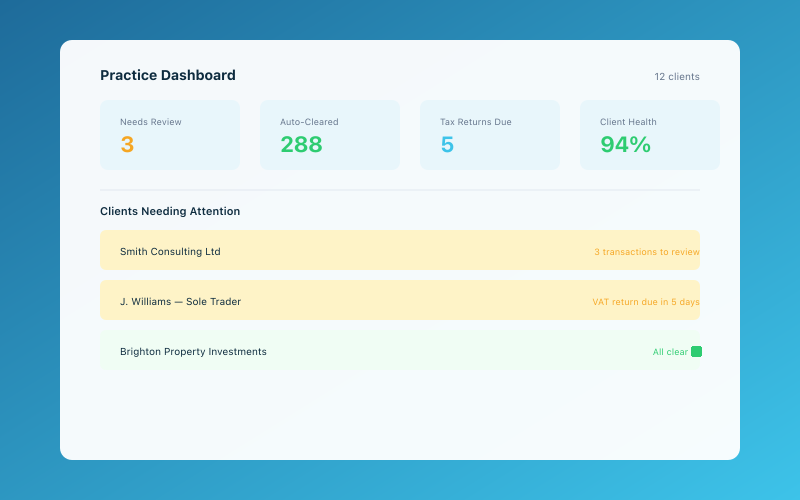 The Accounted practice dashboard — manage all your clients in one place
Now, let's be fair. Your accountant is busy. They have other clients. They're not going to drop everything the moment you ring. A reasonable response time for a non-urgent query might be 24-48 hours. But if you're consistently waiting a week or more for a response, or if your calls and emails regularly go unanswered entirely, that's a problem.
It's particularly concerning during critical periods. If you can't get hold of your accountant in January when your Self Assessment deadline is approaching, or when HMRC has written to you with a question, that's not just poor service — it's potentially damaging to your financial interests.
Before you write them off entirely, consider whether you've communicated your expectations clearly. Some accountants have specific communication hours or prefer email to phone calls. It's worth having an honest conversation about communication preferences. But if you've raised the issue and nothing changes, that tells you everything you need to know.
Your Tax Returns Are Always Last-Minute
If your accountant consistently files your returns at the last possible moment — or worse, has ever missed a deadline on your behalf — that's a serious red flag.
Yes, the Self Assessment deadline is 31 January. But a well-organised accountant should be working on your return months before that. If they're requesting your records in mid-January and filing on the 30th, they're not managing their workload effectively, and you're bearing the risk.
Late filing means there's no time to review the return properly, no time to identify tax-saving opportunities, and no time to deal with any issues that come up. It also means you have very little warning about how much tax you owe, which can cause cash flow problems.
With Making Tax Digital introducing quarterly submissions, this issue is only going to get worse. An accountant who can't manage one annual deadline is unlikely to handle four quarterly ones effectively.
A good accountant will have a clear timeline for the year, will request your records well in advance, and will have your return prepared with time to spare. If that doesn't describe your experience, it's worth asking why.
They Don't Seem to Understand Your Business
Every business is different, and good accounting advice needs to be tailored to your specific situation. If your accountant consistently gives you generic advice that doesn't reflect the realities of your business, they're not earning their fee.
For example, if you're a freelance consultant working entirely from home, your accountant should be proactively advising you about claiming home office expenses, rather than waiting for you to ask. If you're a tradesperson, they should know the ins and outs of the Construction Industry Scheme without needing to look it up.
This doesn't mean your accountant needs to be an expert in your specific industry — but they should take the time to understand how your business works and tailor their advice accordingly. If every conversation feels like they're hearing about your business for the first time, something is wrong.
One telling sign: do they ever give you proactive advice? A good accountant doesn't just process your numbers — they spot opportunities and flag risks. If your accountant has never said "Have you considered...?" or "You might want to think about...", they're probably not engaging with your business deeply enough to add real value.
Their Fees Keep Rising With No Extra Value
Accountancy fees do go up over time — that's normal. Inflation, increased regulatory requirements, software costs, and general business overheads all play a role. But the increases should be reasonable and, ideally, accompanied by improved or additional services.
What's not acceptable is significant fee increases with no explanation, or creeping costs from add-on charges you weren't expecting. If you're being charged extra every time you ask a question, send an email, or need a simple letter, the relationship has become transactional in the worst sense.
Ask yourself: am I getting value for what I'm paying? If your accountant charges £1,500 a year but saves you £3,000 in tax through smart planning, that's excellent value. If they charge £1,500 and all they do is put numbers in boxes on a tax return — something you could increasingly do yourself with modern bookkeeping software — that's harder to justify.
It's perfectly reasonable to ask your accountant for a breakdown of their fees and a discussion about value. If they get defensive about this, that's another red flag.
They Make Mistakes
Everyone makes mistakes occasionally. But patterns of errors are different from one-off slip-ups, and they should be taken seriously.
Warning signs include:
- Your bank balance doesn't match their records
- They mix up your figures with another client's
- They make data entry errors on your tax return
- They miss allowable expenses you've told them about
- They give you incorrect advice about deadlines or regulations
If you've noticed errors, raise them immediately and clearly. A good accountant will be mortified, will fix the problem promptly, and will put measures in place to prevent it happening again. A bad one will be dismissive, defensive, or — worst of all — will try to blame you.
If a mistake by your accountant results in a financial penalty from HMRC, they should cover that cost. If they don't offer to, that tells you a lot about their professionalism and integrity.
They're Not Keeping Up With Changes
Tax legislation changes constantly. Every Budget and Autumn Statement brings new rules, new thresholds, and new deadlines. An accountant who isn't staying current isn't doing their job.
The biggest current example is Making Tax Digital for Income Tax. If your accountant isn't talking to you about the April 2026 deadline, isn't advising you on compatible software, and doesn't seem to have a plan for how quarterly submissions will work, that's a major concern.
Other areas where up-to-date knowledge matters include changes to capital allowances, pension contribution rules, National Insurance thresholds, and dividend taxation. If your accountant is still giving you advice based on rules from three years ago, you could be paying more tax than necessary — or inadvertently falling foul of new regulations.
You shouldn't need to be the one telling your accountant about changes in the rules. That's literally what you're paying them for.
How to Actually Make the Switch
So you've decided it's time to change. How do you go about it?
First, find your new accountant before leaving the old one. You don't want a gap in coverage, especially if you have deadlines approaching. The new accountant will handle most of the transition process for you.
Give formal notice. Check your engagement letter for any notice period or contractual obligations. Most accountants require 30 days' notice, though some have longer periods. Put your notice in writing — email is fine.
Request your records. Your accountant is required to hand over your records when you leave. This includes your original documents, copies of filed returns, and any working papers. If they drag their feet on this, remind them of their professional obligations.
Your new accountant will write a professional clearance letter. This is standard practice. They write to your old accountant to confirm there are no professional reasons why they shouldn't take you on as a client. Your old accountant is obliged to respond.
Settle any outstanding fees. If you owe your departing accountant for work they've completed, pay promptly. It's the right thing to do, and it prevents any disputes that could delay the handover of your records.
Make the transition as clean as possible. If you're using Accounted for your day-to-day bookkeeping, this is actually much simpler because all your transaction data, categorisations, and records are already digital and portable. You simply share access with your new accountant and they can see everything they need.
Don't Feel Guilty
This is important, so we'll say it directly: changing your accountant is a normal business decision. It's not personal, it's not disloyal, and it's not ungrateful. You're paying for a professional service, and if that service isn't meeting your needs, you have every right — and frankly, a responsibility to your business — to find someone who will.
Good accountants understand this. They won't take it personally, and they'll handle the transition professionally. If your accountant reacts badly to you leaving, that rather confirms you made the right decision.
Your business deserves an accountant who is responsive, competent, proactive, and genuinely invested in helping you succeed. If that's not what you've got, it's time to find one who is.
Related reading:
- Do You Need an Accountant as a Sole Trader?
- Working With Your Accountant — A Practical Guide
- Accountant vs Bookkeeper — What's the Difference?
Accounted helps UK sole traders stay on top of their bookkeeping and tax. Start your free 30-day trial at getaccounted.co.uk.
Related Reading
Learn about our free accountant portal and how it saves your practice time.
Accounted gives accountants a free practice portal — manage all your clients, file to HMRC, and let Penny handle the routine work. See the accountant portal →
Editorial & Research
The Accounted editorial team covers software comparisons, technology, and the tools UK sole traders need to run their businesses efficiently. All software comparisons are based on independent research and publicly available pricing.
Ready to try Accounted?
Join UK sole traders who are simplifying their bookkeeping and tax.
Start your 14-day free trial