Why the Best Accountants Are Embracing AI (Not Fighting It)
The Conversation That Keeps Coming Up
At every accounting conference, in every practice management forum, and across LinkedIn, the same conversation is happening: "Is AI going to replace accountants?"
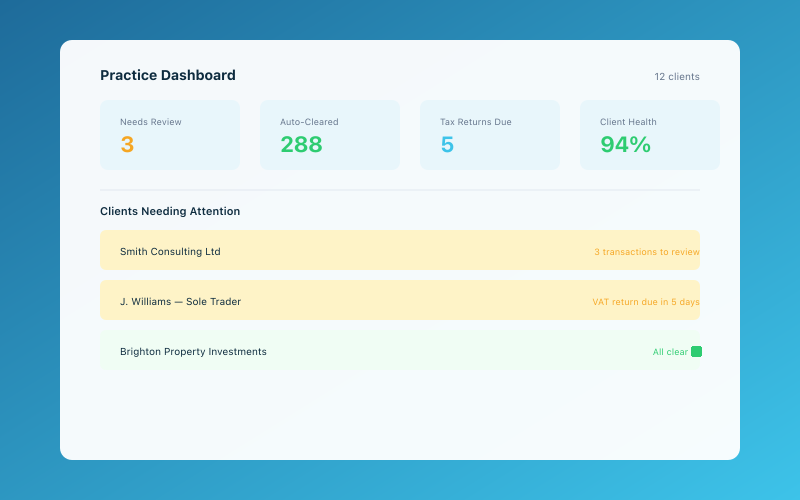 The Accounted practice dashboard — manage all your clients in one place
The short answer is no. The longer, more useful answer is that AI is going to replace the work that accountants shouldn't be doing in the first place — and the practices that recognise this early are already pulling ahead of those that don't.
We've spoken to dozens of accountants across the UK over the past year, and a clear pattern has emerged. The ones thriving aren't the ones ignoring AI, and they're not the ones panicking about it either. They're the ones thoughtfully integrating it into their practices and using the time it saves to do higher-value work.
What AI Can Actually Do in Accounting (Right Now)
Let's be specific about what AI is genuinely capable of today, not in some theoretical future, but right now in 2026.
Transaction Categorisation
AI can look at a bank transaction — "TESCO STORES 2847" — and correctly categorise it as a business expense, personal spending, or something that needs further investigation. Modern AI bookkeeping tools like Penny (the AI bookkeeper in Accounted) can categorise the vast majority of transactions accurately, learning from corrections to get better over time.
This is work that used to take bookkeepers hours per client. Now it takes minutes of review time.
Receipt Processing
AI-powered OCR (optical character recognition) can extract data from receipts — the date, amount, VAT, supplier name — and match it to corresponding bank transactions. Clients snap a photo of a receipt on their phone, and the data flows into their accounts automatically.
Bank Reconciliation
When transaction categorisation and receipt matching are automated, bank reconciliation becomes largely a review process rather than a manual one. The AI does the matching; the accountant or bookkeeper checks the work.
Anomaly Detection
AI excels at spotting things that don't look right — a duplicate payment, an unusually large expense, a transaction that doesn't match the normal pattern. This is valuable for both bookkeeping accuracy and fraud detection.
Document Processing
From extracting data from invoices to processing payroll documents, AI can handle routine document work that used to require manual data entry.
Natural Language Queries
Some AI tools now let clients (or accountants) ask questions in plain English: "How much did I spend on materials in January?" or "What's my profit for the last quarter?" Instead of running reports and interpreting numbers, the AI provides an immediate, conversational answer.
What AI Cannot Do (And Why Accountants Are Safe)
For all its capabilities, AI has significant limitations that aren't going away any time soon.
Complex Tax Planning
AI can calculate tax based on known rules. It cannot advise a client on whether to incorporate, how to structure their pension contributions for maximum relief, or whether to accelerate capital expenditure before the end of the tax year. Tax planning requires understanding a client's goals, circumstances, risk tolerance, and long-term plans — this is advisory work that demands human judgement.
Client Relationships
No AI can sit across the table from a client who's worried about cash flow and say, "I've been in this situation with other clients, and here's what we did." The trust, empathy, and personal connection that define the best accountant-client relationships are fundamentally human.
Interpreting Context
AI processes data. It doesn't understand context. It doesn't know that your client's revenue dropped in March because their biggest customer went into administration, or that the spike in expenses in September was a one-off equipment purchase, not a trend. Accountants understand the story behind the numbers — and that story is what makes their advice valuable.
Regulatory Judgement
Tax law is full of grey areas. Does this expense qualify as wholly and exclusively for business purposes? Is this contractor genuinely self-employed or should they be on payroll? These judgement calls require experience, knowledge of case law, and often a bit of professional intuition. AI can flag the question; it takes a qualified human to answer it.
Business Strategy
"Should I take on a business partner?" "Is now the right time to expand?" "Should I focus on this market or that one?" These are the questions that clients increasingly want from their accountants, and no algorithm can answer them.
Freeing Up Time for Advisory Work
Here's where the real opportunity lies. If AI handles 70-80% of the routine compliance work, what do you do with all that freed-up time?
The most successful practices are using it to shift from compliance-focused to advisory-focused services:
Tax Planning Consultations
Instead of spending hours categorising expenses, you spend that time reviewing a client's tax position and identifying savings. "Based on your current figures, if you make a pension contribution of £20,000 before April, you'll save approximately £8,000 in tax." That's a conversation worth having — and worth charging for.
Management Accounts and Forecasting
Monthly management accounts with commentary and forecasts are hugely valuable to business owners but often too time-consuming for practices to offer at accessible price points. When the data processing is automated, producing management accounts becomes viable for a much wider range of clients.
Business Health Checks
Regular reviews of a client's financial health — cash flow, profitability, debt levels, tax efficiency — position you as a strategic partner rather than a compliance processor. Clients who receive this level of service are more loyal, more likely to refer, and happy to pay higher fees.
Industry-Specific Advice
When you're not bogged down in data entry, you have time to specialise. Whether it's Construction Industry Scheme compliance, property tax planning, or advising creative freelancers, specialisation commands premium fees and builds your reputation.
Client Expectations Are Changing
Your clients' expectations are being shaped by every other technology they use. They bank on their phone, order shopping with a voice assistant, and get real-time notifications from their fitness tracker. They expect the same from their accounting.
What Modern Clients Want
- Real-time information — not quarterly reports that arrive six weeks after the quarter ends
- Easy communication — WhatsApp messages and quick voice notes, not formal letters
- Proactive advice — "You should know that..." rather than "You should have told me..."
- Transparency — clear pricing, no surprises, visibility into what's happening with their accounts
- Speed — same-day responses, quick turnarounds, instant access to their numbers
AI-powered tools help you deliver all of this. When your clients' bookkeeping is handled in real time by AI-powered tools, you always have up-to-date numbers to work with. When routine queries are handled automatically, you have time to respond to the important ones quickly.
The Competitive Advantage
Practices that embrace AI aren't just keeping up — they're creating competitive advantages that are hard for laggards to replicate.
Capacity
A practice using AI can handle significantly more clients per team member. Not by cutting corners, but by eliminating the repetitive work that consumed most of the time. This means more revenue without proportional increases in staffing costs.
Pricing
When your costs per client are lower (because AI handles the grunt work), you can either increase margins or offer more competitive pricing. Many forward-thinking practices are doing both — charging less for basic compliance while charging premium rates for advisory services.
Client Satisfaction
Clients of AI-enhanced practices get faster turnarounds, more proactive communication, and better advice. They're less likely to switch, more likely to buy additional services, and more likely to recommend you — all of which drives practice growth.
Staff Retention
Here's one that doesn't get discussed enough. Junior accountants and bookkeepers don't enter the profession because they love data entry. When AI handles the monotonous work, your team gets to do more interesting, intellectually challenging tasks. This makes your practice a more attractive place to work and reduces the turnover that plagues the industry.
Training and Upskilling Your Team
Embracing AI doesn't mean everyone in your practice needs to become a data scientist. But it does require some investment in training.
For Partners and Directors
- Understanding what AI tools are available and what they can do
- Evaluating which tools fit your practice's needs and budget
- Developing advisory service offerings that leverage the time AI frees up
- Communicating the changes to clients and staff
For Managers and Senior Staff
- Learning to review AI-processed work rather than doing it manually
- Building advisory skills (presentation, communication, analysis)
- Understanding where AI makes mistakes and how to catch them
- Managing workflow changes as processes evolve
For Junior Staff and Bookkeepers
- Training on new AI-powered software tools
- Shifting from data entry to data review and exception handling
- Developing client-facing skills they'll need as their roles evolve
- Understanding the technology well enough to explain it to clients
Ongoing Learning
AI tools evolve quickly. What's possible today wasn't possible a year ago, and what'll be possible in a year isn't possible today. Build a culture of ongoing learning — regular software reviews, team training sessions, and time to experiment with new tools.
Ethical Considerations
AI in accounting isn't without ethical questions, and responsible practices should consider them.
Data Security
Client financial data is sensitive. Any AI tool you use must have robust data protection, be GDPR compliant, and ideally be UK-hosted or at least compliant with UK data residency requirements. Ask vendors specific questions about where data is stored, who has access, and what happens if there's a breach.
Professional Responsibility
When AI categorises a transaction incorrectly and that error makes it into a tax return, who's responsible? You are. AI is a tool — professional responsibility remains with the qualified accountant. This means you must review AI-processed work, not blindly trust it.
Transparency with Clients
Clients should know that AI is being used in their accounts. Most are perfectly comfortable with it — many prefer it because it means faster, more accurate processing. But they should be informed, and they should know that a qualified human is reviewing everything.
Bias and Accuracy
AI systems learn from historical data, which can contain biases. Regular accuracy audits — checking a sample of AI-categorised transactions against manual categorisation — help ensure the technology is performing as expected.
The Accountant's Role Is Evolving, Not Disappearing
The analogy that keeps coming up is calculators. When electronic calculators appeared, people predicted the end of mathematics as a profession. Instead, calculators freed mathematicians from tedious arithmetic and let them focus on higher-level thinking.
AI is doing the same thing for accounting. It's not replacing accountants — it's replacing the parts of accounting that were never the best use of a qualified professional's time. The accountants who embrace this shift will offer better services, attract better clients, charge higher fees, and enjoy their work more.
The ones who resist will find themselves competing on price for a shrinking pool of pure compliance work, while their AI-savvy competitors take the advisory high ground.
If you're an accountant looking at how tools like Accounted and Penny can help your practice — or help your clients keep better records so your job is easier — it's worth exploring. The practices that are winning right now aren't the biggest or the oldest. They're the ones that are most willing to evolve.
Related Reading
Learn about our free accountant portal and how it saves your practice time.
Accounted gives accountants a free practice portal — manage all your clients, file to HMRC, and let Penny handle the routine work. See the accountant portal →
Editorial & Research
The Accounted editorial team covers software comparisons, technology, and the tools UK sole traders need to run their businesses efficiently. All software comparisons are based on independent research and publicly available pricing.
Ready to try Accounted?
Join UK sole traders who are simplifying their bookkeeping and tax.
Start your 14-day free trial