Offering Advisory Services — Moving Beyond Compliance
If you're running an accountancy practice built primarily on compliance work — tax returns, annual accounts, VAT filings — you're sitting on a ticking clock. Not because compliance is going away (it isn't), but because it's becoming commoditised. Software is getting smarter, MTD is automating more of the process, and clients increasingly see compliance as a basic expectation rather than something worth paying a premium for.
The practices that will thrive over the next decade are the ones that move beyond ticking boxes and start genuinely helping clients make better decisions. Advisory services — sometimes called consultancy, business support, or strategic advice — represent the single biggest growth opportunity for most small and mid-sized firms.
But making the shift isn't as simple as adding "advisory" to your website. It requires a change in mindset, skillset, and how you structure your client relationships.
Why Compliance Alone Isn't Enough
Let's be blunt about the market dynamics. A basic sole trader tax return can be prepared by software for a few pounds a month. Tools like Accounted, with AI-powered categorisation and Penny handling the heavy lifting, mean that even non-technical business owners can keep clean books with minimal effort.
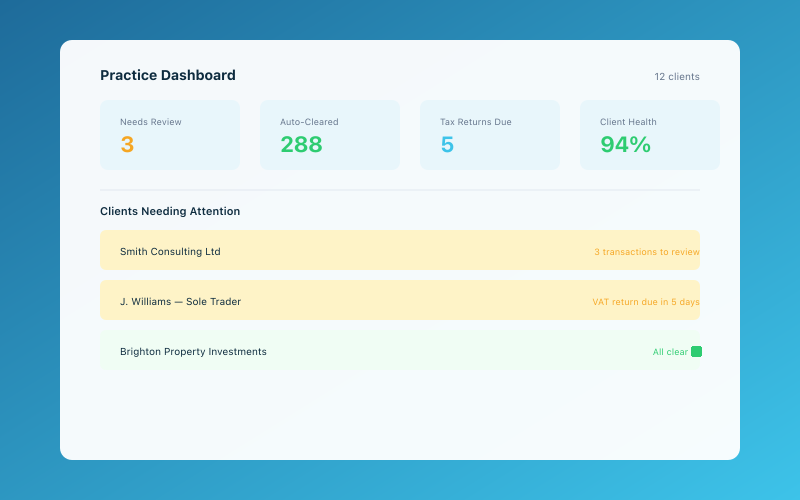 The Accounted practice dashboard — manage all your clients in one place
That doesn't make accountants redundant — far from it. But it does mean that the value you provide needs to go beyond what software can do. And software can't do advisory.
Software can't sit down with a client and help them decide whether to incorporate. It can't look at their numbers and spot that they're underpricing their services. It can't explain why their cash flow is fine on paper but they're constantly scraping by in practice. It can't help them plan for retirement, structure a property portfolio, or navigate a difficult business partnership.
That's advisory work, and it's where the real value lies — both for your clients and for your practice.
The numbers back this up. Practices that offer advisory services alongside compliance typically see 40–60% higher revenue per client. They also report better client retention, because advisory relationships are stickier. When you're someone's trusted adviser, they don't leave over a £20/month price difference with a competitor.
Identifying Advisory Opportunities With Existing Clients
The good news is you don't need to go out and find new clients to start offering advisory services. Your existing client base is full of opportunities — you just need to learn to spot them.
Every set of accounts tells a story. When you're preparing a client's year-end figures, ask yourself:
- Are their profit margins healthy, or are they working too hard for too little?
- Is their business growing, stagnating, or declining — and do they know?
- Are they extracting money from the business in the most tax-efficient way?
- Do they have a plan for the next 12 months, or are they just winging it?
- Are they aware of reliefs, allowances, or structures that could benefit them?
Each of these questions is an advisory conversation waiting to happen. The key is shifting from "here are your numbers" to "here's what your numbers are telling us, and here's what we might do about it."
Start small. After completing a client's accounts, schedule a 30-minute review call. Walk them through the key figures, highlight anything interesting, and offer one or two suggestions. You don't need to have all the answers — sometimes just asking the right questions is enough to add enormous value.
Types of Advisory Services You Can Offer
Advisory is a broad umbrella, and not every service will suit every practice. Here are some of the most popular and accessible options:
Tax planning. This is the easiest entry point because it builds directly on your existing expertise. Helping clients plan ahead to minimise their tax bill — through pension contributions, timing of income, use of allowances, or structural changes — is something most accountants can do but few proactively offer.
Business planning and forecasting. Helping clients set financial goals, create budgets, and build cash flow forecasts. This is particularly valuable for businesses going through growth or change.
Pricing and profitability analysis. Many small business owners have no idea whether individual products, services, or clients are profitable. Helping them understand their margins and adjust their pricing can have a transformative impact.
Exit planning. Whether a client is five years or fifteen years from selling or winding down their business, planning ahead can save significant tax and maximise value.
Technology advisory. Recommending and helping clients implement the right software stack. Given that most accountants are already doing this informally, formalising it as a service is a natural step.
Management reporting. Providing regular, meaningful financial reports — not just year-end accounts — that help clients understand their business performance in real time.
Pricing Advisory Work
This is where many accountants get stuck. Compliance work is relatively easy to price — you know roughly how long a tax return takes, and you can quote accordingly. Advisory work is harder because the time involved is variable and the value is subjective.
Here's the thing: don't price advisory by the hour. It's a trap. An hour of advisory that saves a client £10,000 in tax is worth far more than an hour of bookkeeping. If you charge the same hourly rate for both, you're massively undervaluing your expertise.
Instead, consider these approaches:
Bundled packages. Include advisory as part of a higher-tier monthly subscription. For example, your premium package might include everything in your standard package plus quarterly advisory meetings, tax planning reviews, and unlimited ad-hoc support. This makes advisory feel like a natural upgrade rather than a separate (and potentially scary) purchase.
Project-based fees. For specific pieces of advisory work — a tax planning review, a business restructuring assessment, a pricing strategy session — quote a fixed project fee based on the complexity and value involved.
Value-based pricing. For high-impact advisory work, price based on the value delivered. If your tax planning advice is likely to save a client £5,000, a fee of £1,000 represents clear value for money.
Our article on fixed vs hourly pricing explores the broader pricing debate in more detail.
Building the Skills You Need
Being a brilliant compliance accountant doesn't automatically make you a brilliant adviser. The technical knowledge is important, but advisory requires additional skills:
Listening. Really listening, not just waiting for your turn to speak. Understanding a client's goals, fears, and priorities requires genuine curiosity and attention.
Questioning. The best advisers ask great questions. "What does success look like for you in three years?" is more powerful than "here's what I think you should do."
Communication. Translating complex financial concepts into plain language that clients can understand and act on. This is a skill, and it can be developed with practice.
Commercial awareness. Understanding not just the numbers but the business context. What's happening in the client's industry? What are their competitors doing? What external factors might affect them?
Confidence. Putting yourself forward as an adviser — rather than just a number-cruncher — requires confidence. Start with topics you know well and expand from there. You don't need to be an expert in everything; you just need to be more expert than your client.
Invest in your own development. Attend advisory-focused CPD events, read business books, listen to podcasts. The more broadly knowledgeable you are, the more value you can offer.
Structuring Advisory Into Your Practice
Advisory shouldn't be an afterthought bolted onto your existing workflows. For it to work properly, it needs to be embedded in how you run your practice.
Schedule advisory time. Block out specific time in your diary for advisory work. If it's not scheduled, it won't happen — compliance deadlines will always take priority.
Build advisory triggers into your processes. When you complete a set of accounts, have a checklist of advisory opportunities to consider. When a client's turnover approaches the VAT threshold, flag it for a planning conversation. When someone mentions they're thinking about buying a property, that's an advisory trigger.
Create templates and frameworks. Advisory meetings are more productive when they follow a loose structure. Create templates for common scenarios — tax planning reviews, annual business health checks, pricing assessments — that you can adapt for each client.
Track the value you deliver. Keep a record of the advisory outcomes you achieve for clients. "We helped Client X save £3,200 through pension planning" is powerful for case studies, testimonials, and your own confidence.
The shift to advisory also impacts your hiring decisions. If you're looking to grow your team, consider hiring people with strong interpersonal skills and commercial awareness, not just technical qualifications. A practice focused on advisory needs advisers, not just accountants.
For more on growing and scaling your practice, our guide on how to grow your accountancy practice in 2026 covers a range of strategies.
Making the Transition
You don't need to overhaul your entire practice overnight. In fact, trying to do too much too quickly is one of the biggest mistakes firms make when moving into advisory.
Start with your best clients — the ones you have the strongest relationships with, the ones whose businesses you understand well, the ones who are most likely to see the value. Offer them an advisory add-on or a complimentary planning session. Use it as a pilot to refine your approach before rolling it out more broadly.
Gather feedback. Ask clients what they found most valuable, what they'd want more of, and what they'd be willing to pay. This real-world input is far more useful than any business plan.
Over time, you'll find that advisory becomes the heartbeat of your practice. It's more interesting, more profitable, and more rewarding than compliance alone. And in a world where software handles more and more of the routine work, it's the service that truly sets you apart.
Related Reading
Accounted helps UK sole traders stay on top of their bookkeeping and tax. Start your free 30-day trial at getaccounted.co.uk
Accounted gives accountants a free practice portal — manage all your clients, file to HMRC, and let Penny handle the routine work. See the accountant portal →
Editorial & Research
The Accounted editorial team covers software comparisons, technology, and the tools UK sole traders need to run their businesses efficiently. All software comparisons are based on independent research and publicly available pricing.
Ready to try Accounted?
Join UK sole traders who are simplifying their bookkeeping and tax.
Start your 14-day free trial