How to Attract Millennial and Gen Z Clients to Your Practice
The demographics of business ownership in the UK are shifting. Millennials (born roughly 1981–1996) now make up the largest group of new business registrations, and Gen Z (born 1997–2012) isn't far behind. Side hustles, freelancing, and digital-first businesses are booming — and these younger entrepreneurs need accountants.
The problem? Many of them don't think they do. Or if they do, they're not looking for the same kind of service their parents used. The stuffy office, the annual meeting, the paper-heavy process — it doesn't resonate with a generation that manages their entire life from a smartphone.
If your practice wants to stay relevant (and grow), understanding what younger clients actually want — and adapting your approach accordingly — isn't optional. It's essential.
Understanding What Younger Clients Actually Want
Let's start by ditching some assumptions. Younger clients aren't less serious about their finances. They're not less willing to pay for professional advice. And they're certainly not less ambitious than older generations.
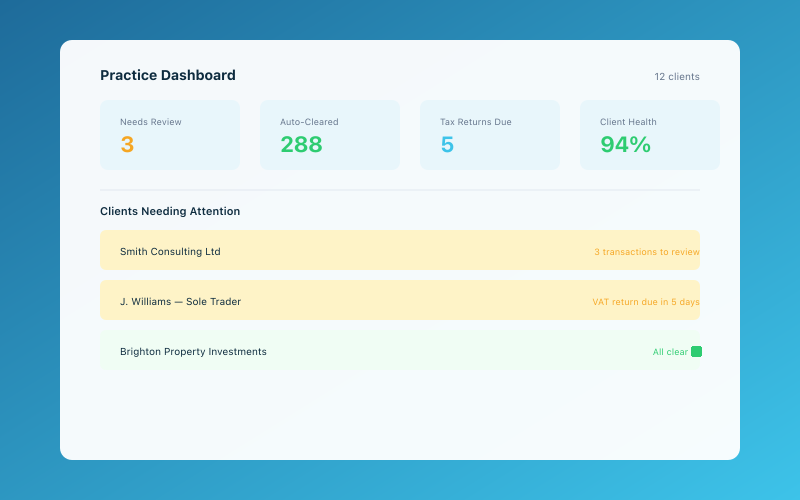 The Accounted practice dashboard — manage all your clients in one place
What they are is digitally native, time-poor, and allergic to unnecessary friction.
Here's what matters to them:
Speed and convenience. They don't want to post documents, sit in waiting rooms, or play phone tag. They want to send a message, get a reply, and move on with their day. If your onboarding process involves printing and signing a paper engagement letter, you've already lost them.
Transparency on pricing. Younger clients are used to subscription models. Netflix, Spotify, gym memberships — they know exactly what they're paying each month. Vague hourly rates and surprise invoices feel alien and untrustworthy. Fixed monthly fees with a clear scope of what's included will win every time.
Communication on their terms. Email is fine, but it's not their preferred channel. Many younger business owners live on WhatsApp, Slack, or Instagram DMs. Meeting them where they already are — rather than forcing them into your preferred channel — makes a huge difference.
Proactive advice, not just compliance. Filing a tax return isn't exciting. But telling someone they could save £2,000 by restructuring their pension contributions? That's valuable. Younger clients want an accountant who helps them make better decisions, not just one who ticks boxes once a year.
Modernising Your Digital Presence
Your website is your shop window, and younger clients will judge you by it. Harsh? Perhaps. But if your site looks like it was built in 2012, loads slowly on mobile, or buries your contact information three clicks deep, prospects will bounce.
Here's what a modern accountancy website needs:
- Mobile-first design. More than 60% of web browsing now happens on phones. If your site doesn't work beautifully on a small screen, fix it.
- Clear pricing (or at least a pricing guide). You don't need to list every fee, but giving visitors a ballpark — "sole trader accounts from £75/month" — builds trust and filters out tyre-kickers.
- Social proof. Testimonials, Google reviews, case studies. Younger clients check reviews before buying anything, and your services are no exception.
- Easy booking. A Calendly link or similar booking tool that lets prospects schedule a discovery call without emailing back and forth.
Beyond your website, think about where younger audiences spend time. LinkedIn is valuable for B2B connections, but Instagram and TikTok are increasingly where freelancers and small business owners hang out. You don't need to do a dance — short, helpful videos explaining tax tips or common mistakes work brilliantly.
For more ideas on growing your practice, take a look at our guide on how to grow your accountancy practice in 2026.
Rethinking Your Service Delivery
Traditional accountancy workflows were designed around the annual cycle: gather records, prepare accounts, file the return, send the invoice. Repeat. It's efficient for the accountant, but it creates a feast-or-famine relationship with the client — months of silence punctuated by a flurry of activity (and a bill).
Younger clients want an ongoing relationship. They want to feel supported throughout the year, not just at tax time. This is where monthly subscription models come in.
A typical monthly package might include:
- Bookkeeping review or full bookkeeping service
- Quarterly check-ins (even brief ones)
- Year-end accounts and tax return
- Ad-hoc support via messaging
- MTD compliance and quarterly submissions
This model works well for both parties. The client gets predictable costs and ongoing support. You get predictable revenue and a deeper relationship with each client. It's a win-win.
Tools play a big role here too. If you're recommending bookkeeping software to sole trader clients, consider suggesting something genuinely simple. Penny, the AI assistant in Accounted, handles much of the day-to-day categorisation and receipt matching for sole traders — which means your clients keep better records without you having to chase them constantly.
Speaking Their Language
The accountancy profession loves jargon. Accruals, capital allowances, basis periods, overlap relief — these terms mean nothing to most business owners, and they're particularly off-putting to younger ones who might already feel intimidated by the whole process.
Plain English isn't dumbing down. It's good communication. When you explain things clearly, clients feel empowered rather than patronised. They understand what you're doing and why, which builds trust and makes them more likely to refer you to others.
This applies to your marketing too. Blog posts, social media content, and emails should be written in a conversational, accessible tone. Imagine you're explaining something to a friend over coffee, not presenting to a boardroom.
Some practical tips:
- Use "tax return" not "self-assessment submission"
- Say "money you can claim back" not "allowable deductions"
- Write "your tax bill" not "your liability"
- Explain the "why" not just the "what"
You'll notice that the best accountancy content creators on social media all share this trait. They make complex topics feel simple and approachable. That's not an accident — it's a deliberate choice that resonates powerfully with younger audiences.
Building a Referral Engine With Younger Clients
Here's something brilliant about millennial and Gen Z clients: when they find a service they love, they tell everyone. Online reviews, social media recommendations, group chat suggestions — word of mouth has gone digital, and it's more powerful than ever.
But it doesn't happen automatically. You need to make it easy and give people a reason to talk about you.
Ask for reviews. After a positive interaction — maybe you've just saved them money on their tax bill, or helped them through their first VAT registration — ask if they'd leave a Google review. Most will happily oblige if you catch them at the right moment and make it easy (send them a direct link).
Create shareable content. An infographic showing key tax deadlines, a short video explaining how to claim mileage, a downloadable checklist for new sole traders — content that's genuinely useful gets shared. Every share puts your practice in front of potential new clients.
Referral incentives. Some practices offer a discount or credit for successful referrals. It doesn't need to be huge — even a £50 credit on next month's fee is enough to prompt someone to mention you to a friend.
Community building. Consider creating a private Facebook group, Discord server, or WhatsApp community for your clients. It sounds unconventional, but younger business owners value community and peer support. Position yourself at the centre of that community, and you become indispensable.
If client retention is a concern, our article on reducing client churn in accounting practices has some useful strategies.
Pricing for the Next Generation
We touched on this earlier, but it's worth going deeper. Pricing is often the single biggest barrier between a younger client and your practice.
The issue isn't necessarily that younger clients have less money (though some do). It's that they have less tolerance for ambiguity. "It depends" isn't a pricing strategy — it's a red flag.
Consider offering tiered packages. Something like:
- Essentials — Self-assessment filing, basic support, MTD compliance
- Growth — Everything in Essentials plus bookkeeping review, quarterly check-ins, advisory calls
- Premium — Full-service bookkeeping, monthly reporting, unlimited support, tax planning
Each tier has a clear monthly price and a defined scope. Clients can see exactly what they're getting and choose the level that fits their budget and needs. If their business grows, they upgrade. Simple.
This approach also makes your sales process much easier. Instead of creating bespoke quotes for every prospect, you can point them to a tier and have a conversation about which one fits.
For a broader look at pricing strategies, our comparison of fixed vs hourly pricing models is worth a read.
Adapting Without Losing Your Identity
A word of caution: attracting younger clients doesn't mean abandoning everything that makes your practice successful. Your technical expertise, your attention to detail, your reliability — these are your core strengths, and they matter just as much to a 28-year-old freelancer as they do to a 55-year-old business owner.
What you're adapting is the delivery and the communication, not the substance. Think of it like a restaurant that updates its décor and menu presentation while keeping the same excellent chef in the kitchen.
The practices that will thrive over the next decade are the ones that combine deep professional expertise with modern, accessible service delivery. The ones that meet clients where they are — literally and figuratively — and make the whole experience of working with an accountant feel straightforward and even enjoyable.
Year on year, the proportion of younger business owners is only going to increase. The time to adapt is now, while it's a competitive advantage rather than a desperate catch-up.
Related Reading
Accounted helps UK sole traders stay on top of their bookkeeping and tax. Start your free 30-day trial at getaccounted.co.uk
Accounted gives accountants a free practice portal — manage all your clients, file to HMRC, and let Penny handle the routine work. See the accountant portal →
Editorial & Research
The Accounted editorial team covers software comparisons, technology, and the tools UK sole traders need to run their businesses efficiently. All software comparisons are based on independent research and publicly available pricing.
Ready to try Accounted?
Join UK sole traders who are simplifying their bookkeeping and tax.
Start your 14-day free trial