Cross-Selling Services to Existing Clients — A Guide for Accountants
Your Best Growth Opportunity Is Already on Your Books
Most accountancy practices spend significant time and money acquiring new clients — networking events, Google Ads, referral incentives, content marketing. And while new client acquisition is important, there's an easier, cheaper, and often more profitable growth strategy sitting right in front of you: selling additional services to your existing clients.
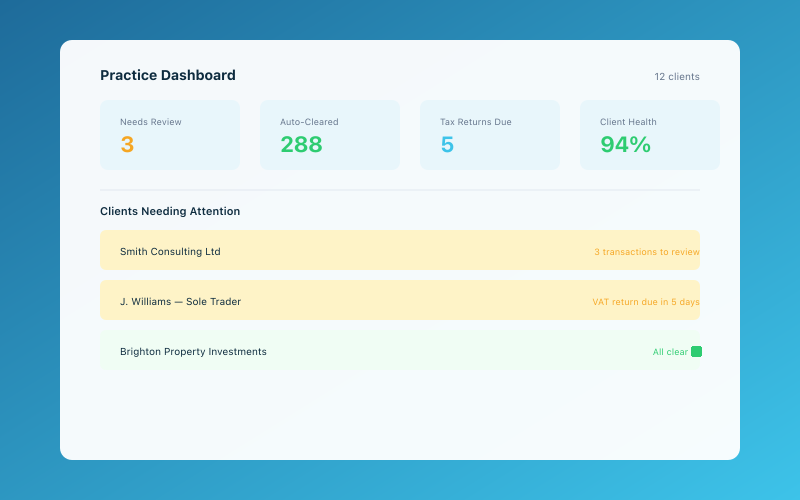 The Accounted practice dashboard — manage all your clients in one place
Think about it. Your existing clients already trust you. They already pay you. They already share their financial information with you. They don't need convincing that you're competent — they experience it every time you file their return or answer their question. All you need to do is help them see how other services you offer could benefit them.
Research consistently shows that selling to existing clients costs 5-7 times less than acquiring new ones, and existing clients are 60-70% more likely to buy from you compared to 5-20% for new prospects. Yet most accountancy practices barely scratch the surface of what their existing clients could buy.
Identifying Cross-Selling Opportunities During Existing Work
The best cross-selling feels natural because it is natural — it emerges from work you're already doing. Here's how to spot opportunities as they arise.
During Self-Assessment Preparation
When you're preparing a client's self-assessment, you're looking at their entire financial picture. This is a goldmine for identifying additional needs:
- High tax liability — suggests the client could benefit from tax planning services. "I notice you're paying quite a lot in tax this year. There might be some planning opportunities we could look at for next year."
- Messy records — if the client's records are disorganised, they likely need bookkeeping support. "It took us a while to pull your figures together this year. Would it help if we handled your bookkeeping quarterly so next year is smoother?"
- No pension contributions — an opportunity to discuss pension planning. "I notice you're not making any pension contributions. Given you're paying higher rate tax, you could save significantly."
- Approaching VAT threshold — the client may need VAT registration and returns. "Your turnover is getting close to the £90,000 VAT threshold. We should probably discuss your options."
During Quarterly MTD Submissions
The shift to quarterly submissions under MTD creates four natural touchpoints per year with each client, up from just one or two. Each touchpoint is an opportunity to review their numbers and suggest improvements.
"Looking at your Q2 figures, your profit margin has dropped compared to last year. Would it be helpful if we put together some monthly management accounts so you can spot these trends earlier?"
During Casual Conversations
Often the best cross-selling opportunities come from informal conversations. A client mentions they're thinking about taking on an employee, or they've started renting out a room, or they're considering buying a van. Each of these has financial implications that you can help with.
Train yourself (and your team) to listen for trigger phrases:
- "I'm thinking about hiring someone" → payroll services
- "I'm not sure how much I can pay myself" → management accounts / cash flow forecasting
- "My business partner and I are thinking of splitting" → restructuring advice
- "I've just inherited some money" → tax planning
- "I'm getting close to retirement" → pension and succession planning
Services You Can Cross-Sell
Tax Planning
Many sole traders and small business owners don't realise that tax planning is different from tax compliance. Compliance is filing the return. Planning is structuring affairs to legally minimise tax — and it's where you add serious value.
What to offer:
- Annual tax planning reviews (November/December is ideal timing)
- Incorporation analysis — should the client move from sole trader to limited company?
- Pension contribution optimisation — particularly valuable for higher-rate taxpayers
- Capital allowances review — are they claiming everything they're entitled to?
- Spouse/partner tax planning — marriage allowance, splitting income, joint ownership
How to position it: "We handle your tax return every year, but we don't currently do any proactive tax planning for you. For a lot of our clients in a similar position, a tax planning session saves them significantly more than it costs. Would you like me to put together some options?"
Management Accounts
Monthly or quarterly management accounts are one of the most valuable services you can offer, yet many practices only offer them to larger clients. With modern software doing much of the heavy lifting, management accounts are viable for smaller clients too.
What to include:
- Profit and loss statement with commentary
- Cash flow summary and forecast
- Comparison to budget and prior period
- Key performance indicators
- Brief narrative on trends and recommendations
How to position it: "You mentioned you're not sure where your money goes each month. If we put together monthly management accounts for you, you'd have a clear picture by the 15th of every month. Most clients find it really eye-opening."
Advisory Services
This is the premium end of your service offering. Advisory services encompass anything where you're using your expertise to help clients make better decisions.
Examples:
- Business valuations
- Succession planning
- Financing advice (how to fund growth, what type of borrowing makes sense)
- Profitability analysis (which services or products make money, which don't)
- Pricing reviews (are they charging enough?)
- Business structure reviews
Payroll
If you have clients who employ staff, payroll is a natural add-on. Many sole traders start with one employee — perhaps a part-time assistant — and don't realise their accountant can handle payroll for them.
How to position it: "Now that you're taking on an employee, you'll need to run payroll, deal with auto-enrolment pensions, and submit RTI to HMRC. We can handle all of that for you so you don't have to worry about it."
Bookkeeping Packages
Many practices shy away from bookkeeping because it's perceived as low-value work. But with AI tools handling most of the manual processing, bookkeeping can be offered efficiently and profitably.
Recommending a tool like Accounted to clients who do their own bookkeeping is a practical option. Penny handles the day-to-day categorisation and reconciliation, which means the records you receive at year-end are cleaner and more complete. Your job becomes easier, and the client gets real-time visibility of their finances.
For clients who want a fully managed service, you can offer bookkeeping packages that include:
- Bank reconciliation
- Expense categorisation and receipt management
- Invoice processing
- Monthly/quarterly financial summaries
- MTD quarterly submissions
Timing the Conversation
Cross-selling done badly feels pushy. Cross-selling done well feels helpful. The difference is almost entirely about timing.
Good Times to Cross-Sell
- After delivering good news — "Your tax bill is lower than last year. One reason is the pension contribution we discussed — if you'd like to explore more planning opportunities, I'd be happy to set up a meeting."
- When the client raises a problem — "You mentioned cash flow is tight. Management accounts would help us spot these issues earlier and plan around them."
- During a scheduled review — annual reviews or MTD quarterly meetings are natural moments to discuss additional services.
- After completing work well — satisfaction with your existing service makes clients receptive to hearing about other things you can help with.
Bad Times to Cross-Sell
- When the client is stressed about a tax bill — they don't want to hear about spending more money right now
- When they're unhappy about something — fix the problem first, then the relationship, then consider additional services later
- Via a mass marketing email — generic "did you know we offer payroll?" emails to your entire client list feel impersonal. Personalised suggestions based on what you know about the individual client are far more effective.
Value-Based Pricing for Additional Services
When you're adding services to an existing client relationship, value-based pricing is particularly effective because you already understand their situation.
Pricing Principles
Anchor to the outcome, not the time. A tax planning session that saves a client £5,000 in tax is worth far more than the 2 hours it took you. Price accordingly.
Bundle where possible. "For £150/month, you get quarterly bookkeeping, MTD submissions, and a year-end tax planning review" is more compelling than pricing each element separately.
Offer an introductory period. "Try management accounts for three months at £200/month. If you don't find them valuable, no obligation to continue." This reduces the client's perceived risk.
Show the maths. "Tax planning typically saves our clients 3-5 times the fee in reduced tax liability" is a powerful statement that makes the price feel like a bargain.
Client Satisfaction and Retention Benefits
Cross-selling isn't just about revenue — it deepens client relationships in ways that improve retention.
The Stickiness Factor
A client who only uses you for self-assessment filing is relatively easy to lose. They might switch to a cheaper practice, try doing it themselves, or just drift away. But a client who uses you for bookkeeping, self-assessment, tax planning, and payroll? They're not going anywhere. The switching cost is too high and the relationship is too valuable.
The Knowledge Effect
The more services you provide, the more you know about the client's business. This knowledge makes your advice better, which makes the client more satisfied, which makes them more likely to buy additional services. It's a virtuous cycle.
Referral Quality
Clients who use multiple services are more engaged with your practice and more likely to recommend you. And when they do recommend you, they say things like "My accountant handles everything for me — they're brilliant" rather than "I've got someone who does my tax return." The former generates far better referrals.
How to Implement Cross-Selling in Your Practice
Create a Service Menu
Make sure your team knows exactly what services you offer and who they're appropriate for. A simple one-page internal document listing each service, its target client, key triggers, and pricing is incredibly useful.
Add It to Your Processes
Build cross-selling prompts into your existing workflows. For example, at the end of every self-assessment preparation, the preparer completes a quick checklist:
- [ ] Could this client benefit from tax planning?
- [ ] Are their records messy enough to suggest bookkeeping services?
- [ ] Are they approaching any thresholds (VAT, pension tapering, etc.)?
- [ ] Have they mentioned any life or business changes?
Train Your Team
Not everyone is comfortable with selling. Training should focus on helping team members understand that cross-selling is about helping clients, not pressuring them. When you suggest tax planning to a client who's paying more tax than they need to, you're genuinely helping them. Frame it that way.
Track and Measure
Monitor how many existing clients use one, two, three, or more services. Set targets for increasing average services per client. Track which team members are most effective at identifying opportunities and learn from them.
Start Small
You don't need to transform your practice overnight. Start by identifying your top 20 clients and reviewing what services they currently use versus what they could benefit from. Have a conversation with each over the next month.
If even a third take up one additional service, the impact on your revenue and client relationships will be meaningful. Your existing clients chose you for a reason. All cross-selling does is help them benefit from more of your expertise — and that's a win for everyone.
Related Reading
Learn about our free accountant portal and how it saves your practice time.
Accounted gives accountants a free practice portal — manage all your clients, file to HMRC, and let Penny handle the routine work. See the accountant portal →
Editorial & Research
The Accounted editorial team covers software comparisons, technology, and the tools UK sole traders need to run their businesses efficiently. All software comparisons are based on independent research and publicly available pricing.
Ready to try Accounted?
Join UK sole traders who are simplifying their bookkeeping and tax.
Start your 14-day free trial