How to Deal With Non-Paying Clients — A Step-by-Step Guide
There's nothing quite like the sinking feeling when a client simply stops responding to your invoices. You've done the work, delivered what was agreed, and now you're left chasing money that should already be in your account. It's frustrating, stressful, and — if it happens often enough — genuinely threatening to your business.
The reality is that most sole traders will deal with a non-paying client at some point. What matters is how you handle it. There's a clear, logical process you can follow that protects your rights, keeps things professional, and maximises your chances of actually getting paid. Let's walk through it step by step.
Step 1: Double-Check Your End First
Before you assume the worst about your client, take a moment to make sure everything is in order on your side. It sounds obvious, but you'd be surprised how often payment issues stem from simple mistakes.
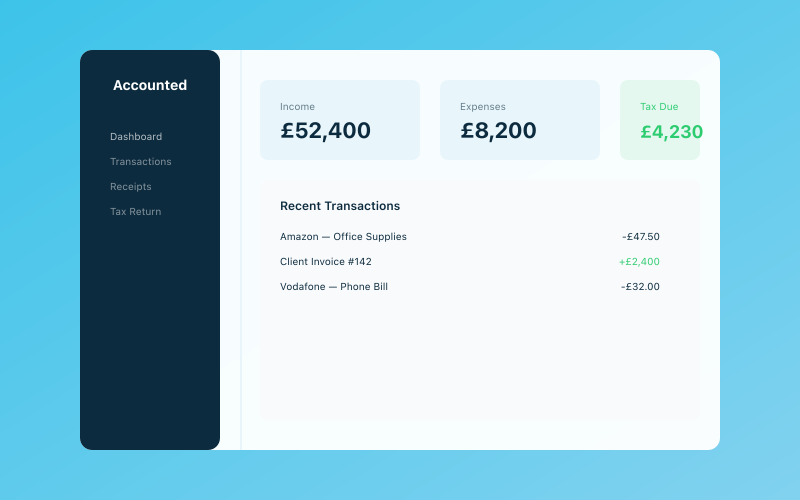 Your Accounted dashboard — income, expenses, and tax at a glance
Check that the invoice was actually sent. Look in your sent folder or your accounting software to confirm it was delivered. If you're using Accounted, you can see whether an invoice was sent and when, which removes any guesswork.
Next, verify the details. Is the amount correct? Did you send it to the right person or email address? Are your bank details on the invoice? A missing sort code or account number is one of the most common reasons payments stall. Have a look at our guide on how to invoice correctly in the UK to make sure your invoices cover all the bases.
Also check your payment terms. If your invoice says "Net 30" and it's only been 20 days, the payment isn't actually late yet. It's worth knowing exactly when the clock started and when it runs out before you start chasing.
Step 2: Send a Friendly Reminder
If the invoice is genuinely overdue, your first move should be a polite, friendly reminder. People forget things. Invoices get buried in inboxes. Accounts teams have backlogs. More often than not, a gentle nudge is all it takes.
Send a brief email reminding the client of the outstanding invoice. Include the invoice number, the amount, the date it was issued, and the original due date. Keep the tone light — something like "Just a quick reminder that invoice #1234 for £1,500 is now overdue. Could you let me know when I can expect payment?"
Don't assume malice at this stage. A friendly approach preserves the relationship and gives the client an easy way to resolve it without embarrassment. If you're not sure what to say, we've put together a collection of chasing invoices email templates that you can adapt.
Step 3: Follow Up More Firmly
If your friendly reminder goes unanswered after a week or so, it's time to step things up. Send a firmer follow-up that makes the situation clear without being aggressive.
In this message, restate the amount owed and how far overdue it is. Reference your original payment terms. You might also mention that you'll need to consider further action if the matter isn't resolved promptly. This isn't a threat — it's a statement of fact. You have a right to be paid for work you've completed.
At this stage, try calling as well as emailing. A phone call is harder to ignore than an email, and it often reveals what's actually going on. Maybe the client is having cash flow problems of their own. Maybe there's a dispute about the work that they haven't raised with you. Either way, a conversation can often uncover the real issue and lead to a resolution.
If the client acknowledges the debt but says they can't pay right now, consider agreeing a payment plan. Getting £500 a month for three months is better than getting nothing while you fight about £1,500.
Step 4: Send a Formal Letter Before Action
If reminders and phone calls haven't worked, it's time for a formal "Letter Before Action" (sometimes called a "Letter Before Claim"). This is a serious step that signals you're prepared to take legal action.
The letter should include:
- A clear statement of how much is owed
- A reference to the original invoice(s) and payment terms
- A summary of your attempts to resolve the matter
- A deadline for payment (usually 14 days, though 7 is sometimes used)
- A statement that you'll commence legal proceedings if payment isn't received by the deadline
- A mention of your right to claim statutory interest and compensation for debt recovery costs under the Late Payment of Commercial Debts (Interest) Act 1998
Send this letter by recorded delivery or a tracked postal service so you have proof it was received. You should also send a copy by email for good measure.
This letter serves two purposes. First, it often prompts payment because the client realises you're serious. Second, if you do end up going to court, having sent a formal letter before action is expected by the courts and demonstrates that you tried to resolve things amicably first.
Step 5: Consider Mediation
Before jumping straight to court, it's worth considering mediation. This is where an independent third party helps you and the client reach an agreement. It's quicker, cheaper, and less adversarial than going to court.
Several organisations offer mediation services in the UK, including the Centre for Effective Dispute Resolution (CEDR) and various local mediation services. Costs vary, but they're typically a fraction of what court proceedings would cost.
Mediation works best when there's a genuine dispute — perhaps the client isn't happy with some aspect of the work, or there's a disagreement about what was agreed. It's less useful when the client simply refuses to engage at all, in which case you may need to go straight to the next step.
Courts also look favourably on parties who've attempted mediation before resorting to legal action. So even if mediation doesn't resolve things, having tried it strengthens your position.
Step 6: Take Legal Action Through the Small Claims Court
If all else fails, you can take legal action through the county court. For debts up to £10,000, this goes through the small claims track, which is designed to be accessible without needing a solicitor.
You can start a claim online through the Money Claim Online (MCOL) service. There's a court fee, which varies depending on the amount you're claiming — for example, claiming £1,500 would cost around £115 in court fees at the time of writing. These fees can be added to your claim.
Here's how the process typically works:
- You submit your claim online with details of the debt and your evidence.
- The court sends the claim to the defendant (your client).
- The client has 14 days to respond. They can pay, admit the debt and propose payment terms, or defend the claim.
- If they don't respond at all, you can request a default judgment — meaning the court rules in your favour automatically.
- If they defend the claim, a hearing will be scheduled. For small claims, these are usually informal and held in a private room rather than a courtroom.
Most non-paying client situations never actually reach a hearing. The act of receiving a court claim is often enough to prompt payment. But it's reassuring to know that the system exists and is designed to be used by individuals without legal training.
Protecting Yourself in the Future
Dealing with a non-paying client is draining. The best strategy is to reduce the chances of it happening again. Here are some practical steps:
Get a written agreement before starting work. Even a simple email confirming the scope, price, and payment terms creates a record you can rely on if things go wrong.
Take deposits for larger projects. Asking for 25-50% upfront is standard practice and entirely reasonable. It shows the client is committed and reduces your risk.
Invoice promptly. The longer you wait to invoice, the longer you wait to get paid. Send your invoice as soon as the work is complete — or at agreed milestones for ongoing projects. Penny in Accounted can remind you about uninvoiced work, so nothing slips through the cracks.
Set clear payment terms. Make sure your terms are on every invoice and in your contracts. Our guide on handling late-paying clients has more practical advice on this.
Use accounting software to track outstanding invoices. Knowing exactly who owes you what, and how overdue each payment is, means you can chase early rather than discovering problems weeks later.
Trust your instincts. If a client is evasive about payment terms during the quoting stage, that's a warning sign. It's better to walk away from a project than to complete it and never get paid.
Related reading:
- How to Invoice Correctly in the UK
- Chasing Invoices — Email Templates That Actually Work
- How to Handle Late-Paying Clients
Accounted helps UK sole traders stay on top of their bookkeeping and tax. Start your free 30-day trial at getaccounted.co.uk.
Related Reading
- DIY Bookkeeping vs Hiring a Bookkeeper — The Real Costs
- When to Hire Help — Signs Your Business Is Ready to Grow
Start your free trial and see how Accounted simplifies your bookkeeping.
Accounted keeps your books sorted automatically so you can focus on running your business. See Accounted →
Business & Operations Advisors
Our business advisors cover the practical side of running a UK sole trader business — from HMRC registration to managing growth. Content is written for real business owners in plain English, not accountants.
Ready to try Accounted?
Join UK sole traders who are simplifying their bookkeeping and tax.
Start your 14-day free trial