When to Hire Help — Signs Your Business Is Ready to Grow
There comes a point in many sole traders' journeys where the workload outgrows the hours in the day. You're turning down projects, missing deadlines, working evenings and weekends, and starting to wonder whether this is sustainable. If any of that sounds familiar, it might be time to think about bringing someone else on board.
Hiring help is one of the biggest decisions you'll make as a business owner. It's exciting — it means your business is growing — but it also comes with costs, responsibilities, and risks. Get the timing right and you can scale your income, improve your work-life balance, and take your business to the next level. Get it wrong and you can end up with expenses you can't cover and stress you didn't need.
In this guide, we'll help you recognise the signs that you're ready to hire, explore your options, and think through the financial realities of bringing on help.
Signs You're Ready to Hire
Not every busy period means you need to hire. Sometimes you're just having a good month, and the workload will settle down. But there are some consistent signals that suggest your business has genuinely outgrown a one-person operation:
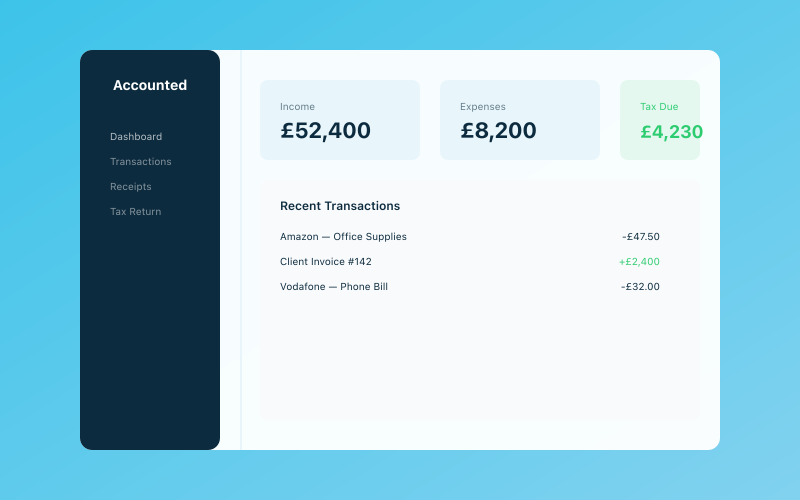 Your Accounted dashboard — income, expenses, and tax at a glance
You're consistently turning down work. If you're regularly saying no to projects — not because they're a bad fit, but because you physically can't take on any more — you're leaving money on the table. And those missed opportunities may not come back.
Your quality is slipping. When you're stretched too thin, the quality of your work suffers. If you've noticed more mistakes, missed details, or client complaints, it may be because you're trying to do too much. Hiring help can free you up to focus on the work that matters most.
You're spending too much time on low-value tasks. If you're spending hours on admin, bookkeeping, social media, or other tasks that don't directly generate income, that's time you could be spending on billable work. Delegating these tasks to someone else — even for just a few hours a week — can free up significant capacity.
Your health and wellbeing are suffering. Working 60-hour weeks isn't a badge of honour. If you're exhausted, stressed, or missing time with family and friends, something needs to change. Hiring help isn't just a business decision — it's a personal one.
You've got more demand than you can meet. Sustained, predictable demand is the strongest signal. If your pipeline has been consistently full for three months or more, and there's no sign of it slowing down, you've probably got the foundation to support someone else.
You've identified tasks someone else could do. Not all of your work requires your specific skills. If there are tasks that a competent person with some training could handle — admin, scheduling, basic client communication, data entry — those are prime candidates for delegation.
What Are Your Options?
Hiring doesn't have to mean taking on a full-time employee from day one. There's a spectrum of options, each with different levels of commitment, cost, and complexity:
Freelancers and subcontractors. This is often the easiest and lowest-risk way to bring on help. You hire someone for specific tasks or projects, they invoice you for their work, and there are no employment obligations. It's flexible, scalable, and you can test the arrangement before making a bigger commitment.
The key is to get the relationship right from a legal perspective. If HMRC decides that your "subcontractor" is actually an employee in disguise, you could face back-taxes and penalties. The distinction comes down to control — if you dictate when, where, and how they work, they may be considered an employee regardless of what you call them.
Part-time employees. If you need someone consistently but not full-time, a part-time employee can be a great middle ground. You might hire someone for two or three days a week, or for a set number of hours each month. This gives you reliable support without the full cost of a salaried position.
Virtual assistants. VAs are particularly popular with sole traders who need help with admin, scheduling, email management, or social media. Many VAs work remotely and charge by the hour, so you only pay for what you use. It's a low-commitment way to reclaim significant chunks of your time.
Full-time employees. This is the biggest commitment, but also the most impactful if you've got the work to support it. A full-time employee gives you a dedicated team member who understands your business, builds relationships with your clients, and can take real ownership of their responsibilities.
Apprentices. If you're willing to invest time in training someone, an apprentice can be a cost-effective option. The government offers financial incentives for taking on apprentices, and you're helping someone develop skills in your industry.
The Financial Reality
Before you hire anyone, you need to know whether you can afford it. This means looking at your finances honestly and forecasting carefully.
For freelancers and subcontractors, the maths is relatively simple. You pay them per project or per hour, and you should be earning more from the work they help you deliver than you're paying them. If you subcontract work at £25 per hour and charge your client £50 per hour, you're still making a profit — plus you've freed up time to take on additional work.
For employees, the costs are more complex. Beyond salary, you need to budget for:
- Employer's National Insurance — currently 13.8% on earnings above the secondary threshold
- Workplace pension contributions — minimum 3% of qualifying earnings under auto-enrolment
- Equipment and software — they'll need tools to do their job
- Insurance — employers' liability insurance is a legal requirement if you have employees
- Training — especially in the early weeks and months
- Payroll admin — processing pay, filing returns with HMRC, managing holiday entitlement
As a rough guide, the total cost of an employee is typically 1.2 to 1.4 times their salary. So a £25,000-a-year employee might cost you £30,000-35,000 in total.
Before committing to this, review your income over the past six to twelve months. Is it stable enough to cover these additional costs? Do you have a financial buffer for quieter periods? Your cash flow forecast is your best friend here — if you haven't got one, our guide on cash flow management for sole traders can help you build one.
Accounted makes it easy to review your income trends and see whether your business can realistically support the cost of hiring. Having clear, accurate financial records means you're making decisions based on data, not guesswork.
Getting the Legal Bits Right
If you're taking on an employee (as opposed to a freelancer), there are legal responsibilities you need to be aware of:
Employment contracts. Every employee must receive a written statement of employment terms on or before their first day. This should cover pay, working hours, holiday entitlement, notice periods, and job description.
Payroll. You'll need to set up a PAYE (Pay As You Earn) scheme with HMRC to handle Income Tax and National Insurance deductions. You can run payroll yourself using software, or outsource it to an accountant or payroll provider.
Workplace pension. Under auto-enrolment rules, you must enrol eligible employees into a workplace pension scheme and make minimum contributions. This applies even if you only have one employee.
Employers' liability insurance. This is a legal requirement if you employ anyone (with very few exceptions). It covers you if an employee is injured or becomes ill because of their work. You need a minimum of £5 million of cover.
Employment rights. From day one, employees have certain rights, including protection from unfair dismissal in some circumstances, the right to a safe working environment, and protection from discrimination. The rules around dismissal, redundancy, and disciplinary procedures can be complex, so it's worth familiarising yourself with the basics or getting professional advice. For a deeper look at insurance, see our sole trader insurance guide.
Right to work checks. You must verify that every employee has the legal right to work in the UK before they start.
Starting Small and Scaling Up
You don't have to go from zero to full-time employee overnight. In fact, it's usually better to start small and scale up as you prove the model works. Here's a sensible approach:
-
Identify the tasks to delegate. Make a list of everything you do in a typical week and categorise each task as something only you can do, something someone else could do with training, or something someone else could do right away. Focus on the last category first.
-
Start with a freelancer or VA. Bring someone on for a few hours a week to handle the tasks you've identified. See how it goes. Does it actually free up your time? Are you earning more as a result?
-
Increase hours gradually. If it's working, increase their hours or bring on a second person. Build up the support around you incrementally, rather than making one big leap.
-
Consider an employee when the need is consistent. Once you've got a predictable, ongoing need for support — and the finances to back it up — that's the time to think about a formal employment arrangement.
-
Reinvest the time wisely. The whole point of hiring help is to create capacity. Use that capacity to do higher-value work, win new clients, develop new services, or simply reclaim your evenings and weekends.
Delegation Is a Skill
If you've been running your business single-handedly, delegation can feel uncomfortable. You're used to doing everything yourself, and letting go of control is hard. But it's a skill you need to develop if you want your business to grow beyond what one person can do.
Start by being clear about what you want — write down processes, create templates, and set expectations. Give your new hire room to learn and make mistakes. Check in regularly, provide feedback, and resist the urge to micromanage.
Over time, you'll build trust and systems that allow you to step back from the day-to-day details and focus on the bigger picture. And that's where real business growth happens.
Penny, the AI bookkeeping assistant in Accounted, is a good example of delegation in action. By letting Penny handle your transaction categorisation and bookkeeping, you free up time for higher-value work without adding to your headcount. It's not the same as hiring a person, but it's a smart first step in learning to let go of tasks you don't need to do yourself.
The Emotional Side of Hiring
Let's be honest — hiring is also an emotional decision. It means admitting you can't do everything yourself, which can feel like a failure (it isn't — it's a sign of success). It means trusting someone else with your business and your clients. And it means taking on responsibility for someone else's livelihood, which is not something to take lightly.
All of these feelings are normal. Acknowledge them, plan carefully, and take the leap when the numbers and the signs tell you it's time. Your future self — the one who's working reasonable hours and earning more than ever — will thank you.
Related Reading
Start your free trial and see how Accounted simplifies your bookkeeping.
Accounted helps UK sole traders stay on top of their bookkeeping and tax. Start your free 30-day trial at getaccounted.co.uk
Accounted keeps your books sorted automatically so you can focus on running your business. See Accounted →
Business & Operations Advisors
Our business advisors cover the practical side of running a UK sole trader business — from HMRC registration to managing growth. Content is written for real business owners in plain English, not accountants.
Ready to try Accounted?
Join UK sole traders who are simplifying their bookkeeping and tax.
Start your 14-day free trial