Bootstrapping vs Funding — Why Most Sole Traders Don't Need Investors
The Myth That Every Business Needs Funding
There is a persistent idea floating around that starting a business requires a big pile of money and a persuasive pitch deck. Television programmes like Dragons' Den have done a brilliant job of making us think that securing investment is a rite of passage for any serious entrepreneur. But here is the truth: most sole traders not only don't need investors — they are better off without them.
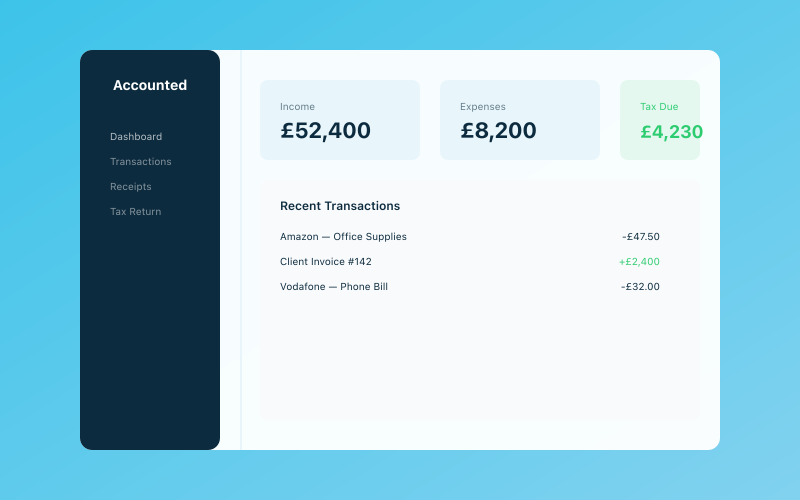 Your Accounted dashboard — income, expenses, and tax at a glance
If you are running a service-based business, freelancing, or setting up a trade, the bootstrapping route is often faster, less stressful, and far more rewarding in the long run. Let us walk through why that is, and explore the rare situations where funding genuinely makes sense.
What Does Bootstrapping Actually Mean?
Bootstrapping simply means starting and growing your business using your own resources — personal savings, revenue from early clients, and a healthy dose of creativity. There is no external investment, no loans to repay, and no one else calling the shots.
For sole traders, this is the natural starting point. You are the business. Your skills, your time, and your existing network are your most valuable assets, and none of them require a bank loan.
The Real Cost of Starting as a Sole Trader
Let us talk numbers. Here is what it actually costs to set up as a sole trader in the UK:
- HMRC registration: Free
- Business bank account: Free to £15/month
- Basic website: £0 to £200/year
- Professional insurance: £50 to £300/year depending on your trade
- Accounting software: From £0 with tools like Accounted
- Marketing: Your time (social media, networking, word of mouth)
For many sole traders, total startup costs come in under £500. Compare that with the average equity investment on Dragons' Den and you will see why bootstrapping makes so much more sense at this stage.
Why Bootstrapping Works So Well for Sole Traders
You Keep Complete Control
When you take on investors or partners, you give away a slice of your business — and often a slice of your decision-making power too. As a sole trader, every penny of profit is yours. Every decision about direction, pricing, and growth is yours. That autonomy is genuinely one of the biggest perks of self-employment.
You Learn Financial Discipline Early
Bootstrapping forces you to be resourceful. You learn to distinguish between expenses that genuinely grow your business and ones that just feel productive. That financial discipline stays with you as your business scales and becomes incredibly valuable. If you are tracking your expenses properly — which Penny, our AI bookkeeper, can help with — you will quickly spot where your money is actually going.
You Avoid Debt Pressure
Taking on a loan when your business is brand new means making repayments before you have a reliable income. That pressure can push you into taking on the wrong clients, undercharging, or making short-term decisions that hurt your long-term prospects. Bootstrapped businesses can afford to be patient and strategic.
Growth Matches Demand
When you grow organically, your business expands in response to real demand. You add services because clients ask for them. You invest in equipment because you need it. There is no artificial pressure to "scale fast" to justify someone else's investment.
Low-Cost Strategies to Get Started
If you are starting from scratch, here are some practical ways to keep your costs down:
- Start from home — You can claim a portion of your home expenses against your tax bill, including broadband, heating, and council tax
- Use free tools first — Free tiers of accounting, design, and project management software are perfectly adequate when you are starting out
- Barter and trade — Exchange services with other small business owners (just remember to account for the fair value in your records)
- Reinvest revenue — Channel your first earnings back into the business rather than taking large drawings
- Build in public — Share your journey on social media to build an audience without spending on advertising
When Funding Actually Makes Sense
Let us be fair — there are situations where external funding is the right call. But they are rarer than you might think for sole traders.
You Need Expensive Equipment or Stock
If your trade requires specialist equipment, vehicles, or significant upfront stock, you may need financial help to get going. A mobile catering business, for instance, needs a van and commercial kitchen equipment before serving a single customer.
You Have a Proven Model That Needs Scale
If you have been trading for a while, have consistent demand, and need capital to scale — perhaps to bring on contractors or move into premises — then funding can accelerate growth that is already happening.
There Is a Time-Sensitive Opportunity
Sometimes a contract or opportunity requires you to invest quickly. A short-term loan to fulfil a large order can make sense if the return is clear and predictable.
Types of Funding Available to Sole Traders
If you do decide that funding is appropriate, here are your main options:
Start Up Loans
The government-backed Start Up Loans scheme offers unsecured personal loans of £500 to £25,000 at a fixed interest rate of 6% per annum. You also get free mentoring, which can be genuinely useful. These are available to businesses that have been trading for under three years.
Grants
Grants are free money — you do not have to repay them. Local councils, Innovate UK, and various industry bodies offer grants for specific purposes. They are competitive and often come with conditions, but they are worth investigating. Check your local authority's business support pages regularly.
Business Credit Cards
A business credit card can smooth out cash flow bumps, but be disciplined. Interest rates are typically 20% to 30%, so always aim to clear the balance monthly.
Personal Savings
The most common source of startup funding for sole traders is simply personal savings. There is no interest, no application process, and no one to answer to. Just be honest with yourself about how much you can afford to risk.
Crowdfunding
Platforms like Crowdfunder and Kickstarter let you raise money from supporters and future customers. This works best for product-based businesses with a compelling story.
Debt vs Equity — Understanding the Difference
If you are considering funding, it is worth understanding the two basic types:
Debt funding (loans, credit) means you borrow money and repay it with interest. You keep full ownership of your business, but you have a fixed obligation regardless of how well things go.
Equity funding (investors, partners) means someone gives you money in exchange for a share of your business. There is nothing to repay directly, but you permanently give up a portion of your profits and control.
For sole traders, equity funding is unusual and structurally awkward — you would typically need to form a partnership or convert to a limited company to offer equity properly. This is another reason bootstrapping tends to be the natural fit.
Bootstrapped UK Businesses That Made It
You do not need to look far to find successful UK businesses that started with almost nothing:
- Gymshark began with a sewing machine and a screen printer in a Birmingham garage
- Innocent Drinks started with £500 worth of fruit at a music festival
- Lush was founded in a small Poole shop with handmade products
These are larger-scale examples, but the principle applies at every level. Thousands of sole traders across the UK build profitable, sustainable businesses every year without a penny of external investment.
Tax Implications of Funding
However you fund your business, there are tax considerations to keep in mind:
- Loan interest on business borrowing is generally an allowable expense and can be deducted from your profits
- Grants may or may not be taxable depending on their purpose — capital grants are treated differently from revenue grants
- Start Up Loan repayments are not tax-deductible (only the interest portion is)
- Personal investment into your business is not a taxable event, but keep clear records of what you put in
With the personal allowance at £12,570 and the basic rate at 20% for income between £12,571 and £50,270, keeping your taxable profits low in the early years is perfectly natural when you are bootstrapping — and that is actually a tax-efficient position to be in.
Making the Decision
Ask yourself these questions before seeking funding:
- Can I start smaller and grow into the business I want?
- Is the funding for something that will directly generate revenue?
- Have I explored all the free and low-cost alternatives?
- Can I afford the repayments if things go slower than planned?
- Am I seeking funding because I genuinely need it, or because I think that is what "serious" businesses do?
If you answered "no" to questions 1 and 3, and "yes" to the rest, funding might be worth exploring. Otherwise, bootstrapping is almost certainly your better bet.
Getting Your Finances Right From Day One
Whether you bootstrap or seek funding, having a clear picture of your finances from the start is non-negotiable. Accounted makes this straightforward — Penny can categorise your transactions, track your expenses, and help you understand exactly where your money is going, so you can make confident decisions about growth without needing a spreadsheet degree.
The best investment most sole traders can make is not in equipment or stock — it is in understanding their own numbers.
Related reading
- Tax Deductions Every Sole Trader Should Know About
- Scaling Without Employees — How to Grow Using Contractors
- Starting a Limited Company vs Sole Trader
Related Reading
- Annual Accounts for Small Companies — What's Required
- Pivoting Your Business — When and How to Change Direction
Start your free trial and see how Accounted simplifies your bookkeeping.
Accounted keeps your books sorted automatically so you can focus on running your business. See Accounted →
Business & Operations Advisors
Our business advisors cover the practical side of running a UK sole trader business — from HMRC registration to managing growth. Content is written for real business owners in plain English, not accountants.
Ready to try Accounted?
Join UK sole traders who are simplifying their bookkeeping and tax.
Start your 14-day free trial