Pivoting Your Business — When and How to Change Direction
Why Pivoting Is Not Failing
Let us get one thing straight — changing the direction of your business is not admitting defeat. It is one of the smartest things you can do. The UK economy shifts constantly, customer needs evolve, and the sole traders who thrive are the ones who adapt rather than stubbornly sticking to a plan that is no longer working.
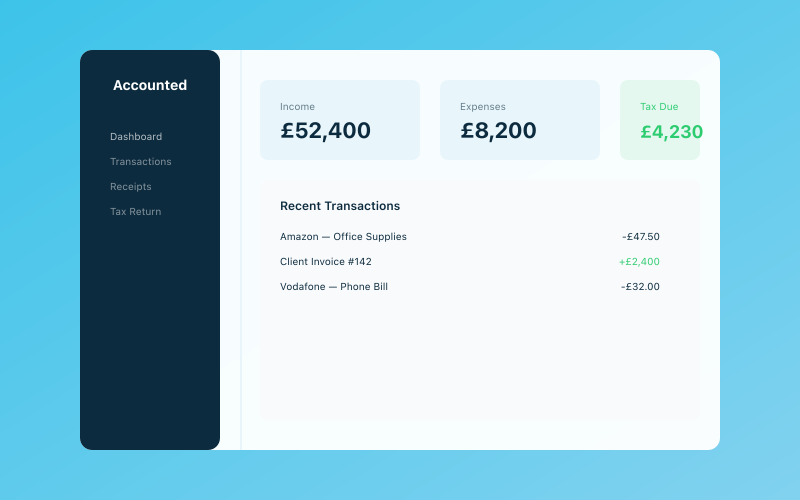 Your Accounted dashboard — income, expenses, and tax at a glance
Some of the most successful businesses in the world started as something completely different. Nokia made rubber boots. Nintendo made playing cards. Your pivot from garden maintenance to landscape design, or from in-person tutoring to online courses, is in excellent company.
Signs You Need to Pivot
Recognising the need for change is the hardest part. Here are the signals that should make you sit up and pay attention:
Your Revenue Is Declining Despite Your Best Efforts
If you are working harder than ever but your income is dropping, the problem might not be your effort — it might be your market. Declining demand for your specific service or product is a strong signal that it is time to rethink.
You Are Competing Solely on Price
When the only way to win work is by being the cheapest, you are in a race to the bottom. This usually means the market is saturated or commoditised, and there is little room for a sole trader to compete sustainably.
Your Best Customers Want Something Else
Pay attention to what your clients keep asking for. If your web design clients constantly ask about SEO, or your accounting clients want business advice, there is a pivot opportunity hiding in those conversations.
You Dread the Work
This is a practical signal, not just an emotional one. If you dread your work, you will eventually deliver a worse service, and your business will suffer. Life is too short, and self-employment is too demanding, to spend it doing something you actively dislike.
The Market Has Fundamentally Changed
Technology, regulation, or economic shifts can render a business model obsolete. The key is spotting this early rather than waiting until you have no choice.
Partial Pivot vs Full Pivot
Not every change needs to be dramatic. Understanding the spectrum of pivots available to you is important.
The Partial Pivot
A partial pivot means adjusting your offering while staying in roughly the same space. Examples include:
- A photographer shifting from weddings to commercial product photography
- A cleaner moving from residential to specialist end-of-tenancy cleaning
- A personal trainer adding online coaching alongside in-person sessions
This is the lower-risk option. You keep your existing expertise and much of your client base while shifting your focus.
The Full Pivot
A full pivot means changing your business model substantially. Perhaps you are moving from a service-based business to a product-based one, or entering an entirely different industry.
This carries more risk but can be necessary when your current market is genuinely dying. If you are considering a full pivot, building multiple income streams during the transition is a sensible strategy.
Keeping Existing Clients During the Transition
One of the biggest fears about pivoting is losing the clients you already have. Here is how to manage that:
Communicate Early and Honestly
Tell your key clients what you are doing and why. Most will appreciate the transparency. Some may even follow you into your new direction — especially if your pivot addresses a need they have been expressing.
Phase the Transition
You do not have to switch overnight. Run your existing services alongside your new direction for a period. Yes, this means more work temporarily, but it protects your cash flow during the transition.
Refer Clients You Cannot Serve
If your pivot means you can no longer serve certain clients, refer them to trusted colleagues. This preserves the relationship and generates goodwill. They may come back to you in your new capacity, or refer others your way.
Offer a Transition Period
Give existing clients notice — three to six months is reasonable for most services. Honour existing contracts and commitments before fully shifting.
Tax Implications of Changing Your Trade
This is where things get practical, and where many sole traders trip up.
Notifying HMRC of Business Changes
If you change the nature of your trade, you should update HMRC. This does not mean re-registering as self-employed — you are still a sole trader. But you should:
- Update your business description through your Government Gateway account
- Inform HMRC if your trade classification changes (the SIC code)
- Consider whether the change constitutes cessation of one trade and commencement of another
The distinction matters because ceasing one trade and starting another can trigger overlap relief and affect how your profits are calculated for the transition period.
Capital Allowances on Old Equipment
If you have equipment from your old trade that you no longer use, you may be able to claim a balancing allowance when you dispose of it. Conversely, new equipment for your pivoted business qualifies for capital allowances in the usual way — the Annual Investment Allowance lets you deduct up to £1 million of qualifying capital expenditure in the year of purchase.
Losses From the Old Business
If your old trade was making losses, you may be able to carry those losses forward or set them against other income. The rules around loss relief can be complex, so this is worth getting right. Penny, the AI bookkeeper within Accounted, can help you keep track of your profit and loss position clearly so you know where you stand.
Rebranding Costs as Expenses
The good news is that most costs associated with pivoting are legitimate business expenses:
- New website design and development — fully deductible
- Updated business cards and marketing materials — fully deductible
- Training courses to acquire new skills relevant to your new direction — deductible if they update existing skills (but not if they teach you a wholly new trade from scratch, which HMRC treats differently)
- Market research — surveys, competitor analysis tools, focus groups — all deductible
- New domain names and branding — deductible
Keep receipts and records for everything. With the move to Making Tax Digital, having clean, digital records is more important than ever.
Market Research on a Budget
Before you pivot, you need to know whether your new direction has legs. Here is how to research without spending a fortune:
Talk to Potential Customers
Nothing beats direct conversation. Reach out to people in your target market and ask about their needs, frustrations, and what they would pay for a solution. Ten honest conversations are worth more than a thousand survey responses.
Test With a Minimum Viable Offer
Before fully committing, offer your new service or product on a small scale. Take on a few clients at a reduced rate in exchange for feedback. This validates demand with minimal risk.
Use Free Online Tools
Google Trends shows you whether interest in your area is growing or declining. Answer the Public reveals what questions people are asking. Social media groups and forums show you what your target market cares about.
Study Your Competition
Look at who is already doing what you want to do. Are they busy? Are they charging well? A competitive market is actually a good sign — it means there is demand. An empty market might mean there is no demand at all.
Run the Numbers
Before you commit, model your finances. What does your new business need to earn to cover your costs? What is a realistic timeline to reach that point? Can you sustain yourself financially during the transition?
With the personal allowance at £12,570 and the basic rate of income tax at 20% on earnings between £12,571 and £50,270, understanding your projected tax position under the new model is essential. Factor in Class 2 National Insurance at £3.45 per week and Class 4 NI at 6% on profits between £12,570 and £50,270 (and 2% above that) to get a realistic picture.
Creating a Pivot Plan
A structured approach reduces the risk of a messy transition:
- Define your new direction clearly — What will you offer, to whom, and at what price?
- Set a timeline — When will you start marketing the new offering? When will you stop taking old clients?
- Identify skills gaps — What do you need to learn, and how quickly can you learn it?
- Plan your finances — How much runway do you have? What is the minimum viable income during transition?
- Update your admin — Business insurance, website, contracts, HMRC records
- Tell your network — Clients, suppliers, referral partners, social media followers
Common Pivot Mistakes to Avoid
Pivoting Without Evidence
Gut feeling is useful, but do the research. A pivot based on a hunch without market validation is just a gamble.
Pivoting Too Often
Constantly changing direction signals to clients that you do not know what you are doing. Commit to a direction for long enough to see results — typically at least six to twelve months.
Ignoring Your Existing Strengths
The best pivots build on what you already know. Your experience, reputation, and existing relationships are assets. A graphic designer pivoting to UX design is building on existing skills. A graphic designer pivoting to plumbing is starting from zero.
Underestimating the Financial Gap
Transitions take longer than you expect. Build a financial cushion of at least three to six months of living expenses before making significant changes.
Moving Forward With Confidence
Pivoting is a sign of business intelligence, not weakness. The sole traders who last are the ones who read the market, listen to their customers, and have the courage to evolve.
If you are considering a change of direction, start by getting a clear view of where you stand financially. Accounted gives you that clarity — with real-time tracking of your income, expenses, and tax position, so you can make your pivot decision from a position of knowledge rather than guesswork.
Related reading
- Building Multiple Income Streams as a Sole Trader
- Bootstrapping vs Funding — Why Most Sole Traders Don't Need Investors
- Making Tax Digital — Your Complete 2026 Guide
Related Reading
- Exit Strategies — What Happens When You Want to Stop
- Client Onboarding — How to Start New Projects Professionally
Start your free trial and see how Accounted simplifies your bookkeeping.
Accounted keeps your books sorted automatically so you can focus on running your business. See Accounted →
Business & Operations Advisors
Our business advisors cover the practical side of running a UK sole trader business — from HMRC registration to managing growth. Content is written for real business owners in plain English, not accountants.
Ready to try Accounted?
Join UK sole traders who are simplifying their bookkeeping and tax.
Start your 14-day free trial