Annual Accounts for Small Companies — What's Required
If you run a small limited company in the UK, preparing and filing annual accounts is one of those non-negotiable obligations that comes with the territory. It's not the most thrilling part of running a business, but getting it right matters — both for staying compliant and for understanding how your company is actually performing.
The good news is that small companies get a lighter touch when it comes to what they need to file publicly. In this guide, we'll walk through exactly what's required, the deadlines you need to hit, and how to make the whole process as painless as possible.
What Are Annual Accounts?
Annual accounts (sometimes called statutory accounts) are a formal set of financial statements that every limited company must prepare at the end of each financial year. They provide a snapshot of the company's financial position and performance over the accounting period.
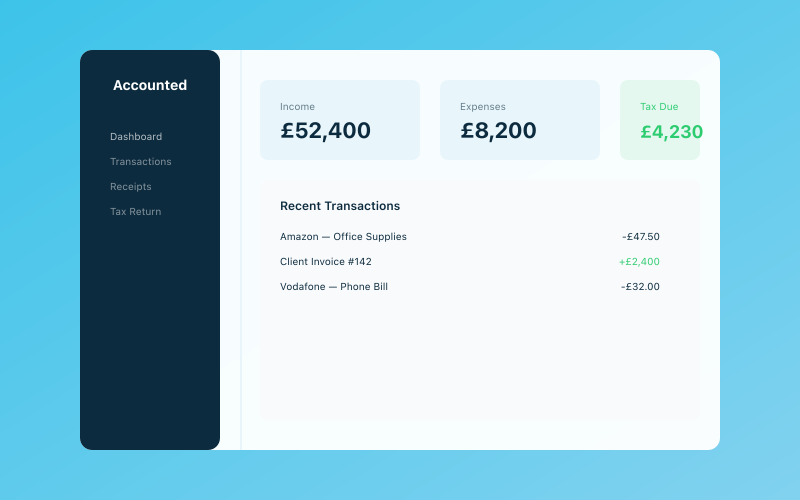 Your Accounted dashboard — income, expenses, and tax at a glance
A full set of annual accounts typically includes:
- A balance sheet (also called a statement of financial position)
- A profit and loss account (also called an income statement)
- Notes to the accounts
- A directors' report
For larger companies, you'd also need a cash flow statement and potentially an auditor's report. But small companies are exempt from several of these requirements, which we'll come to shortly.
Your company's annual accounts serve two audiences. First, they go to Companies House, where they become part of the public record — meaning anyone can look them up. Second, they go to HMRC as part of your Company Tax Return (CT600). Importantly, what you file at Companies House and what you send to HMRC can be different. More on that in a moment.
What Counts as a "Small Company"?
To qualify as a small company for filing purposes, you must meet at least two of the following three criteria in the financial year:
- Annual turnover of no more than £10.2 million
- Balance sheet total (gross assets) of no more than £5.1 million
- No more than 50 employees on average
The vast majority of UK limited companies qualify as small — we're talking about over 99% of all registered companies. If you're a contractor, freelancer, or small business owner running a limited company, you'll almost certainly qualify.
There's also a "micro-entity" category for even smaller companies. To be a micro-entity, you must meet at least two of these:
- Annual turnover of no more than £632,000
- Balance sheet total of no more than £316,000
- No more than 10 employees on average
Micro-entities get even more simplified filing requirements, which can be a real time-saver.
What Small Companies Must File at Companies House
Here's the practical bit. As a small company, you have the option to file abbreviated or "filleted" accounts at Companies House. This means you can choose to leave out the profit and loss account and the directors' report from your public filing.
What you must file:
- A balance sheet, signed by a director
- Notes to the accounts (though these can be very brief for micro-entities)
- A statement on the balance sheet confirming the accounts have been prepared in accordance with the small companies regime
What you can choose to omit from the public filing:
- The profit and loss account
- The directors' report
This is significant because it means your competitors, suppliers, and the general public won't be able to see your turnover or profit figures. Many small company directors choose to take advantage of this — and understandably so. There's no obligation to share more than the minimum.
If you're a micro-entity, you can file even simpler accounts — essentially just a very basic balance sheet with minimal notes.
What you must send to HMRC:
HMRC wants the full picture. Your Company Tax Return must include a complete set of accounts — balance sheet, profit and loss account, and notes — along with a tax computation showing how your corporation tax liability has been calculated. These accounts are not made public; they're between you and HMRC.
Key Deadlines You Need to Know
Missing your filing deadlines can result in automatic penalties, and Companies House isn't known for being lenient. Here are the dates to mark in your calendar:
Companies House filing deadline: You must file your annual accounts within 9 months of your accounting reference date (your financial year end). So if your year end is 31 March 2026, your accounts must be filed by 31 December 2026.
For your very first set of accounts, you get a bit longer — 21 months from the date of incorporation, or 9 months from the accounting reference date, whichever is longer.
HMRC filing deadline: Your Company Tax Return must be filed within 12 months of the end of the accounting period. Using the same example, that would be 31 March 2027.
Corporation tax payment deadline: Corporation tax must be paid within 9 months and 1 day of the end of the accounting period — so by 1 January 2027 in our example.
Yes, the HMRC and Companies House deadlines are different. It catches people out every year, so it's worth keeping both dates clearly recorded. Something like Accounted can help you track these important deadlines so nothing slips through the cracks.
Late Filing Penalties
Companies House imposes automatic penalties for late filing, and they're not small:
- Up to 1 month late: £150
- 1 to 3 months late: £375
- 3 to 6 months late: £750
- More than 6 months late: £1,500
These penalties double if your accounts are late for a second consecutive year. There's no appeal process based on "I forgot" or "my accountant was busy" — Companies House takes a strict approach.
HMRC has its own penalty regime for late Company Tax Returns, which can include a £100 initial penalty, a further £100 after three months, and tax-based penalties after six and twelve months.
The message is clear: file on time, every time.
Preparing Your Annual Accounts — Practical Steps
Getting your annual accounts ready doesn't have to be a last-minute scramble. Here's a practical approach:
Keep your bookkeeping up to date throughout the year. This is the single most important thing you can do. If your books are in good shape, preparing year-end accounts becomes a matter of tidying up and making adjustments rather than reconstructing an entire year's worth of transactions. If you're using Penny to categorise your transactions as you go, you'll already be in a strong position.
Reconcile your bank accounts. Make sure every transaction in your bank account is recorded and categorised in your accounting records. Any unreconciled items need to be investigated and resolved before your accounts can be finalised.
Review your debtors and creditors. At year end, you'll need to account for any money owed to you (debtors) and any money you owe to others (creditors). This is important for getting an accurate picture of your company's financial position, especially if you're using accrual accounting.
Account for depreciation and capital allowances. If your company owns assets like equipment, vehicles, or computer hardware, you'll need to calculate depreciation for the accounts and capital allowances for the tax computation.
Prepare your tax computation. This takes your accounting profit and adjusts it for items that are treated differently for tax purposes — things like entertainment expenses (not tax-deductible), capital allowances (replacing depreciation), and any other tax adjustments.
File at Companies House and HMRC. You can file your Companies House accounts online using their WebFiling service or through compatible software. Your Company Tax Return is filed through HMRC's online services.
Do You Need an Accountant?
Technically, small companies aren't required to have their accounts audited or prepared by a professional accountant. You can prepare and file everything yourself if you're confident in what you're doing.
In practice, many small company directors use an accountant — at least for the year-end accounts and tax return. The annual accounts need to comply with applicable accounting standards (usually FRS 102 Section 1A for small entities, or FRS 105 for micro-entities), and getting the tax computation right requires a decent understanding of corporation tax rules.
That said, the more organised your records are throughout the year, the less your accountant needs to do at year end — which can mean lower fees. This is one of the areas where keeping your books tidy with a tool like Accounted really pays off. You hand over clean, well-categorised records, and your accountant can focus on the specialist stuff rather than spending hours sorting through a shoebox of receipts.
If you're weighing up whether a limited company structure is right for you, our comparison of sole trader vs limited company structures might be useful.
Common Mistakes to Avoid
A few things trip up small company directors year after year:
Confusing the Companies House and HMRC deadlines. They're different. Companies House gives you 9 months; HMRC gives you 12 months. But corporation tax must be paid within 9 months and 1 day. Keep all three dates in your diary.
Filing the wrong type of accounts. Make sure you're claiming the small company (or micro-entity) exemptions you're entitled to. There's no point filing more information than you need to at Companies House.
Forgetting director's loan account balances. If you've taken money out of the company beyond your salary and dividends, there may be tax implications. This needs to be properly reflected in your accounts.
Not accounting for corporation tax owed. Your balance sheet at year end should include a provision for the corporation tax due on that year's profits, even though you haven't paid it yet.
Leaving everything to the last minute. Year-end accounts preparation is much smoother when you start early. Leaving it until the week before the deadline is a recipe for errors and stress.
Related Reading
Start your free trial and see how Accounted simplifies your bookkeeping.
Accounted helps UK sole traders stay on top of their bookkeeping and tax. Start your free 30-day trial at getaccounted.co.uk.
Accounted keeps your books sorted automatically so you can focus on running your business. See Accounted →
Business & Operations Advisors
Our business advisors cover the practical side of running a UK sole trader business — from HMRC registration to managing growth. Content is written for real business owners in plain English, not accountants.
Ready to try Accounted?
Join UK sole traders who are simplifying their bookkeeping and tax.
Start your 14-day free trial