How to Set Your Rates as a Freelancer
Pricing is one of the hardest things to get right as a freelancer. Charge too little and you'll burn out working long hours for not enough money. Charge too much — well, actually, most freelancers are far more likely to undercharge than overcharge, so let's start by acknowledging that.
If you've been agonising over what to put on your invoices, you're not alone. Setting your rates feels deeply personal, and there's often a nagging fear that asking for "too much" will scare clients away. But getting your pricing right is one of the most important things you can do for the long-term health of your business.
In this guide, we'll walk through practical methods for calculating your rates, common pricing models, and how to have confident conversations about money with your clients.
Start With Your Numbers
Before you think about what the market will bear or what your competitors charge, you need to know your own numbers. This is the foundation of any sensible pricing strategy.
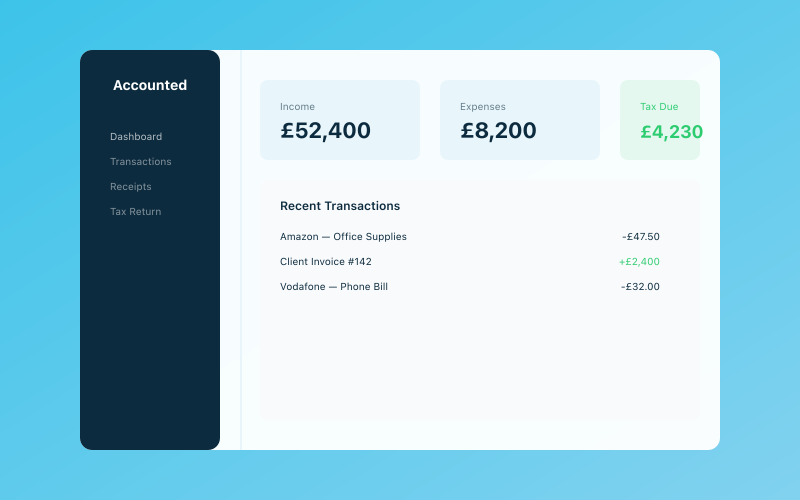 Your Accounted dashboard — income, expenses, and tax at a glance
Step 1: Work out your minimum annual income. Add up everything you need to cover in a year — rent or mortgage, bills, food, transport, insurance, savings, and anything else that's non-negotiable. This is your personal baseline.
Step 2: Add your business costs. Software subscriptions, equipment, insurance, professional development, marketing, accounting fees, phone and internet — it all adds up. For most freelancers, business costs range from £2,000 to £10,000 a year, depending on your industry.
Step 3: Factor in tax and National Insurance. As a self-employed person, you're responsible for your own Income Tax and National Insurance contributions. A rough rule of thumb is to add 25-30% on top of your pre-tax income target, though the exact amount depends on your earnings. If you're not sure how much tax you'll owe, our guide on how tax works for sole traders can help.
Step 4: Account for non-billable time. This is the bit that catches most freelancers out. You won't be billing for every hour you work. Admin, marketing, pitching for new work, bookkeeping, professional development, invoicing, and chasing payments all take time. A realistic billable ratio for most freelancers is around 60-70% of their working hours. So if you work 40 hours a week, you might only bill for 24-28 of them.
Step 5: Do the maths. Let's say you need £40,000 after tax to cover your personal and business costs. Add 30% for tax and NI, and you need to earn roughly £52,000 in gross income. If you work 48 weeks a year (allowing for holidays and sick days) and bill for 25 hours a week, that's 1,200 billable hours. £52,000 divided by 1,200 gives you an hourly rate of about £43.
That's your floor — the minimum you can charge and still make the numbers work. Ideally, you want to charge more than your floor, because it gives you a buffer for quiet months, unexpected expenses, and the occasional bad debt.
Hourly, Daily, or Project-Based?
There's no single right way to price your services. The best model depends on your industry, your clients, and the type of work you do.
Hourly rates are simple and transparent. Clients know exactly what they're paying for, and you get paid for the time you put in. The downside is that hourly rates can penalise you for being good at your job — if you get faster with experience, you earn less per project even though your work is better.
Hourly rates work well for tasks where the scope is hard to define upfront, like ongoing consulting, maintenance work, or ad-hoc support.
Day rates are essentially hourly rates multiplied by the number of hours in your working day (typically 7-8). They're common in creative industries, consulting, and IT contracting. Day rates feel more professional than hourly rates and are easier for clients to budget around.
A typical calculation: if your hourly rate is £45 and you work 7.5-hour days, your day rate would be around £335-340. In practice, most people round to neat numbers — £350 or £375, for example.
Project-based pricing means quoting a fixed fee for a defined piece of work. This is often the most profitable model, because you can charge based on the value of the outcome rather than the time it takes you. A logo design that takes you four hours but delivers enormous value to the client can justifiably command a higher fee than four hours at your hourly rate would suggest.
The risk with project pricing is scope creep — where the project gradually expands beyond what was originally agreed, eating into your profit. Clear briefs, detailed proposals, and firm boundaries are essential. If you struggle with scope creep, have a read of our guide on setting boundaries with clients.
Retainer arrangements are where a client pays a fixed monthly fee for a set amount of your time or a defined scope of work. Retainers provide predictable income, which is brilliant for cash flow, and they deepen your relationship with the client. They're particularly common in marketing, PR, and ongoing advisory work.
What Are Others Charging?
Your own numbers give you a floor, but the market gives you context. It's worth researching what other freelancers in your field and location charge, so you know where you sit.
Some ways to find out:
- Freelancer communities and forums — many have regular rate-sharing threads or surveys
- Industry salary guides — translate employed salaries into freelance equivalents by adding 30-50% (to account for the lack of benefits, holiday pay, and employer NI)
- Job boards and freelance platforms — look at what clients are offering and what other freelancers are advertising
- Ask other freelancers — many experienced freelancers are surprisingly open about what they charge, especially if you're not a direct competitor
Don't be tempted to simply undercut everyone else. Competing on price is a race to the bottom. Instead, use market rates as a benchmark and focus on differentiating yourself through quality, reliability, and specialisation.
The Psychology of Pricing
Pricing isn't just a maths problem — it's a confidence problem. Here are a few psychological traps to watch out for:
Impostor syndrome. Many freelancers, especially early in their careers, feel like they're not good enough or experienced enough to charge "proper" rates. The truth is, if clients are happy with your work, you're providing value. Price accordingly.
Anchoring too low. If you start with low rates to attract clients, it's incredibly difficult to raise them later. Clients anchor to the first price they see, and significant increases can feel like a betrayal. It's better to start at a fair rate and negotiate down occasionally than to start low and try to climb up.
Comparing to employment. When you first go freelance, it's tempting to think "I earned £15 an hour in my old job, so £20 an hour freelance is great." But freelance rates need to cover tax, NI, equipment, software, insurance, pension contributions, holidays, sick pay, and all the non-billable time you spend running your business. An equivalent hourly rate for a freelancer is typically 1.5-2x the employed equivalent.
Fear of saying the number. When a client asks "what do you charge?" many freelancers mumble, hedge, or immediately offer a discount. Practice saying your rate clearly and confidently, without apologising for it. "My day rate is £400" is all you need to say. If the client thinks it's too much, they'll tell you — and then you can decide whether to negotiate.
When and How to Raise Your Rates
Your rates shouldn't stay the same forever. As you gain experience, build your reputation, and develop specialist skills, your rates should reflect that growth.
A good time to raise your rates is:
- Annually — even a modest 5-10% increase each year keeps pace with inflation and reflects your growing expertise
- When you're fully booked — if you've got more work than you can handle, it's a clear sign your rates are too low
- When you add new skills — if you've invested in training or qualifications that make your work more valuable, adjust your pricing
- When your costs increase — rising business costs, tax changes, or increased living expenses all justify a rate review
For existing clients, give plenty of notice — at least a month, ideally more. Explain the increase briefly (you don't need to justify every penny) and focus on the value you deliver. Most reasonable clients expect rates to go up over time.
For new clients, simply quote your new rate from the start. There's no need to mention what you used to charge.
Tracking Your Income and Profitability
Setting your rates is only half the battle. You also need to track whether those rates are actually delivering the income you planned for. It's surprisingly easy to set a good hourly rate but still end up earning less than you expected, because of scope creep, unpaid overtime, or too many non-billable hours.
Use your bookkeeping software to monitor your actual income against your targets. With Accounted, you can see your income in real time, track it against previous months, and spot patterns — like whether certain types of work are more profitable than others or whether particular clients are costing you more time than they're worth.
Penny, the AI assistant in Accounted, can help you categorise your income and expenses automatically, so you've always got an accurate picture of where you stand. That data is invaluable when it comes to making pricing decisions.
A Note on Value-Based Pricing
We've mostly talked about cost-based and market-based pricing, but there's a third approach worth mentioning: value-based pricing. This is where you price based on the value your work delivers to the client, rather than the time it takes or what the market charges.
For example, if you're a copywriter and your sales page generates £50,000 in revenue for a client, charging £2,000 for that page is excellent value — even if it only took you a day to write. The client is paying for the outcome, not the hours.
Value-based pricing works best when you can clearly demonstrate the impact of your work. It requires confidence, good client relationships, and a willingness to have frank conversations about results. It's not for everyone or every situation, but as your experience grows, it's worth exploring.
Related Reading
Start your free trial and see how Accounted simplifies your bookkeeping.
Accounted helps UK sole traders stay on top of their bookkeeping and tax. Start your free 30-day trial at getaccounted.co.uk
Accounted keeps your books sorted automatically so you can focus on running your business. See Accounted →
Business & Operations Advisors
Our business advisors cover the practical side of running a UK sole trader business — from HMRC registration to managing growth. Content is written for real business owners in plain English, not accountants.
Ready to try Accounted?
Join UK sole traders who are simplifying their bookkeeping and tax.
Start your 14-day free trial