Late Payment Interest — Your Right to Charge It
Late payment is one of those problems that almost every sole trader deals with at some point. You send the invoice, you wait, the due date comes and goes, and suddenly you're subsidising someone else's cash flow out of your own pocket. What many sole traders don't realise is that UK law gives you a clear, statutory right to charge interest on late commercial payments — and to claim compensation for the cost of collecting the debt.
It's a powerful tool that most people never use, partly because they don't know about it and partly because they're worried about damaging client relationships. But understanding your rights doesn't mean you have to exercise them aggressively. Sometimes just mentioning them is enough to change the dynamic entirely.
The Law Behind Late Payment Interest
Your right to charge interest on late payments comes from the Late Payment of Commercial Debts (Interest) Act 1998, and subsequent regulations that updated and strengthened it. This legislation applies to all commercial transactions — that is, transactions between businesses, or between a business and a public authority. It doesn't apply to consumer transactions (where you're selling to an individual for personal use).
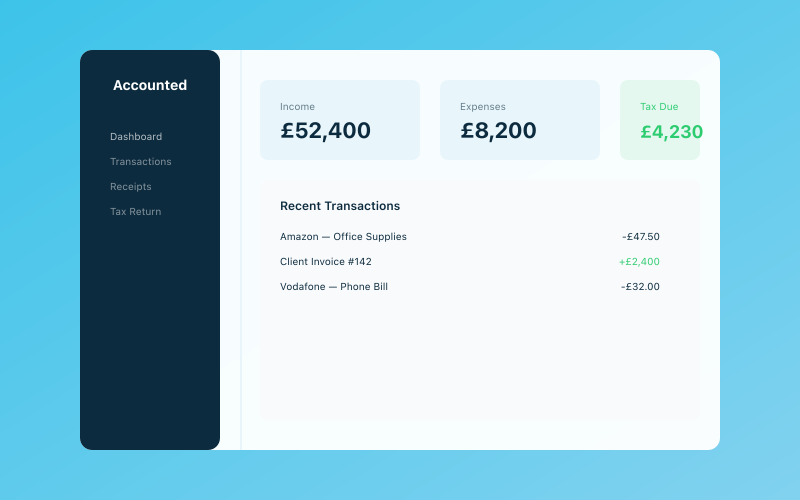 Your Accounted dashboard — income, expenses, and tax at a glance
Under this Act, if a commercial debt isn't paid on time, you're automatically entitled to charge statutory interest. You don't need to include it in your contract or mention it on your invoices for the right to exist — it's a default provision of law. However, including it in your terms makes it much easier to enforce and removes any element of surprise.
The Act also allows you to claim a fixed sum as compensation for the cost of recovering the late payment. This is on top of the interest — it's meant to cover the administrative cost of chasing the debt.
It's worth noting that this legislation specifically aims to protect smaller businesses from the payment practices of larger ones. The government has recognised that late payment disproportionately affects sole traders and small businesses, and this Act is one of the tools designed to address that.
How to Calculate Statutory Interest
The calculation is straightforward, though the numbers involved might surprise you.
Statutory interest is charged at a rate of 8% per year above the Bank of England base rate. As of early 2026, the base rate fluctuates, so you'll need to check the current rate when making your calculation. Let's use an example with a base rate of 4.5%, which gives a total interest rate of 12.5% per year.
Here's how it works:
- Take the total amount owed (for example, £3,000).
- Multiply by the annual interest rate (12.5%), giving you the annual interest (£375).
- Divide by 365 to get the daily rate (approximately £1.03 per day).
- Multiply by the number of days the payment is overdue.
So if that £3,000 invoice is 45 days overdue, you could charge approximately £46.23 in interest. On its own, that might not sound like much, but it adds up — and more importantly, it sends a clear message.
For larger or more persistently late debts, the figures become more significant. A £10,000 invoice that's 90 days overdue at the same rate would accrue approximately £308 in interest.
Fixed Compensation on Top of Interest
In addition to interest, you're entitled to claim fixed compensation for the cost of recovering the late payment. The amounts are set by legislation:
- £40 for debts up to £999.99
- £70 for debts between £1,000 and £9,999.99
- £100 for debts of £10,000 or more
This compensation is per invoice, not per client. So if a client has three overdue invoices of £800 each, you're entitled to £40 compensation on each — £120 in total, plus the interest on each.
You can also claim "reasonable costs" of recovering the debt if those costs exceed the fixed compensation amount. This might include the cost of legal advice, debt recovery agency fees, or court fees. However, you'd need to demonstrate that the costs were reasonably incurred.
When and How to Actually Charge It
Having the right to charge interest and knowing when to actually do it are two different things. Here's a practical approach that balances firmness with pragmatism.
Include your right to charge interest in your terms from the start. On every invoice, in every contract, and in your standard terms and conditions. Something like: "Invoices are due within 14 days. Late payments are subject to statutory interest at 8% above the Bank of England base rate, plus fixed compensation under the Late Payment of Commercial Debts (Interest) Act 1998."
This serves as a deterrent. Most clients, when they see this, will prioritise paying on time. It also means that if you do charge interest later, the client can't claim they didn't know.
Don't charge interest on the first late payment from an otherwise good client. If a long-standing client pays three days late for the first time ever, charging interest would be disproportionate and could damage the relationship unnecessarily. A friendly reminder is the right approach. Save the interest charges for persistent offenders or clients who show a pattern of disregarding your terms.
Mention interest in your follow-up reminders. After the initial friendly reminder, subsequent chasing emails should reference your right to charge interest. "Please note that under the Late Payment of Commercial Debts Act, statutory interest is accruing on this overdue balance." This often prompts action without you actually having to apply the charge.
Issue a formal interest invoice when warranted. If a client consistently pays late despite reminders, issuing a separate invoice for the accrued interest sends a clear message. You're not being petty — you're exercising a legal right that exists specifically because late payment causes real financial harm to small businesses.
If you're using Accounted, Penny can help you track which invoices are overdue and by how many days, making it easier to calculate interest if you need to. Having clear records of when invoices were sent, when they were due, and when they were paid strengthens your position significantly.
Common Concerns About Charging Interest
Many sole traders worry about the practical implications of charging late payment interest. Let's address the most common concerns.
"Won't I lose the client?" Possibly, if they're the kind of client who considers it unreasonable to pay for work they've already received. But ask yourself: is a client who consistently pays late really one you want to keep? The cost of carrying that debt — both financially and in terms of the stress and admin of chasing — might be more than the client is worth.
That said, the goal isn't usually to charge interest. The goal is to get paid on time. Including interest provisions in your terms, and occasionally referencing them in reminders, is often enough to achieve that without ever actually raising an interest invoice.
"Is it legal to charge interest even if it's not in my contract?" Yes. Statutory interest applies automatically to late commercial debts. However, if your contract includes its own late payment provisions, those take precedence — but only if they provide a "substantial remedy" for late payment. If your contractual terms are less generous than the statutory provisions, the statutory ones still apply.
"What if the client disputes the interest?" They can dispute it, but the law is clear. If the debt was genuinely late, you're entitled to charge interest. If it goes to court, the judge will apply the statutory provisions. Having clear records — invoice dates, due dates, payment dates, and copies of your chasing correspondence — makes your position straightforward to defend.
"Do I need to charge interest to claim it later?" No, but there's a limitation period. You can claim interest going back six years under normal limitation rules. However, it's much better to raise it at the time, while the details are fresh and the records are clear.
The Bigger Picture: Changing the Culture
Late payment isn't just your problem. It's a systemic issue in the UK economy that the government has been trying to address for decades. The statutory interest provisions are part of that effort, along with initiatives like the Prompt Payment Code and the Small Business Commissioner.
By including late payment provisions in your terms — and being willing to enforce them — you're not just protecting your own business. You're contributing to a culture shift that benefits all small businesses. The more sole traders and freelancers stand firm on payment terms, the harder it becomes for late-paying clients to treat small suppliers as interest-free lenders.
If you'd like to strengthen your overall approach to invoicing and payment collection, our guides on how to invoice correctly in the UK and getting paid faster as a small business complement the advice in this article well.
And remember — your right to charge interest exists because Parliament decided that small businesses deserve to be paid on time. Don't be afraid to use it.
Related reading:
- How to Invoice Correctly in the UK
- Getting Paid Faster as a Small Business
- Chasing Invoices — Email Templates That Actually Work
Accounted helps UK sole traders stay on top of their bookkeeping and tax. Start your free 30-day trial at getaccounted.co.uk.
Related Reading
- Direct Debit vs Bank Transfer — Which Is Better for Collecting Payment?
- What to Include on a UK Invoice — Legal Requirements
Start your free trial and see how Accounted simplifies your bookkeeping.
Accounted keeps your books sorted automatically so you can focus on running your business. See Accounted →
Business & Operations Advisors
Our business advisors cover the practical side of running a UK sole trader business — from HMRC registration to managing growth. Content is written for real business owners in plain English, not accountants.
Ready to try Accounted?
Join UK sole traders who are simplifying their bookkeeping and tax.
Start your 14-day free trial