What to Include on a UK Invoice — Legal Requirements
If you're a sole trader or freelancer in the UK, you've probably sent your fair share of invoices. But here's a question worth asking — do your invoices actually meet the legal requirements? Because sending an invoice that's missing key information isn't just unprofessional. It can cause genuine problems, from delayed payments to issues with HMRC.
The good news is that getting your invoices right isn't complicated. Once you know what needs to be on there, it becomes second nature. So let's walk through everything your UK invoices need to include, why each element matters, and how to make sure you never send a dodgy one again.
Why Legal Compliance on Invoices Matters
You might think an invoice is just a polite way of asking for money. And in a sense, it is. But it's also a legal document. Your invoices form part of your business records, and HMRC expects them to meet certain standards.
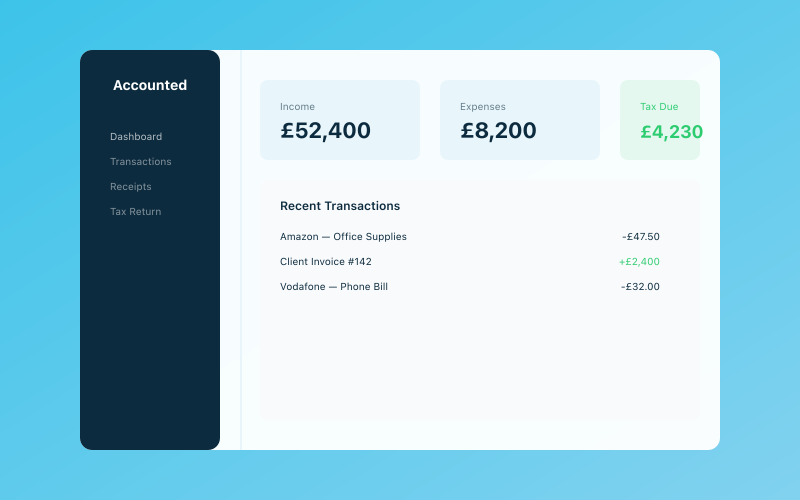 Your Accounted dashboard — income, expenses, and tax at a glance
If your invoices are incomplete or inaccurate, a few things can go wrong. First, clients may refuse to pay until the invoice is corrected — and rightly so, since their own accountants will want proper documentation. Second, if HMRC ever investigates your records, incomplete invoices could raise red flags. Third, if you're VAT-registered, there are specific requirements that, if missed, could mean your clients can't reclaim VAT on your services.
Beyond the legal side, a well-structured invoice simply makes you look more professional. It tells your clients that you take your business seriously and that you're organised. That impression matters more than you might think.
The Essential Elements Every UK Invoice Must Include
Let's get into the specifics. Whether you're VAT-registered or not, every invoice you issue should include the following:
Your business name and contact details. This means your trading name (or your own name if you trade under your personal name), your address, and ideally a phone number or email address. If you're a limited company, you must include your registered company name and registered office address — even if they differ from your trading name and actual premises.
Your client's name and address. You need to clearly identify who the invoice is addressed to. This should be the legal name of the business or individual you're billing, along with their address.
A unique invoice number. Every invoice must have a unique, sequential number. You can use any numbering system you like — some people go with simple numbers (001, 002, 003), while others prefer a format like INV-2026-001. The key point is that each number must be unique and follow a logical sequence. You can't have gaps or duplicates.
The invoice date. This is the date you issue the invoice. It's important for tax purposes and for calculating when payment is due.
A clear description of the goods or services. You need to describe what you're charging for in enough detail that there's no ambiguity. "Consulting services" is a bit vague. "Website design consultancy — 10 hours at £75/hour, March 2026" is much better.
The amount being charged. Break down the charges clearly. Show the quantity, unit price, and total for each line item. If you're offering a discount, show that too.
The total amount due. State the final amount clearly, including any VAT if applicable.
Payment terms. When do you expect to be paid? Net 30? Net 14? On receipt? Make this crystal clear. For more on setting these up properly, have a look at our guide on how to invoice correctly in the UK.
Additional Requirements for VAT-Registered Businesses
If you're registered for VAT, your invoices need to include several extra pieces of information. Missing any of these can mean your client can't reclaim the VAT, which won't make you popular.
Your VAT registration number. This is the nine-digit number HMRC assigned when you registered.
The tax point (date of supply). This is the date the goods were delivered or the services were performed. It's not always the same as the invoice date.
The net amount (before VAT). Show the total before VAT is added.
The VAT rate applied. For most services, this will be the standard rate of 20%, but some goods and services are subject to reduced rates (5%) or are zero-rated.
The VAT amount. Show the actual amount of VAT being charged.
The gross total (including VAT). The final amount your client needs to pay.
If you're on the VAT flat rate scheme, you still need to show VAT at the standard rate on your invoices — you just account for it differently when you file your return.
It's also worth noting that for invoices under £250 (including VAT), simplified invoices are acceptable. These need fewer details, but it's generally good practice to include everything regardless. Penny, the AI assistant within Accounted, can flag if an invoice you're creating is missing any required fields — which saves a lot of second-guessing.
Common Mistakes That Can Invalidate an Invoice
Even experienced sole traders make mistakes on their invoices from time to time. Here are the ones we see most often:
Duplicate invoice numbers. If two invoices share the same number, it creates confusion in your records and your client's. It can also look suspicious to HMRC. Always use a sequential system and stick to it.
Missing or incorrect dates. The invoice date matters for tax calculations, especially if you're working across tax years. A missing date can also make it harder to enforce your payment terms.
Vague descriptions. "Work completed in February" tells your client almost nothing. Be specific about what was delivered, the quantity, and the rate. This also protects you if there's ever a dispute about what was agreed.
Wrong VAT treatment. Charging VAT when you're not registered, or failing to charge it when you should, can both cause problems. If you're not VAT-registered, make sure your invoices don't include a VAT number or show VAT as a separate charge.
Missing payment details. Surprisingly common — people send invoices without telling the client how to pay. Always include your bank details (sort code and account number) or a payment link. The easier you make it to pay, the faster you'll get paid. Our article on creating professional invoices covers this in more detail.
What About Self-Billing and Pro Forma Invoices?
Not all invoices work the same way. Two variations worth understanding are self-billing and pro forma invoices.
Self-billing is an arrangement where your client creates the invoice on your behalf. This is common in certain industries, like construction under the CIS scheme. For self-billing to be valid, both parties must agree to the arrangement in writing, and the client must be VAT-registered. The invoices they produce on your behalf must meet all the same legal requirements.
Pro forma invoices are essentially quotes or estimates formatted to look like invoices. They're not legal invoices and shouldn't be recorded as such in your accounts. They're useful for giving clients an idea of costs before work begins, but the actual invoice should be issued separately once the work is done or the goods are delivered.
Understanding the difference matters because recording a pro forma as a real invoice — or failing to issue a proper invoice after a self-billing arrangement ends — can create problems with your records.
How Long Must You Keep Your Invoices?
HMRC requires you to keep records — including copies of all invoices you've issued and received — for at least five years after the 31 January submission deadline for the relevant tax year. If you're VAT-registered, you need to keep VAT records for six years.
That might sound like a lot of paperwork, but if you're using accounting software like Accounted, your invoices are stored digitally and automatically. No filing cabinets, no hunting through folders. Everything is there when you need it, whether that's for your own reference or an HMRC enquiry.
It's worth noting that HMRC accepts digital records, so you don't need paper copies. But the records must be complete and accurate, which brings us back to the importance of getting your invoices right in the first place.
Making Compliance Effortless
Once you know what's required, keeping your invoices legally compliant is straightforward. The trick is building good habits from the start — or fixing any gaps now before they become bigger problems.
Here's a quick checklist you can use every time you raise an invoice:
- Your business name, address, and contact details
- Your client's name and address
- A unique, sequential invoice number
- The invoice date
- A clear description of goods or services
- Itemised charges with quantities and rates
- The total amount due
- Your payment terms and bank details
- VAT details (if VAT-registered)
If you're looking for a deeper dive into structuring your invoices, our guide on getting paid faster as a small business covers how smart invoicing practices can improve your cash flow too.
Related reading:
- How to Invoice Correctly in the UK
- How to Create a Professional Invoice
- Getting Paid Faster as a Small Business
Accounted helps UK sole traders stay on top of their bookkeeping and tax. Start your free 30-day trial at getaccounted.co.uk.
Related Reading
- How to Deal With Non-Paying Clients — A Step-by-Step Guide
- Striking Off a Company vs Liquidation — Which to Choose
Start your free trial and see how Accounted simplifies your bookkeeping.
Accounted keeps your books sorted automatically so you can focus on running your business. See Accounted →
Business & Operations Advisors
Our business advisors cover the practical side of running a UK sole trader business — from HMRC registration to managing growth. Content is written for real business owners in plain English, not accountants.
Ready to try Accounted?
Join UK sole traders who are simplifying their bookkeeping and tax.
Start your 14-day free trial