Chasing Invoices — Email Templates That Actually Work
There's a special kind of frustration that comes with chasing an unpaid invoice. You've done the work, you've delivered on time, you've sent the invoice — and now you're sitting there refreshing your bank app, wondering when (or if) the money will arrive. It's awkward, it's stressful, and it's one of the most common complaints among freelancers and sole traders.
The good news is that most late payments aren't malicious. They're usually the result of disorganisation, busy inboxes, or clunky internal processes. A well-timed, well-worded reminder is often all it takes to get things moving. The key is knowing what to say, when to say it, and how to escalate without burning bridges.
In this guide, we'll give you a set of email templates you can use at every stage of the chasing process, along with practical advice for getting paid faster and protecting your cash flow.
Before the Invoice Is Due: The Friendly Reminder
Don't wait until an invoice is overdue to start communicating about it. A gentle reminder a few days before the due date can work wonders. It keeps your invoice at the top of the pile and gives the client a chance to flag any problems before the deadline passes.
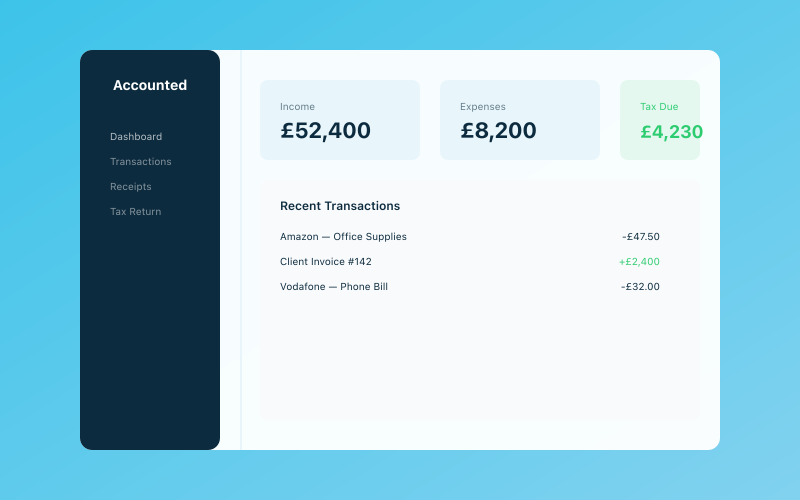 Your Accounted dashboard — income, expenses, and tax at a glance
Template: Pre-Due Date Reminder
Subject: Invoice #[NUMBER] — Due on [DATE]
Hi [NAME],
Just a quick note to let you know that invoice #[NUMBER] for £[AMOUNT] is due on [DATE]. I've attached a copy for your reference.
If you've already arranged payment, please ignore this — and thank you! If there's anything you need from me to process it, just let me know.
Thanks, [YOUR NAME]
This is light, friendly, and doesn't put anyone on the defensive. It's simply a helpful nudge. Many sole traders find that sending this kind of reminder cuts late payments significantly — some by as much as half.
If you're using invoicing software, you may be able to automate this reminder. Accounted, for example, lets you set up automatic payment reminders so you don't have to remember to send them yourself.
The Day After It's Due: The Polite Chase
If the due date passes without payment, send a follow-up the next working day. Don't wait a week hoping the money will materialise. The sooner you follow up, the better — it signals that you're on top of your finances and that payment terms matter.
Template: First Overdue Reminder
Subject: Invoice #[NUMBER] — Now Overdue
Hi [NAME],
I hope you're well. I wanted to follow up on invoice #[NUMBER] for £[AMOUNT], which was due on [DATE]. I don't appear to have received payment yet.
Could you let me know when I can expect this to be settled? If there are any issues with the invoice, I'm happy to help resolve them.
I've attached the invoice again for convenience.
Many thanks, [YOUR NAME]
Notice the tone — it's still polite and assumes good faith. You're not accusing anyone of anything. You're simply flagging that the payment is overdue and asking for an update.
One Week Overdue: The Firm Follow-Up
If you don't hear back within a few days, it's time to send a slightly firmer message. At this point, you're entitled to feel frustrated, but keep your tone professional. The goal is to get paid, not to win an argument.
Template: Second Overdue Reminder (7 Days)
Subject: Invoice #[NUMBER] — 7 Days Overdue
Hi [NAME],
I'm following up on my previous email regarding invoice #[NUMBER] for £[AMOUNT], which was due on [DATE] and is now 7 days overdue.
I'd appreciate it if you could arrange payment at your earliest convenience, or let me know if there's a reason for the delay so we can sort it out.
For reference, I've attached the invoice and my bank details are as follows: [BANK DETAILS]
Please could you confirm when payment will be made?
Thank you, [YOUR NAME]
Including your bank details directly in the email removes one common excuse ("I couldn't find your payment details"). Asking them to confirm when payment will be made gives them a specific action to take, rather than just vaguely acknowledging the email.
Two Weeks Overdue: Escalating the Tone
At this stage, you've sent multiple reminders and haven't received payment or a satisfactory explanation. It's time to escalate — not aggressively, but firmly.
Template: Third Overdue Reminder (14 Days)
Subject: Urgent: Invoice #[NUMBER] — 14 Days Overdue
Hi [NAME],
I've now sent several reminders regarding invoice #[NUMBER] for £[AMOUNT], which was due on [DATE] and remains unpaid.
I value our working relationship and want to resolve this quickly. However, I do need this invoice settled as a matter of urgency. Could you please arrange payment within the next 3 working days?
If there's a problem I'm not aware of, please let me know so we can find a solution.
I look forward to hearing from you.
Kind regards, [YOUR NAME]
The "3 working days" gives a clear deadline. It's firm but fair, and the reference to valuing the relationship keeps things from feeling adversarial.
One Month Overdue: The Final Notice
If you've reached this point without payment or meaningful communication, it's time to send a formal final notice. This is the last step before considering more serious action.
Template: Final Notice (30 Days)
Subject: Final Notice — Invoice #[NUMBER]
Dear [NAME],
Despite several reminders, invoice #[NUMBER] for £[AMOUNT], dated [INVOICE DATE] and due on [DUE DATE], remains unpaid.
Please treat this as a formal final notice. If payment is not received within 7 days of this email, I will need to consider further action to recover the amount owed. This may include:
- Charging statutory interest under the Late Payment of Commercial Debts (Interest) Act 1998
- Instructing a debt recovery service
- Making a claim through the Small Claims Court
I sincerely hope it doesn't come to that. If you're experiencing difficulties, I'm open to discussing a payment plan.
Please arrange payment or contact me as a matter of urgency.
Yours sincerely, [YOUR NAME]
This template references the Late Payment of Commercial Debts (Interest) Act 1998, which gives you the right to charge interest on late commercial payments (currently 8% plus the Bank of England base rate). Simply mentioning this legislation can prompt a swift response, as most businesses would rather pay the original invoice than deal with additional charges and legal proceedings.
Tips for Effective Invoice Chasing
Beyond the templates, here are some practical tips to improve your success rate:
Pick up the phone. Emails are easy to ignore. A phone call is much harder to avoid, and it often resolves things in minutes. If your emails aren't getting a response, try calling. Be calm, be professional, and ask directly when you can expect payment.
Keep records of everything. Save every email, note every phone call, and document every promise. If the situation escalates to formal action, a clear paper trail strengthens your position enormously.
Invoice promptly. The sooner you send your invoice after completing the work, the sooner you'll get paid. Waiting weeks to invoice gives the client the impression that you're not in a hurry, which makes them less likely to prioritise your payment.
Set clear payment terms upfront. Your payment terms should be on every invoice and, ideally, agreed in writing before work begins. Common terms are 14 days, 21 days, or 30 days. Shorter terms generally mean faster payments. For more on this, read our guide on how to create a professional invoice.
Make it easy to pay you. Include your bank details on every invoice and reminder. If you accept card payments or bank transfers, say so clearly. The fewer obstacles between the client and paying you, the better.
Don't keep working for non-payers. If a client owes you money and wants to commission more work, pause until the outstanding invoice is settled. It's not rude — it's good business practice.
Consider requiring deposits. For larger projects, asking for a deposit (typically 25-50%) before you start work protects you if the client turns out to be a slow payer. It also demonstrates their commitment to the project.
Automating the Process
Chasing invoices manually is time-consuming and emotionally draining. The more you can automate, the better.
With Accounted, Penny can track your outstanding invoices and send automatic reminders on your behalf, so you don't have to write awkward emails or keep a mental tally of who owes you what. It takes the personal sting out of the process and ensures nothing falls through the cracks.
Automated reminders also have the advantage of feeling less personal to the client. When a reminder comes from "the system," it's easier for both parties to treat it as routine admin rather than a confrontation.
When Chasing Doesn't Work
If you've exhausted your reminders and the client still won't pay, you've got a few options:
- Mediation — a neutral third party helps you reach an agreement. It's cheaper and less stressful than court.
- Small Claims Court — for debts under £10,000, you can make a claim online through Money Claims Online (MCOL). The process is straightforward, and you don't need a solicitor. The filing fee ranges from £35 to £455 depending on the amount.
- Debt recovery services — professional debt collectors charge a fee (usually a percentage of the debt) but can be effective for stubborn cases.
For more strategies on dealing with non-payers, have a look at our guide on handling late-paying clients.
Nobody wants to get to this point, and in most cases, a consistent, professional chasing process prevents it from ever happening. The key is starting early, following up consistently, and never letting an unpaid invoice just sit there and gather dust.
Related Reading
Start your free trial and see how Accounted simplifies your bookkeeping.
Accounted helps UK sole traders stay on top of their bookkeeping and tax. Start your free 30-day trial at getaccounted.co.uk
Accounted keeps your books sorted automatically so you can focus on running your business. See Accounted →
Business & Operations Advisors
Our business advisors cover the practical side of running a UK sole trader business — from HMRC registration to managing growth. Content is written for real business owners in plain English, not accountants.
Ready to try Accounted?
Join UK sole traders who are simplifying their bookkeeping and tax.
Start your 14-day free trial