Record Keeping — How Long You Must Keep Business Records
You know you're supposed to keep records. But for how long? And which records? It's one of those questions that most sole traders have a vague answer to — "a few years, I think?" — without really knowing the specifics. And the specifics matter, because getting it wrong can land you in trouble with HMRC.
Let's clear this up once and for all. Here's a comprehensive guide to how long you need to keep your business records, what counts as a record, and what happens if you fall short.
The Basic Rule for Sole Traders
If you're a sole trader filing Self Assessment, the general rule is straightforward:
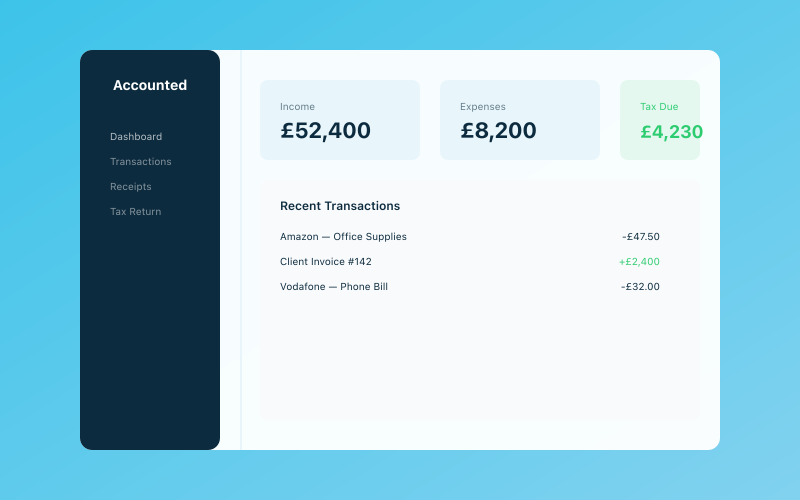 Your Accounted dashboard — income, expenses, and tax at a glance
You must keep your records for at least five years after the 31 January submission deadline for the relevant tax year.
Let's unpack that with an example. For the 2025/26 tax year (ending 5 April 2026), your Self Assessment return is due by 31 January 2027. You must keep the records for that tax year until at least 31 January 2032 — that's five full years after the filing deadline.
In practice, this means you're holding onto records for roughly six years from when the transactions actually took place. It's a long time, but there are good reasons for it.
Why Five Years?
The five-year retention period exists because HMRC has the power to open an enquiry into your Self Assessment return for up to twelve months after the filing deadline (for returns filed on time). But if they discover carelessness or errors, they can go back further — up to six years for careless mistakes and twenty years for deliberate tax evasion.
By keeping records for five years after the filing deadline, you're covered for the most common enquiry scenarios. If HMRC opens an investigation and asks for evidence, you'll have it. If you've already shredded everything, you'll be in a much weaker position. You can learn more about what an investigation involves in our guide to HMRC investigation — what to expect.
What Counts as a Business Record?
The term "business records" covers a wide range of documents. Here's what HMRC expects you to keep:
Sales and income records:
- Invoices you've issued to clients or customers
- Records of cash sales
- Bank statements showing income received
- Till rolls or point-of-sale records
- Records of any other income (interest, rental income, etc.)
Purchase and expense records:
- Receipts for business purchases
- Invoices from suppliers
- Records of petty cash expenditure
- Credit card statements for business transactions
- Mileage logs for vehicle expenses
- Utility bills (if claiming home office expenses)
Banking records:
- Bank statements for all business accounts
- Records of payments in and out
- Loan agreements and repayment records
Employment records (if you have staff):
- Payroll records
- P45s, P60s, and P11Ds
- Records of statutory payments
Other records:
- Contracts and agreements
- Correspondence with clients about financial matters
- Records of assets purchased and sold (for capital allowances and capital gains tax)
- VAT records (if registered — more on this below)
If you're not sure whether something counts as a record, err on the side of keeping it. It's much easier to discard something later than to recreate it years down the line.
VAT Records — Different Rules
If you're VAT-registered, you need to keep your VAT records for at least six years. This is longer than the standard Self Assessment requirement and catches some people out.
VAT records include:
- All sales and purchase invoices
- Credit and debit notes
- Records of goods imported and exported
- Records of items bought or sold where no VAT was charged
- VAT account summaries
- Copies of your VAT returns
Under Making Tax Digital, you also need to maintain digital records that can be submitted electronically. Spreadsheets that feed into compatible software are acceptable, but the records must be held digitally — paper-only records won't do.
CIS Records
If you work in the construction industry under the Construction Industry Scheme, keep all CIS-related records for at least three years after the end of the tax year they relate to. This includes payment and deduction statements, verification records, and monthly returns.
Landlord Records
If you receive rental income, the same five-year rule applies. Keep records of rental income received, allowable expenses claimed, mortgage interest statements, and any capital expenditure on the property. Our guide to landlord record keeping for HMRC covers this in more detail.
Digital vs Paper Records
Here's the good news: HMRC doesn't care whether your records are digital or paper, as long as they're accurate and you can produce them when asked. Digital records are perfectly acceptable — and frankly, they're far more practical.
Digital records have several advantages:
- They don't take up physical space
- They're searchable, so you can find specific transactions quickly
- They can be backed up, so you're protected against fire, flood, or theft
- They integrate with accounting software, making tax returns easier
If you're keeping paper records, make sure they're stored securely and organised logically. Shoeboxes of unsorted receipts are technically records, but they won't impress HMRC if you're asked to produce specific information quickly.
With Accounted, your records are stored digitally and organised automatically. Penny categorises your transactions and keeps everything in one place, which means you're not only meeting HMRC's requirements — you're exceeding them. If an enquiry ever does land on your desk, you can pull up exactly what's needed in seconds rather than days.
What Happens If You Don't Keep Records?
Failing to keep adequate records is a separate offence in itself, and HMRC can impose a penalty of up to £3,000 for inadequate record-keeping. In practice, this penalty is most commonly applied during enquiries when HMRC finds that records are missing, incomplete, or unreliable.
Beyond penalties, poor record-keeping weakens your position in any dispute with HMRC. If you can't evidence your expenses, HMRC may disallow them entirely. If you can't explain a bank deposit, HMRC may treat it as undeclared income. The burden of proof is effectively on you — HMRC can make estimates and assumptions, and it's up to you to provide evidence that those estimates are wrong.
In short, keeping records isn't just a legal requirement — it's your insurance policy against HMRC getting the wrong end of the stick.
When Can You Safely Destroy Records?
Once the retention period has passed, you're free to destroy your records. But before you fire up the shredder, check the following:
Is there an open enquiry or investigation? If HMRC has opened an enquiry into any tax year, keep all records for that year until the enquiry is fully closed, regardless of the standard retention period.
Are there ongoing disputes? If you're in the middle of an appeal or dispute with HMRC, hold onto everything until it's resolved.
Do you have any outstanding tax debts? If you're on a payment plan or have unpaid tax, keep records for the relevant years until the debt is cleared.
Could earlier records affect current or future returns? Capital allowances, brought-forward losses, and certain other tax reliefs depend on records from previous years. If you claimed capital allowances on equipment bought in 2020, you might still need those purchase records to support claims in current years.
If none of these apply, you can go ahead and securely destroy the records. For paper records, shredding is advisable. For digital records, permanent deletion (not just moving to the recycle bin) is the way to go.
A Simple Record-Keeping System
You don't need anything fancy. Here's a simple system that works:
- As transactions happen, photograph or scan receipts and file them digitally. Use your phone — it takes seconds.
- At least monthly, reconcile your bank statements with your records. Make sure everything matches up.
- At year-end, do a thorough review. Check that you have records for every expense claimed and every income source declared.
- After filing, archive that year's records in a clearly labelled folder (physical or digital).
- After the retention period, review and destroy records you no longer need.
If you want a more detailed walkthrough, our guide on how to keep business records for HMRC is a great starting point.
Make It Effortless With Accounted
The reality is that record-keeping doesn't have to be a chore. With the right tools, it's almost automatic. Accounted connects to your bank account and pulls in transactions automatically. Penny helps you categorise them, flag anything unusual, and keep everything organised.
When filing time comes around, your records are already there — complete, categorised, and ready to go. And if HMRC ever asks questions, you've got a clear digital audit trail stretching back as far as you need.
Related reading:
- How to Keep Business Records for HMRC
- Landlord Record Keeping for HMRC
- HMRC Investigation — What to Expect
Accounted helps UK sole traders stay on top of their bookkeeping and tax. Start your free 30-day trial at getaccounted.co.uk.
Related Reading
Start your free trial and see how Accounted simplifies your bookkeeping.
Accounted keeps your books sorted automatically so you can focus on running your business. See Accounted →
Business & Operations Advisors
Our business advisors cover the practical side of running a UK sole trader business — from HMRC registration to managing growth. Content is written for real business owners in plain English, not accountants.
Ready to try Accounted?
Join UK sole traders who are simplifying their bookkeeping and tax.
Start your 14-day free trial