Morning Routines That Actually Help Your Business
The internet is saturated with morning routine content. Wake at four. Meditate for an hour. Cold shower. Journal. Exercise. Drink a smoothie that costs more than lunch. Read thirty pages of a business book. All before the sun comes up.
It's exhausting just reading about it, let alone doing it. And for most self-employed people — who are already juggling a hundred responsibilities and probably didn't sleep brilliantly because they were worrying about an unpaid invoice — it's about as realistic as running a marathon before breakfast.
The truth is, you don't need a two-hour morning ritual to run a successful business. What you need is a short, repeatable set of actions that helps you start your working day with intention rather than chaos. That's it. No ice baths required.
Here are morning routines that actually work for real self-employed people with real lives.
Why Mornings Matter (But Not For The Reasons You Think)
The productivity world has turned mornings into something almost mystical. "Win the morning, win the day" and all that. It's well-meaning but it misses the point.
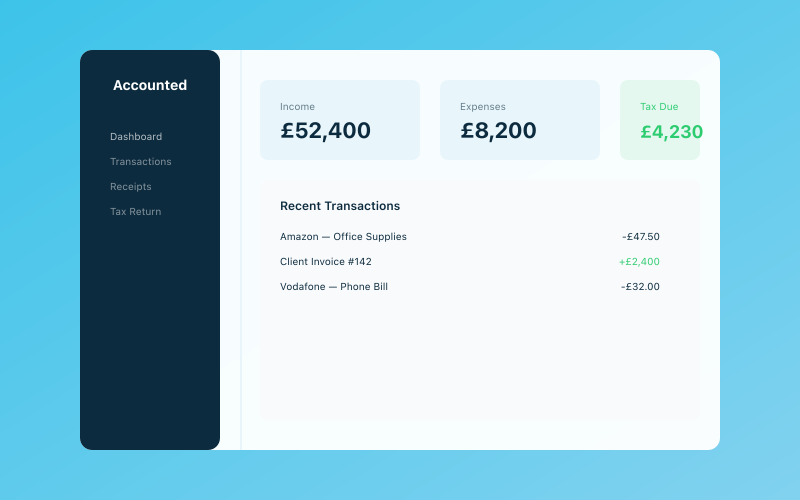 Your Accounted dashboard — income, expenses, and tax at a glance
Mornings matter because they set the tone for what follows. Not in some magical, vibrational sense — in a practical, psychological sense. If you start your day reactively — checking emails, scrolling social media, responding to other people's demands — you spend the rest of the day playing catch-up. Your agenda is set by someone else before you've even decided what your own priorities are.
If you start your day intentionally — even if "intentionally" just means spending ten minutes deciding what matters today — you're far more likely to spend your working hours on things that actually move your business forward.
The goal of a morning routine isn't productivity maximisation. It's giving yourself a moment of calm control before the chaos of the day begins.
The Only Two Things That Really Matter
If you strip away all the noise, a good morning routine for a self-employed person does two things:
1. It creates a transition from "off" to "on."
When you worked in an office, the commute did this for you. The physical act of travelling from home to work gave your brain time to shift gears. Working from home removes that transition entirely, which is why so many people struggle to start their day with any kind of focus.
Your morning routine is your replacement commute. It doesn't need to be long. It just needs to be a consistent signal to your brain that says "work is starting now."
For some people, that's making a specific coffee. For others, it's a ten-minute walk around the block. For others, it's sitting down at their desk and opening a particular app. The ritual itself matters less than its consistency.
2. It helps you identify your priorities for the day.
Before you open your email, before you check your messages, before the world starts making demands: what are the one to three things that would make today a good day?
Write them down. Seriously. On a Post-it note, in a notebook, in your phone — wherever you'll see them. These are your anchors for the day. Everything else is secondary.
This takes roughly two minutes and is the single most valuable thing you can do each morning. It doesn't matter how the rest of your day goes — if you accomplish your priorities, you've had a productive day.
A Realistic Morning Routine Template
Here's a morning routine that takes about thirty minutes and is designed for actual humans who work for themselves:
Wake up at a consistent time (but not an absurd one). You don't need to wake at five. You need to wake at the same time each day, whatever that time is. Consistency regulates your body clock, which improves both your sleep quality and your morning energy. If eight o'clock works for you, eight o'clock is fine.
Avoid your phone for the first fifteen minutes. This is the hardest one and the most impactful. The moment you check your phone, you hand your attention to other people — their emails, their social media posts, their news stories. Give yourself fifteen minutes of phone-free time to wake up on your own terms.
Move your body, even briefly. A full workout is great if you're into that, but it's not necessary. A ten-minute walk, a few stretches, a quick yoga video — anything that gets blood flowing to your brain. The difference between starting work from a standing position versus rolling from bed to desk is significant.
Eat something. Your brain runs on glucose. Skipping breakfast and trying to do your best thinking on an empty stomach is like trying to drive a car with no petrol. It doesn't have to be elaborate — toast, porridge, fruit, whatever you fancy. Just eat.
Set your priorities. Sit down at your desk, close everything except a blank page, and write down the one to three things you need to accomplish today. Then start on the most important one.
That's it. No meditation (unless you want to). No journaling (unless you want to — and if you do, we've got a whole guide on journaling for business clarity). No motivational affirmations. Just the basics, done consistently.
What To Do In Your First Working Hour
Your first working hour is your most valuable. Protect it ruthlessly.
This means: don't start with email. Email is other people's to-do list for you. If you start your day in your inbox, you'll spend your freshest, most focused energy reacting to other people's priorities instead of advancing your own.
Instead, spend your first hour on your most important task. The thing that requires the most brainpower, the most creativity, the most strategic thinking. The proposal you need to write. The client problem you need to solve. The piece of work that will have the biggest impact on your business.
Do it first, before you've been depleted by a dozen small decisions and interruptions. This single habit — protecting your first hour for deep work — is worth more than every other productivity hack combined.
Your email can wait. Your social media can wait. The admin can wait. Do the important thing first, while you have the mental resources to do it well.
And speaking of admin — if bookkeeping is one of those things that preys on your mind first thing in the morning, take it off the table entirely. Accounted runs in the background, with Penny categorising your transactions and keeping your records up to date automatically. One less thing to worry about when you sit down to work.
Morning Routines For Different Work Styles
Not everyone works the same way, and your morning routine should reflect your actual life, not someone else's ideal.
If you're a night owl: Don't fight your natural rhythm. If you do your best work in the afternoon and evening, your morning routine might simply be: wake up, move, eat, handle light admin, and save your deep work for later. There's no rule that says mornings must be your most productive time.
If you have children: Your morning routine might be ten minutes between the school run and sitting down at your desk. That's fine. Make those ten minutes count — set your priorities, take a breath, start work intentionally.
If you exercise in the morning: Build your work transition into your post-exercise routine. Shower, change, sit down, set priorities, begin. The exercise itself becomes your "commute."
If you share a workspace: Coordinate with the other person. Agree on a start time, minimise interruptions during each other's first hour, and communicate your boundaries. Morning routines work best when the people around you understand and respect them.
If you struggle with mornings full stop: Start incredibly small. One thing. Just one thing that you do every morning before work. Make your bed. Drink a glass of water. Walk to the end of the road and back. Build from there. The habit matters more than the content.
What To Avoid
A few morning habits that seem productive but actually aren't:
Checking social media "for work." It's never just for work. You'll end up down a rabbit hole and emerge twenty minutes later feeling worse than when you started. Schedule social media for a specific time later in the day.
Responding to every message immediately. Just because your phone dinged doesn't mean you need to reply right now. Batch your communications for set times during the day.
Over-planning your day. Spending forty-five minutes creating a detailed hour-by-hour schedule is procrastination wearing a productivity costume. Identify three priorities and start working. That's your plan.
Comparing your morning to someone else's. That entrepreneur on Instagram who claims to do more before 6am than most people do all day? They're either exaggerating, have significant help you can't see, or are heading for a burnout they haven't recognised yet. Comparison is a waste of your morning energy. If you need a reminder about sustainable work habits, have a read of how to stop working evenings and weekends.
The Compound Effect Of Consistency
The magic of a morning routine isn't in any single morning. It's in the accumulation. Two hundred mornings of setting clear priorities, starting intentionally, and protecting your first hour add up to something enormous.
You won't see results in a week. You probably won't see them in a month. But three months in, you'll look back and realise that you're getting more done, feeling less stressed, and running your business with a sense of control that you didn't have before.
And on the mornings when your routine falls apart — because life happens, children get ill, you sleep through your alarm, the boiler breaks — don't beat yourself up. Just pick it up again tomorrow. The routine is a tool, not a prison.
The same principle applies to your business admin. Consistency matters more than perfection. Keeping your books roughly up to date each week is better than doing everything perfectly once a quarter. Accounted makes that easy — Penny keeps things ticking along day by day, so nothing ever builds up into an overwhelming backlog.
For more ideas on keeping your business admin from piling up, we've got a detailed guide on automating the things that drain your time and energy.
Start tomorrow morning. Just the basics. See how it feels.
Related reading:
- Journaling for Business Clarity — A Practical Approach
- How to Stop Working Evenings and Weekends
- How to Automate Your Admin as a Sole Trader
Accounted helps UK sole traders stay on top of their bookkeeping and tax. Start your free 30-day trial at getaccounted.co.uk.
Related Reading
- How to Work From Home Productively (Real Tips, Not Clichés)
- Time Tracking for Freelancers — Why It Matters and How to Start
Start your free trial and see how Accounted simplifies your bookkeeping.
Business & Operations Advisors
Our business advisors cover the practical side of running a UK sole trader business — from HMRC registration to managing growth. Content is written for real business owners in plain English, not accountants.
Ready to try Accounted?
Join UK sole traders who are simplifying their bookkeeping and tax.
Start your 14-day free trial