Journaling for Business Clarity — A Practical Approach
When someone suggests journaling, the image that comes to mind is usually a leather-bound notebook, a cup of herbal tea, and someone writing about their feelings in flowing longhand. Which is lovely, but not exactly what most sole traders and freelancers are after on a Wednesday morning when they've got three deadlines and an overflowing inbox.
But business journaling is a different thing entirely. It's not about feelings (though those sometimes feature). It's about clarity. It's about taking the swirling chaos of running a business — the decisions, the worries, the half-formed plans, the problems you can't quite articulate — and getting it out of your head and onto paper where you can actually do something with it.
The research on this is surprisingly strong. Regular reflective writing has been linked to better decision-making, reduced stress, improved goal achievement, and greater creative problem-solving. And it takes about ten minutes a day.
Here's how to do it in a way that's genuinely useful for your business, without it feeling like homework.
Why Your Brain Needs The Outlet
Running a business — even a small one — generates an extraordinary amount of mental noise. At any given moment, you might be thinking about client deadlines, unpaid invoices, a tricky email you need to send, a marketing idea you had in the shower, whether you've filed your receipts, what to charge for a new service, and whether you remembered to buy milk.
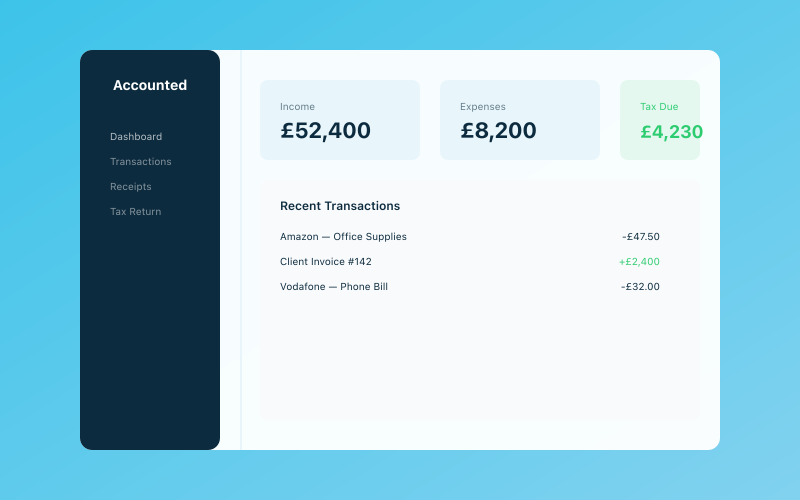 Your Accounted dashboard — income, expenses, and tax at a glance
This mental clutter is exhausting. Your brain treats each of these open loops as an active task, burning cognitive energy even when you're not consciously thinking about them. It's why you feel tired at the end of the day even when you haven't done much "real" work — your mind has been running a dozen background processes all day.
Journaling provides an outlet. By writing things down, you close those loops. Your brain stops trying to hold everything and starts focusing on what matters. It's essentially a defrag for your mind.
And unlike meditation or mindfulness apps (which are great but require a specific kind of focus), journaling meets you where you are. Stressed? Write about what's stressing you. Confused about a decision? Write out the options. Excited about a new idea? Get it down before it evaporates. There's no wrong way to do it, which is precisely why it works.
The Morning Brain Dump
The simplest and most effective business journaling practice is the morning brain dump. Before you start work — ideally before you check your email or phone — sit down with a notebook or blank document and write for ten minutes without stopping.
Don't plan what you're going to write. Don't try to be coherent or elegant or strategic. Just write whatever comes to mind. Stream of consciousness. The good, the bad, the mundane, the anxious.
"I'm worried about the invoice I sent last week. Haven't heard back. Need to follow up but I hate chasing. Also need to finish the proposal for that new client. Not sure what to charge — might be underpricing myself again. Should I raise my rates? The kitchen needs cleaning. Focus. What's the most important thing today? Probably finishing that report..."
This isn't polished thinking. It's pre-thinking. You're emptying your mental buffer so that when you sit down to actually work, your mind is clearer. Over time, you'll notice patterns in your morning dumps — recurring worries, persistent questions, ideas that keep surfacing. These patterns are valuable data about where your business needs attention.
The Weekly Review
If the morning brain dump is your daily housekeeping, the weekly review is your deeper clean. Set aside thirty minutes at the end of each week (Friday afternoon works well for most people) and reflect on the week just gone.
Some useful prompts:
- What went well this week? Not just client wins — include personal victories, moments you handled well, things you're proud of.
- What didn't go well? Be honest but not harsh. You're identifying areas for improvement, not punishing yourself.
- What did I learn? About your business, your clients, yourself, your industry.
- What's on my plate next week? Get the upcoming week's tasks out of your head and onto paper.
- What am I avoiding? This is the powerful one. We all have things we're putting off — the difficult conversation, the financial review, the project we've been dragging our feet on. Naming the avoidance is the first step to dealing with it.
If you find yourself consistently writing about the same avoided task — say, sorting out your bookkeeping or dealing with your tax admin — that's a signal. For bookkeeping specifically, Accounted takes the pain away entirely. Penny keeps your records in order automatically, so "sort out my books" never has to appear on your avoidance list again.
Decision Journaling
One of the most powerful uses of journaling for business is decision-making. When you're faced with a choice — raise rates or keep them the same, take on a new client or decline, invest in that course or save the money — writing about it can provide remarkable clarity.
The approach is simple. Write out:
- The decision you're facing, in one sentence.
- The options available to you (usually two or three).
- The pros and cons of each option, as honestly as you can.
- Your gut feeling. Before you analyse, what does your instinct say?
- What you're afraid of. Often, the thing blocking a decision isn't logic — it's fear. Name the fear and it loses some of its power.
- What you'd advise a friend in the same situation. We're always wiser when the stakes aren't personal.
Don't try to reach a conclusion in one sitting. Write it out, close the notebook, and come back to it tomorrow. You'll often find that the answer feels obvious when you re-read your own words with fresh eyes.
Going back and reviewing past decisions — what you chose, why, and how it turned out — is also incredibly valuable. Over time, you build a record of your own decision-making patterns. You learn where your instincts are reliable and where they tend to lead you astray.
Gratitude and Wins (Without The Cheese)
Yes, gratitude journaling has become a bit of a cliche. No, that doesn't mean it's useless.
Working for yourself can feel like a relentless grind, especially in the early years. There's always more to do, more to earn, more to figure out. It's exhausting, and it can blind you to the progress you're actually making.
Taking two minutes at the end of each day to write down three things that went well — three genuine wins, however small — counterbalances the negativity bias that self-employment amplifies. It doesn't have to be profound. "Sent that proposal I'd been putting off" is a win. "Client said they loved the work" is a win. "Sorted my receipts for the month" is a win.
Over weeks and months, these small entries accumulate into a genuinely encouraging record. On the bad days (and there will be bad days), flipping back through your wins is a concrete reminder that you're doing better than you think.
The Problem-Solving Journal
When you're stuck on a business problem — a difficult client, a pricing challenge, a strategic question — try writing about it as though you're explaining the situation to someone who knows nothing about your business.
This forces you to articulate things you might be taking for granted. It exposes assumptions you didn't know you were making. And the act of structuring your thoughts into coherent prose often reveals the solution hiding within the problem.
Start with: "The problem is..." and write until you've fully explained the situation. Then write: "What I've tried so far is..." Then: "What I haven't tried yet is..." Then: "What I think the real issue might be is..."
By the time you've worked through those prompts, you'll usually have at least a starting point. And if not, you've got a clear, well-articulated description of the problem that you can share with a mentor, a peer, or a professional for advice.
Practical Tips For Making It Stick
Journaling only works if you actually do it. Here's how to make the habit stick:
Keep it short. Ten minutes in the morning, five minutes in the evening. That's enough. You don't need to write a thousand words. Sometimes three sentences do the job.
Lower the bar. Some days your journal entry will be insightful and revelatory. Most days it'll be unremarkable. That's fine. The value is in the consistency, not the quality of any individual entry.
Choose your medium. Pen and paper has a particular quality — the slowness forces reflection, and there's something satisfying about the physical act. But a digital document works too, especially if your handwriting is atrocious or you need to search your notes later. Use whatever you'll actually stick with.
Don't re-read immediately. Write your morning dump and close the notebook. The value is in the writing, not the reading. Come back to your entries weekly or monthly, when you can spot patterns with some distance.
Pair it with something you already do. Journal while drinking your morning coffee. Write your weekly review immediately after your Friday afternoon admin session. Habits stick better when they're attached to existing routines.
Don't make it precious. Use a cheap notebook, not a beautiful one you're afraid to write in. Use bullet points instead of full sentences if that's easier. Doodle in the margins. Cross things out. It's for your eyes only.
And honestly, keeping the rest of your business admin running smoothly makes it far easier to sit down and journal without a nagging feeling that you should be doing your books instead. This is where Accounted earns its keep — with Penny handling your bookkeeping and admin automatically, your mental space is freed up for the reflective work that actually moves your business forward.
What You'll Notice After A Month
If you journal consistently for a month — even imperfectly, even briefly — you'll notice a few things:
Your mornings will feel calmer. Not because your problems have gone away, but because they're on paper instead of rattling around your skull.
Your decision-making will sharpen. You'll start trusting your own judgement more, because you can see a written record of good decisions you've made.
You'll spot patterns. The same clients causing stress. The same types of work bringing satisfaction. The same fears holding you back. Patterns are actionable in a way that vague feelings are not.
And you'll feel more in control. Not because you've suddenly mastered self-employment — nobody ever does — but because you've given yourself a tool for processing the experience. That's worth ten minutes a day, every day.
For further reading on managing the mental load of self-employment, take a look at our piece on the mental health cost of being self-employed. Journaling is one part of the puzzle, but it's a surprisingly effective one.
Related reading:
- How to Automate Your Admin as a Sole Trader
- The Mental Health Cost of Being Self-Employed
- Freelancer Burnout — Signs and Solutions
Accounted helps UK sole traders stay on top of their bookkeeping and tax. Start your free 30-day trial at getaccounted.co.uk.
Related Reading
- Morning Routines That Actually Help Your Business
- Summer Business Slow-Down — How to Use Quiet Periods Wisely
Start your free trial and see how Accounted simplifies your bookkeeping.
Business & Operations Advisors
Our business advisors cover the practical side of running a UK sole trader business — from HMRC registration to managing growth. Content is written for real business owners in plain English, not accountants.
Ready to try Accounted?
Join UK sole traders who are simplifying their bookkeeping and tax.
Start your 14-day free trial