Summer Business Slow-Down — How to Use Quiet Periods Wisely
If you're a sole trader or freelancer, chances are you've noticed it: that peculiar lull that settles over your business sometime around late June and lingers until September. Emails slow down, clients go on holiday, enquiries dry up, and your diary starts looking worryingly empty.
It can be unsettling, especially if you're used to being busy. But a summer slow-down isn't necessarily a problem — it's an opportunity. The question isn't whether quiet periods will happen (they will), but what you do with them when they arrive.
Here's how to make the most of the quieter months without losing your mind — or your income.
Why Does Summer Go Quiet?
Before you start worrying that your business is failing, it helps to understand why summer tends to be slow. The reasons are mostly structural:
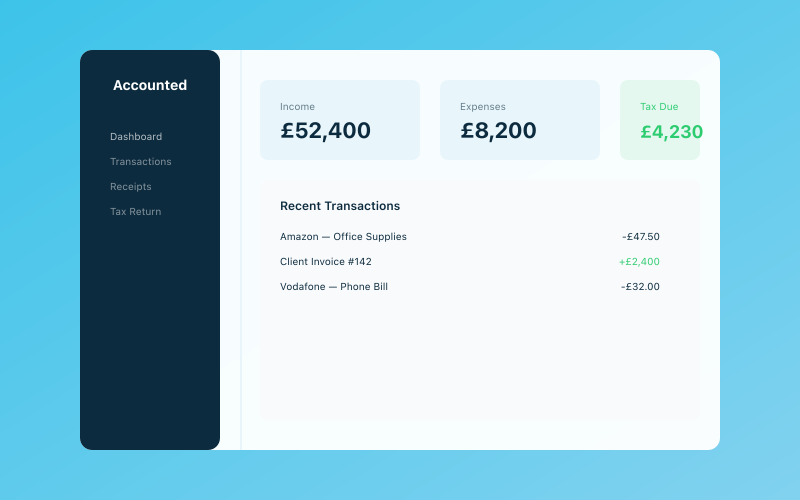 Your Accounted dashboard — income, expenses, and tax at a glance
- Clients take holidays. Decision-makers disappear for weeks at a time. Projects that were urgent in May suddenly stall until "after the summer."
- Budgets are committed. Many businesses operate on an April-to-March financial year. By summer, the year's budget is largely allocated, and new spending decisions get deferred.
- The general mood shifts. There's a cultural tempo to the working year. Summer is when people slow down, whether consciously or not. Fridays become half-days, out-of-office replies multiply, and everything takes a bit longer.
- Schools break up. If you're a parent, or your clients are parents, the school holidays reshape everyone's availability.
None of this means your services are unwanted. It means the rhythm of demand has a seasonal pattern, and smart business owners plan around it.
Catch Up on Your Admin
Let's start with the least exciting but most valuable use of quiet time: admin. During busy periods, bookkeeping, filing, and record-keeping tend to slide. Summer is the perfect time to catch up.
Reconcile your accounts. Go through your bank transactions and make sure everything is categorised correctly. If you're using Accounted, Penny can help flag anything that looks out of place or hasn't been assigned to a category.
Chase outstanding invoices. It's easy to let overdue invoices drift when you're busy with new work. Use the quiet period to follow up on anything unpaid. A polite email reminder is often all it takes.
Review your expenses. Are you claiming everything you're entitled to? Summer is a good time to go through your records and check you haven't missed any deductible expenses. Common ones that get overlooked include professional subscriptions, home office costs, and mileage.
File anything that's outstanding. If you haven't filed your Self Assessment return yet and you're within the window, now is an ideal time. Filing early doesn't mean paying early — your deadline remains 31 January — but it gets the job done while you have breathing room. For a full walkthrough, see our Self Assessment deadlines guide for 2025/26.
Invest in Your Skills
When was the last time you learned something new? Not a quick YouTube tutorial, but a proper deep dive into a skill that could genuinely move your business forward?
Quiet periods are ideal for professional development. Consider:
- Online courses. Platforms like Coursera, Skillshare, and LinkedIn Learning offer thousands of courses relevant to freelancers and small business owners. Many are free or inexpensive.
- Industry reading. Catch up on trade publications, blogs, and books in your field. Understanding where your industry is heading helps you position your services for the future.
- Software skills. Is there a tool you've been meaning to learn properly? Whether it's design software, project management, or — dare we say — your bookkeeping app, dedicated time to explore features pays dividends later.
- Networking. Summer events, meetups, and conferences can be less crowded and more relaxed than their autumn counterparts. It's a good time to build relationships without the pressure of a packed schedule.
The cost of training is usually an allowable business expense, too, provided it's relevant to your current trade. That takes some of the sting out of the investment.
Review Your Business Strategy
It's hard to think strategically when you're deep in the day-to-day. A quieter period gives you the mental space to step back and ask some bigger questions.
Are you charging enough? Inflation, rising costs, and growing experience all justify regular price reviews. If you haven't raised your rates in the past year, summer is a good time to research the market and plan an increase for the autumn.
Who are your best clients? Not just in terms of revenue, but in terms of enjoyment, reliability, and growth potential. Are there clients you'd like more of — and clients you'd quietly like to move on from?
What services should you add or drop? Your offerings should evolve with demand. Are there services you provide that aren't profitable or fulfilling? Are there new services your clients are asking about that you could realistically deliver?
What does your cash flow look like? Summer is a natural point to review your financial position for the year so far. Accounted's reporting features can give you a clear picture of income versus expenses, month by month. If you spot a pattern — say, income consistently dips in July and August — you can plan for it next year by saving more during peak months.
Create Content and Build Visibility
If your clients aren't buying in summer, they may still be browsing. This is a good time to invest in the kind of marketing that builds visibility over the longer term.
Update your website. When was the last time you reviewed your portfolio, testimonials, or service descriptions? Outdated content can put off potential clients. A refreshed website signals that your business is active and professional.
Write blog posts or articles. If content marketing is part of your strategy, summer is when you have the time to actually write. Create guides, case studies, or opinion pieces that showcase your expertise. They'll work for you long after the summer is over.
Improve your social media presence. You don't have to post every day, but a consistent, thoughtful presence helps. Batch-create some posts during the quiet weeks so you have content ready when things pick up.
Ask for reviews and testimonials. Happy clients are usually willing to write a testimonial — they just need to be asked. A quiet period is a great time to send those requests.
Plan for the Autumn Bounce
The flip side of the summer slow-down is the autumn bounce. September and October are typically among the busiest months for freelancers and service businesses, as clients return from holiday, budgets get refreshed, and year-end projects kick off.
Use the summer to prepare:
- Line up proposals and pitches. If you know certain clients will have work in the autumn, get your proposals ready now so you can send them the moment they're back.
- Update your processes. Is your onboarding smooth? Are your contracts up to date? Do you have templates for common tasks? Streamlining now means you can handle a rush without dropping the ball.
- Set your goals for the rest of the year. The tax year runs until 5 April, but many sole traders think in calendar years. Either way, summer is the halfway point — a natural time to review your targets and adjust if needed.
Don't Forget to Actually Rest
This might be the most important point on the list. Sole traders are notoriously bad at taking time off. When work is busy, you can't stop. When work is quiet, you feel guilty for not hustling.
But rest isn't a luxury — it's maintenance. Taking a proper break during the summer, even a short one, helps you avoid burnout and come back to work with more energy and better ideas.
You don't need to fly somewhere exotic. A week away from your inbox, a few days exploring somewhere new, or even just a commitment to finish work by 3pm for a fortnight — it all helps.
If the idea of stepping away feels impossible, that might be a sign your business is too dependent on you being present every hour of every day. Which, come to think of it, is another excellent thing to address during a quiet period.
Related reading:
Accounted helps UK sole traders stay on top of their bookkeeping and tax. Start your free 30-day trial at getaccounted.co.uk.
Related Reading
- How to Work From Home Productively (Real Tips, Not Clichés)
- Working From Home vs Coworking — Which Is Better for Your Business?
Start your free trial and see how Accounted simplifies your bookkeeping.
Business & Operations Advisors
Our business advisors cover the practical side of running a UK sole trader business — from HMRC registration to managing growth. Content is written for real business owners in plain English, not accountants.
Ready to try Accounted?
Join UK sole traders who are simplifying their bookkeeping and tax.
Start your 14-day free trial