How to Plan Your Business Finances for the New Year
There's something about January that makes people want to start fresh. Gym memberships spike, diets begin, and — if you're a sole trader — there's often a renewed determination to "get on top of the finances this year."
The difference between a New Year's resolution and a proper financial plan is structure. A resolution is a wish; a plan is a set of actions with numbers behind them. This guide will help you build the latter — a realistic, practical financial plan for your business that you can actually stick to.
You don't need a finance degree or a fancy spreadsheet. You just need to understand where your money comes from, where it goes, and how to make sure there's enough left over to pay yourself, pay your tax, and sleep at night.
Review Last Year First
Before you plan for the future, you need to understand the past. Pull up your records for the previous 12 months and look at the big picture.
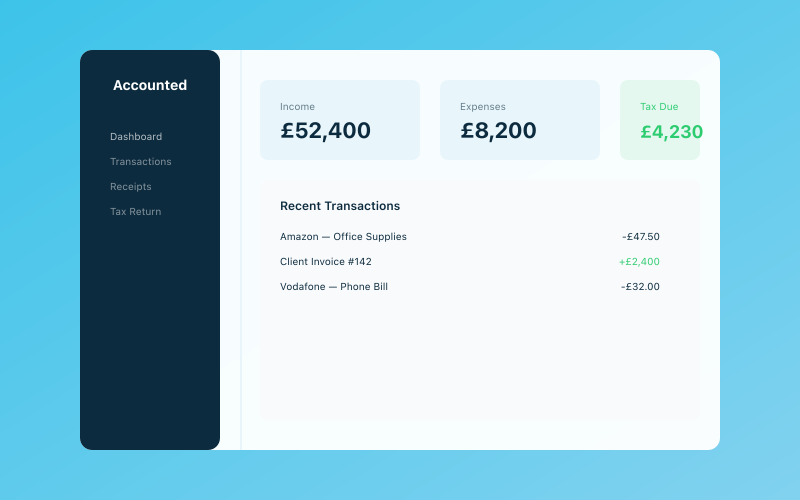 Your Accounted dashboard — income, expenses, and tax at a glance
Total income: How much did your business actually bring in? Not what you quoted or invoiced — what landed in your bank account? If there's a gap between what you invoiced and what you received, that tells you something about your collection process.
Total expenses: What did it cost to run your business? Break this down into categories: materials, software, travel, insurance, professional fees, marketing, and so on. Are there any categories that feel disproportionately high?
Net profit: Income minus expenses. This is the number that matters — it's what you actually earned, and it's what HMRC will base your tax bill on.
Cash flow patterns: Did your income arrive steadily throughout the year, or was it lumpy? Were there months when things were tight? Understanding your cash flow rhythm helps you plan for the same patterns in the year ahead.
If you've been using Accounted, pulling these figures together takes minutes. Penny can generate a summary of your annual income and expenses, broken down by month and category, giving you a clear picture of how the year actually went — as opposed to how you think it went.
Set Your Income Target
With last year's figures as a baseline, decide what you want to earn this year. This isn't about plucking an ambitious number from thin air — it's about working backwards from what you need.
Start with your personal needs:
- Living expenses: What does it cost you to live each month? Include rent or mortgage, food, bills, transport, childcare, and everything else.
- Tax and National Insurance: For the 2025/26 tax year, you'll pay income tax at 20% on profits between £12,570 and £50,270, and 40% on profits above that. Class 4 NICs add 6% between £12,570 and £50,270, and 2% above. As a rough guide, set aside 25–30% of your profits for tax. For guidance on calculating what you'll owe, see our guide to planning for a big tax bill.
- Savings and pension: What do you want to put away each month? Even a small pension contribution grows significantly over time, especially with tax relief.
- Business reinvestment: Do you want to invest in equipment, training, or marketing this year?
Add it all up, and you have your target profit. Add your estimated business expenses, and you have your income target.
For example: If you need £30,000 to live on, £8,000 for tax and NI, £3,000 for pension contributions, and your business expenses are £5,000, your income target is £46,000.
Build a Budget
A budget is simply a plan for how you'll spend your money. For sole traders, it doesn't need to be complicated.
Fixed costs: These are expenses that stay roughly the same each month — software subscriptions, insurance, phone contracts, loan repayments. List them out and add them up. These are your baseline costs; you'll incur them whether you earn anything or not.
Variable costs: These change depending on your activity level — materials, subcontractor fees, travel, marketing spend. Estimate these based on last year's figures, adjusted for any changes you're planning.
One-off costs: Are you planning any significant purchases this year? A new laptop, a training course, a piece of equipment? Factor these in so they don't catch you by surprise.
Total planned expenses = Fixed costs + Variable costs + One-off costs.
Subtract this from your income target, and you can see how much you need to earn each month, on average, to hit your goals.
Plan Your Cash Flow
Revenue and cash flow are not the same thing. You might have a brilliant month in terms of work completed, but if your clients don't pay for 30 or 60 days, your bank account tells a different story.
Cash flow planning means anticipating when money will come in and when it will go out. A few strategies:
Invoice promptly. The sooner you send an invoice, the sooner you get paid. Don't wait until the end of the month — invoice as soon as the work is delivered.
Set clear payment terms. 30 days is standard, but there's no rule against asking for 14 days, or even payment on receipt. Shorter payment terms improve your cash flow without affecting the amount you earn.
Chase late payments. This feels uncomfortable, but it's essential. A polite reminder at 7 days overdue, a firmer follow-up at 14 days, and a phone call at 30 days. Most late payments are due to oversight, not malice.
Build a buffer. Aim to keep at least two to three months' worth of fixed costs in a business savings account. This gives you a cushion for quiet periods or late-paying clients.
Stagger large expenses. If you need to make a big purchase, see if you can spread the cost or time it for a month when you know income will be strong.
Accounted's cash flow view shows you your income and outgoings on a timeline, making it easier to spot potential pinch points before they become problems.
Set Financial Goals
A budget tells you what you need to earn. Goals tell you what you're working towards. They're not the same thing, and having both keeps you motivated.
Good financial goals are specific, measurable, and time-bound. For example:
- "Increase my monthly income by 10% by June" — specific and measurable.
- "Save £5,000 in my business emergency fund by December" — clear and achievable.
- "Pay off my business credit card by September" — motivating and deadline-driven.
Avoid vague goals like "earn more" or "spend less." They don't give you anything to aim for or measure against.
Write your goals down. Review them quarterly. Adjust them if circumstances change — because they will.
Review Your Pricing
The new year is a natural time to review what you charge. Many sole traders set their rates when they start out and then leave them unchanged for years, even as their skills, experience, and costs all increase.
Ask yourself:
- Have my costs gone up? Inflation, software price increases, and rising household bills all erode your margins. Your pricing should account for this.
- Has my experience increased? You should be charging more in year five than you did in year one. If you're not, you're undervaluing yourself.
- What does the market look like? Research what others in your field are charging. You don't need to match the most expensive, but you shouldn't be the cheapest either.
- Am I too busy? If you're fully booked and turning work away, that's a strong signal to raise your rates. Price is a lever for managing demand.
If you decide to raise your prices, communicate it clearly and give existing clients fair notice — 30 to 60 days is typical. Frame it positively: you're investing in your skills and tools so you can deliver better work.
Prepare for Tax
Tax shouldn't be an afterthought — it should be part of your financial plan from day one of the new year.
Set aside money monthly. Transfer a percentage of every payment you receive into a separate savings account. When your tax bill arrives, the money is already there.
Know your deadlines. For the 2025/26 tax year, key dates include:
- 5 April 2026: Tax year ends
- 31 July 2026: Second payment on account for 2025/26
- 5 October 2026: Deadline to register for Self Assessment (if new)
- 31 January 2027: File your return and pay your tax
For a complete timeline, see our Self Assessment deadlines guide for 2025/26.
Consider Making Tax Digital. From April 2026, self-employed individuals earning over £50,000 will need to comply with Making Tax Digital for Income Tax. This means quarterly digital updates to HMRC. If you're not already using digital bookkeeping, now is the time to start. Our guide to what's changing in April 2026 has the full detail.
Make It a Habit
The best financial plan in the world is useless if you don't follow it. The key is to build financial management into your routine rather than treating it as a separate chore.
- Weekly: Spend 15 minutes categorising transactions, checking your bank balance, and logging any expenses. Penny can handle much of this automatically if you're using Accounted.
- Monthly: Review your income against your target, check your cash flow, and reconcile your accounts.
- Quarterly: Review your goals, check your tax set-aside, and adjust your budget if needed.
- Annually: Repeat this entire planning process.
Consistency beats intensity. Fifteen minutes a week throughout the year is worth far more than a frantic weekend in January trying to piece together 12 months of records.
Related reading:
Accounted helps UK sole traders stay on top of their bookkeeping and tax. Start your free 30-day trial at getaccounted.co.uk.
Related Reading
Start your free trial and see how Accounted simplifies your bookkeeping.
Accounted keeps your books sorted automatically so you can focus on running your business. See Accounted →
Business & Operations Advisors
Our business advisors cover the practical side of running a UK sole trader business — from HMRC registration to managing growth. Content is written for real business owners in plain English, not accountants.
Ready to try Accounted?
Join UK sole traders who are simplifying their bookkeeping and tax.
Start your 14-day free trial