New Tax Year — What's Changing in April 2026
Every April brings a fresh set of rules, rates, and thresholds that affect how much you earn, how much you keep, and how much goes to HMRC. Some years the changes are modest; others bring significant shifts that demand attention.
April 2026 sits somewhere in between — there's nothing earth-shattering, but several changes will have a real impact on sole traders and small business owners across the UK. Here's what you need to know.
Income Tax Rates and Thresholds
The personal allowance remains frozen at £12,570 for the 2026/27 tax year. This freeze, which has been in place since 2021/22, was originally set to last until April 2026 but has been extended through to April 2028. In practice, this means fiscal drag continues to pull more of your income into higher tax bands as your earnings grow with inflation.
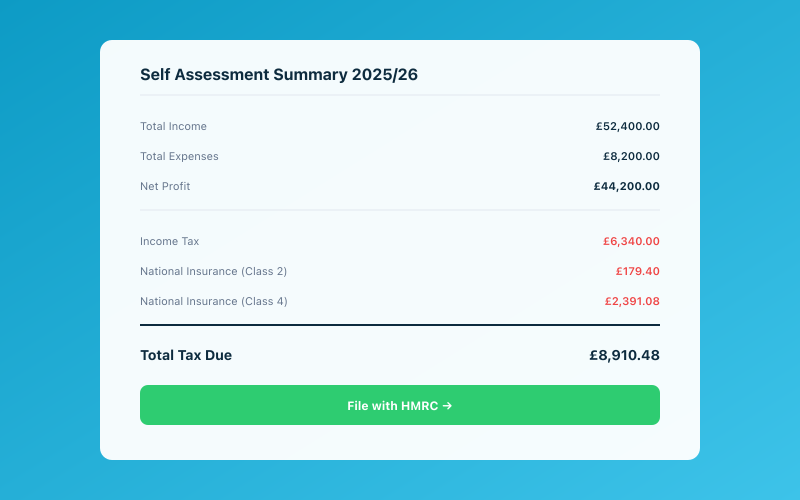 Your Accounted dashboard shows your real-time tax position
The income tax bands for England and Northern Ireland are:
- Personal allowance: £0–£12,570 (0%)
- Basic rate: £12,571–£50,270 (20%)
- Higher rate: £50,271–£125,140 (40%)
- Additional rate: Over £125,140 (45%)
Scotland has its own rate structure with six bands, so if you're based north of the border, check the Scottish Government's published rates for 2026/27.
The key takeaway: if your income has risen even modestly over the past few years, you may now be paying tax on a larger proportion of it than you were when the freeze began. It's worth reviewing your pricing and expenses to account for this.
National Insurance Contributions
National Insurance is where things get interesting for the self-employed in 2026/27.
Class 2 NICs were effectively abolished for most self-employed earners from April 2024. You no longer need to pay Class 2 contributions to access the state pension and other benefits, provided your profits exceed the Small Profits Threshold (£6,845 for 2026/27). Voluntary contributions remain available for those with lower profits who want to protect their National Insurance record.
Class 4 NICs remain at:
- 6% on profits between £12,570 and £50,270
- 2% on profits above £50,270
These rates were reduced from 8% and 2% respectively in the 2024/25 tax year, so they remain at the lower level. That said, watch for any announcements in the Autumn Statement that might alter these for future years.
Employer NICs rose significantly in April 2025 — the rate went up from 13.8% to 15%, and the threshold at which employers start paying dropped from £9,100 to £5,000. If you employ staff, even part-time, this remains a notable cost increase to factor into your planning. The Employment Allowance did increase to £10,500, which offsets some of the burden for smaller employers.
Making Tax Digital for Income Tax
This is the big one. Making Tax Digital for Income Tax Self Assessment (MTD for ITSA) is set to begin from April 2026 for self-employed individuals and landlords with qualifying income over £50,000. If that's you, you'll need to:
- Keep digital records of your income and expenses
- Submit quarterly updates to HMRC using compatible software
- File an end-of-period statement and a final declaration
From April 2027, the threshold drops to £30,000, bringing more sole traders into scope.
If your income is below £50,000, you won't be affected immediately, but it's coming — HMRC has indicated the threshold will continue to fall. Getting your digital bookkeeping sorted now, rather than waiting until you're forced to, is a sensible move. Accounted is designed to be MTD-compatible, so if you're already using it, you're well ahead of the curve.
For more on what the Spring Budget means for sole traders, see our Spring Budget 2026 summary.
Dividend and Savings Allowances
The dividend allowance remains at £500 for 2026/27. If you operate through a limited company and pay yourself in dividends, this is significantly lower than the £2,000 allowance that was in place just a few years ago. Dividend tax rates remain at 8.75% (basic), 33.75% (higher), and 39.35% (additional).
The personal savings allowance stays at £1,000 for basic rate taxpayers and £500 for higher rate taxpayers. With interest rates still elevated compared to the near-zero era, more people are finding their savings interest exceeds these thresholds.
Capital Gains Tax
Capital Gains Tax (CGT) rates for 2026/27 are:
- Basic rate: 18% (24% for residential property)
- Higher rate: 24% (24% for residential property)
The annual CGT exemption remains at £3,000, down from £6,000 in 2023/24 and £12,300 the year before that. If you're selling business assets, equipment, or property, the reduced exemption means more of the gain is taxable. Business Asset Disposal Relief (formerly Entrepreneurs' Relief) continues with a lifetime limit of £1 million, but the rate has risen to 14% from April 2025 and will increase further to 18% from April 2026.
VAT Registration Threshold
The VAT registration threshold increases to £90,000 for 2026/27 (up from £85,000 in earlier years, with the increase having taken effect from April 2024). If your taxable turnover is approaching this level, keep a close eye on your rolling 12-month total. Once you cross the threshold, you must register within 30 days.
The deregistration threshold is £88,000.
Minimum Wage and Living Wage
If you employ staff, the National Living Wage (for workers aged 21 and over) rises to £12.21 per hour from April 2025, with a further increase expected for April 2026 — check the Low Pay Commission's recommendations for the confirmed figure. The age threshold was lowered from 23 to 21 in April 2024, broadening the number of workers entitled to the higher rate.
Pension Annual Allowance
The pension annual allowance remains at £60,000 for 2026/27. You can contribute up to this amount (or your total earnings, whichever is lower) and receive tax relief at your marginal rate. For higher rate taxpayers, this means the government effectively contributes 40p for every 60p you put in — making pensions one of the most tax-efficient vehicles available to sole traders.
If you haven't used your full allowance in previous years, you can carry forward unused allowance from the preceding three tax years, provided you were a member of a pension scheme during those years. This can be particularly useful if you've had a strong year and want to reduce your tax bill significantly.
The money purchase annual allowance (for those who have flexibly accessed their pension) stays at £10,000. The tapered annual allowance for high earners begins reducing at adjusted income of £260,000.
What This Means for Your Business
The cumulative effect of frozen thresholds, reduced allowances, and MTD requirements is that running a small business in the UK requires more careful financial management than ever. A few practical steps:
- Review your profit projections. With thresholds frozen, even modest income growth could push you into a higher band. Use Penny to model different scenarios.
- Get your digital records in order. Even if MTD doesn't apply to you yet, adopting digital bookkeeping now will save you a headache later. The transition is far less painful if you start early rather than rushing to comply at the last minute.
- Maximise your pension contributions. With the annual allowance at £60,000, pension contributions remain one of the most tax-efficient things you can do. Consider setting up a regular monthly contribution rather than trying to find a lump sum at the end of the year.
- Plan for payments on account. If your tax bill is growing year on year, your payments on account will grow too. Budget accordingly.
- Watch the VAT threshold. If your turnover is approaching £90,000, monitor your rolling 12-month total closely. Crossing the threshold triggers a mandatory registration within 30 days, and late registration can result in penalties.
For a full checklist of things to do before the tax year ends, read our tax year end checklist.
Related reading:
Accounted helps UK sole traders stay on top of their bookkeeping and tax. Start your free 30-day trial at getaccounted.co.uk.
Related Reading
- Gifting Business Assets — Tax Implications
- What's New in the 2026/27 Tax Year — Everything That's Changing
Start your free trial and let Penny handle your bookkeeping automatically.
Penny, your AI bookkeeper, tracks your tax position in real time and flags opportunities to reduce your bill. Meet Penny →
Tax & Compliance Specialists
Our tax specialists have decades of combined experience in UK sole trader and small business taxation, MTD compliance, and HMRC submissions. All content is reviewed against current HMRC guidance before publication and updated quarterly to reflect legislative changes.
Ready to try Accounted?
Join UK sole traders who are simplifying their bookkeeping and tax.
Start your 14-day free trial