Gifting Business Assets — Tax Implications
Giving away a business asset might sound simple — you own something, you hand it to someone else, done. But in the eyes of HMRC, gifting a business asset is treated as a disposal, and that means there are tax consequences. Depending on what you're gifting, who you're giving it to, and the value involved, you could be looking at capital gains tax, income tax, or even inheritance tax implications.
This guide covers the main tax rules around gifting business assets in the UK, the reliefs that might be available, and the practical steps you should take before transferring anything.
Why Gifting Is Treated as a Disposal
When you give away an asset, HMRC treats it as if you sold it at its current market value — even though no money changed hands. This is called a "deemed disposal" and it can trigger a capital gains tax (CGT) liability.
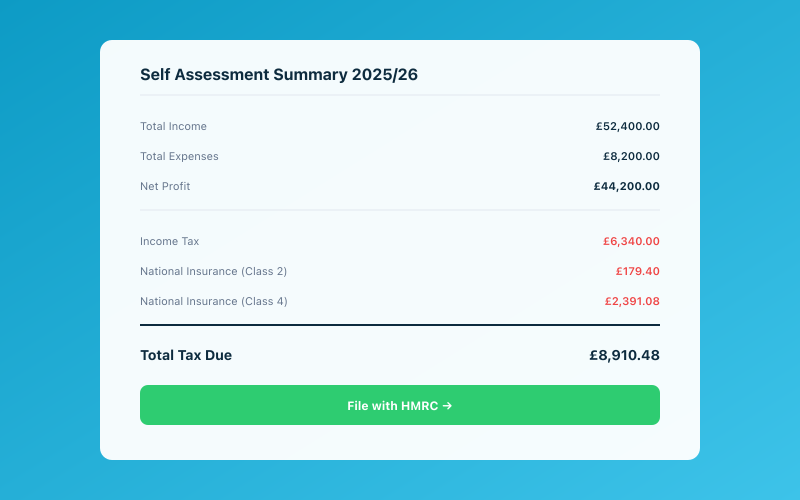 Your Accounted dashboard shows your real-time tax position
The logic is straightforward from HMRC's perspective: if you bought a piece of equipment for £5,000 and it's now worth £15,000, you've made a gain of £10,000. Whether you sell it for £15,000 or give it away for nothing, the gain is the same. HMRC wants its share either way.
This applies to most business assets, including:
- Plant and machinery
- Vehicles used in the business
- Commercial property
- Goodwill
- Shares in a business
- Intellectual property
The rate of CGT you'll pay depends on your total taxable income for the year and the type of asset. For most business assets, the rates are 10% (basic rate) or 20% (higher rate). Property disposals may attract higher rates.
For a broader overview of what happens when you dispose of business assets, our guide on tax on selling business assets is a useful companion to this article.
Gift Hold-Over Relief — The Key Relief for Business Assets
The good news is that there's a specific relief designed for exactly this situation. Gift Hold-Over Relief (under Section 165 of the Taxation of Chargeable Gains Act 1992) allows you to defer the capital gains tax when you give away certain business assets.
Here's how it works: instead of you paying CGT on the gain at the time of the gift, the gain is "held over" and effectively transferred to the recipient. When they eventually sell or dispose of the asset, they'll be treated as if they acquired it at your original cost, so they'll pay CGT on the full gain at that point.
Both you (the donor) and the recipient need to make a joint election for this relief. It's done using HMRC form HS295, and it must be claimed within a specific time limit — generally within four years of the end of the tax year in which the gift was made.
Assets that qualify for Gift Hold-Over Relief include:
- Assets used in your trade, profession, or vocation
- Shares in an unquoted trading company
- Shares in your personal trading company (where you hold at least 5% of the voting rights)
- Agricultural property
- Assets on which inheritance tax is chargeable (or would be but for an exemption)
Assets that don't qualify:
- Investment assets (shares in listed companies, buy-to-let properties, etc.)
- Assets not used for business purposes
- Personal possessions
There's an important limitation: if you gift an asset that's only partly used for business, only the business proportion of the gain can be held over. The non-business element is taxable immediately.
What About Assets You've Claimed Capital Allowances On?
If you've been claiming capital allowances on a business asset — say, a van or a piece of specialist equipment — and you then give it away, the gift triggers a balancing charge or balancing allowance. HMRC treats the gift as a disposal at market value, and compares that to the asset's tax written-down value.
If the market value is higher than the written-down value, you'll have a balancing charge, which is added to your taxable profits. If the market value is lower, you'll have a balancing allowance, which reduces your taxable profits.
For example, say you bought a van for £20,000, claimed capital allowances that reduced its written-down value to £8,000, and the van is now worth £12,000 at the time you gift it. The balancing charge would be £4,000 (£12,000 minus £8,000), and that £4,000 would be added to your self-employment profits for the year.
This is an income tax charge, not a CGT charge, because capital allowances are an income tax relief. It's separate from any CGT that might also apply (though for most plant and machinery, CGT won't be relevant because the asset is a wasting asset).
Tracking capital allowances properly is crucial here. If you use Accounted to manage your bookkeeping, Penny can help you keep tabs on your asset values so you're not caught off guard when it comes time to dispose of something.
Gifting to Family Members
Gifting business assets to family members is one of the most common scenarios, and it's where things can get tangled. The tax rules don't give you any special breaks just because the recipient is a family member — in fact, the "connected persons" rules mean HMRC is particularly vigilant about these transactions.
When you gift to a connected person (which includes spouses, civil partners, siblings, parents, children, and their spouses), the disposal is always treated as being at market value, regardless of what you actually charge. You can't sell an asset to your son for £1 and claim the disposal value was £1 — HMRC will substitute market value.
The one exception is transfers between spouses and civil partners. These are treated as "no gain, no loss" disposals, meaning no CGT arises at the time of transfer. The recipient takes on your original cost base, and any gain will crystallise when they eventually dispose of the asset to someone else.
This spousal exemption can be a useful planning tool. If one spouse has a lower income and therefore a lower CGT rate, transferring an asset to them before disposal can reduce the overall tax bill. But be aware that HMRC may challenge arrangements that look artificial or have no purpose other than tax reduction.
Inheritance Tax Implications
Gifting business assets also has inheritance tax (IHT) implications. When you give away something of value during your lifetime, it's treated as a "potentially exempt transfer" for IHT purposes. If you survive for seven years after making the gift, it drops out of your estate entirely. If you die within seven years, the value of the gift is brought back into your estate and may be subject to IHT at up to 40%.
However, there's a significant relief available: Business Property Relief (BPR). If the business asset qualifies for BPR, it may be relieved from IHT at 100% or 50%, depending on the type of asset. Qualifying assets include:
- A business or interest in a business (100% relief)
- Shares in an unquoted company (100% relief)
- Land, buildings, or machinery used in a business you're a partner in or control (50% relief)
BPR is a powerful relief, but it comes with conditions. The asset must have been owned for at least two years, and the business must be a trading business (investment businesses generally don't qualify).
One trap to watch for: if you gift a business asset but continue to benefit from it (for example, you give away your commercial premises but continue to use them rent-free), the "gift with reservation of benefit" rules may apply. This means the asset is still treated as part of your estate for IHT purposes, negating the benefit of the gift.
Practical Steps Before Gifting a Business Asset
Before you gift any business asset, here's what you should do:
-
Get a proper valuation. HMRC will want to see that you've used a genuine market value. For property, this means a professional valuation. For shares, goodwill, or intellectual property, you may need a specialist.
-
Check whether Gift Hold-Over Relief applies. If it does, make the joint election with the recipient. Keep copies of the signed election form.
-
Consider the capital allowances position. If you've claimed allowances on the asset, work out the balancing charge or allowance. This should be reflected in your accounts for the year.
-
Think about IHT. If the gift is significant, consider whether BPR applies and whether you'll need to survive seven years for the potentially exempt transfer rules to fully apply.
-
Keep detailed records. Record the date of the gift, the market value at that date, your original cost, any reliefs claimed, and the identity of the recipient. You'll need all of this if HMRC asks questions.
-
Update your business records. If you use Accounted, remove the asset from your books and record the disposal. This keeps your records clean and ensures your accounts accurately reflect what your business owns.
For related reading on CGT and property, our capital gains tax property guide covers many of the same principles in a property context.
When Professional Advice Is Worth It
Gifting business assets is one of those areas where getting it wrong can be expensive. The interaction between CGT, income tax (via capital allowances), and IHT is genuinely complex, and the right approach depends heavily on your individual circumstances.
If you're gifting something of modest value — a laptop, some tools, a small piece of equipment — the tax consequences may be negligible and you can probably handle it yourself. But if you're gifting property, shares, goodwill, or anything with significant value, professional advice is well worth the cost. A good accountant can help you structure the gift to minimise tax whilst keeping everything within the rules.
Related Reading
Start your free trial and let Penny handle your bookkeeping automatically.
Accounted helps UK sole traders stay on top of their bookkeeping and tax. Start your free 30-day trial at getaccounted.co.uk.
Penny, your AI bookkeeper, tracks your tax position in real time and flags opportunities to reduce your bill. Meet Penny →
Tax & Compliance Specialists
Our tax specialists have decades of combined experience in UK sole trader and small business taxation, MTD compliance, and HMRC submissions. All content is reviewed against current HMRC guidance before publication and updated quarterly to reflect legislative changes.
Ready to try Accounted?
Join UK sole traders who are simplifying their bookkeeping and tax.
Start your 14-day free trial