Tax Implications of Converting a Hobby to a Business
That Moment When Your Hobby Starts Making Money
It usually starts innocently enough. You bake a few cakes for friends, sell some handmade jewellery at a craft fair, or fix a neighbour's laptop for a bit of cash. Then word spreads. Orders come in. Before you know it, your Saturday afternoon hobby is generating real income — and you're wondering whether HMRC is about to come knocking.
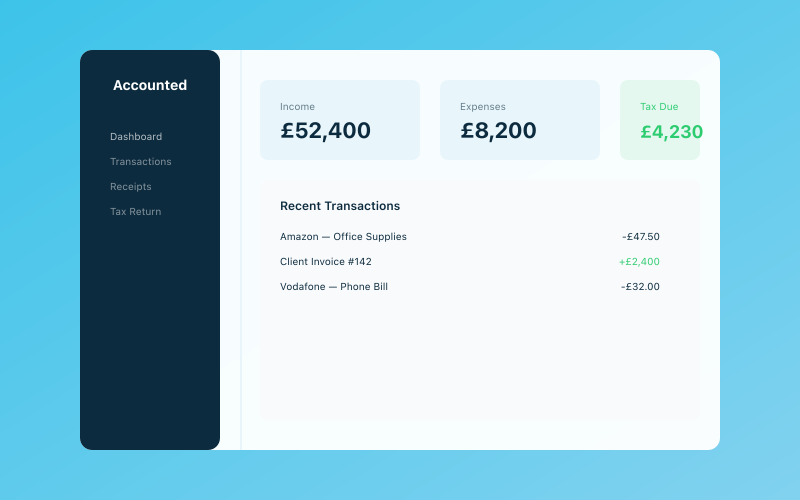 Your Accounted dashboard — income, expenses, and tax at a glance
The truth is, there's a grey area between "hobby" and "business," and it's not always obvious when you've crossed the line. But understanding where that line is — and what it means for your taxes — can save you from nasty surprises down the road.
The Trading Allowance: Your £1,000 Bridge
Before we get into the nitty-gritty, there's some good news. The trading allowance gives everyone a £1,000 tax-free threshold for miscellaneous trading income. If your total income from self-employment or casual trading is less than £1,000 in a tax year, you don't need to tell HMRC about it at all.
Think of it as a bridge between hobby and business. Earning a bit of pocket money from your craft stall? Under £1,000? You're fine — no registration, no tax return, no worries.
But the moment your trading income crosses that £1,000 threshold, things change. You'll need to register with HMRC as self-employed and file a Self Assessment tax return.
HMRC's Badges of Trade — When Does a Hobby Become a Business?
HMRC doesn't just look at how much you earn. They use a set of criteria known as the "badges of trade" to determine whether an activity constitutes a trade (and is therefore taxable). Here are the key ones:
Intent to Make a Profit
Are you doing this to make money, or purely for enjoyment? If you're setting prices to cover costs and generate profit, that looks like trading. If you're giving things away or selling at a loss with no intention of ever being profitable, it looks more like a hobby.
Frequency of Transactions
Selling one painting a year at a village fete? Probably a hobby. Selling paintings every week through an online shop? That's starting to look like a business.
The Nature of the Asset
Some items are inherently held for personal enjoyment (your record collection, for example), while others are clearly acquired for resale (buying wholesale stock). If you're buying materials specifically to make products for sale, that's a strong indicator of trading.
Modifications to the Product
If you're buying items, improving or modifying them, and selling them at a profit, HMRC is more likely to view this as trading. Think of someone buying old furniture, restoring it, and selling it on — that's a business pattern.
Organisation and Method
Do you have a system? A website? Business cards? A social media presence specifically for selling? The more organised and systematic your activity, the more it resembles a business.
Length of Ownership
If you buy something and sell it quickly, that suggests you acquired it for the purpose of trading. If you've owned something for years and decide to sell it, that's more likely a personal disposal.
It's worth noting that no single badge is decisive. HMRC looks at the overall picture. But if several badges point towards trading, you're running a business — whether you've formally registered or not.
When You Must Register with HMRC
The technical rule is that you must register for Self Assessment by 5th October following the end of the tax year in which you started trading. So if you started your business in July 2025 (tax year 2025/26), you'd need to register by 5th October 2026.
But in practice, you should register as soon as you recognise that your hobby has become a trade. The earlier you register, the easier it is to stay compliant and avoid penalties.
You'll need a Government Gateway account, and you'll receive a Unique Taxpayer Reference (UTR) number — usually within 10 working days. Our guide on how to register for Self Assessment walks you through the entire process with screenshots.
What If You Should Have Registered Earlier?
Don't panic. HMRC is generally understanding if you come forward voluntarily. This is called a "voluntary disclosure," and it's always better than waiting for HMRC to find out themselves.
You'll need to file returns for any years you should have been registered, pay the tax owed, and potentially pay some interest on late payments. But penalties for voluntary disclosures are typically much lower than penalties imposed after an HMRC investigation.
Claiming Expenses From Before You Registered
Here's something many new business owners don't realise: you can claim pre-trading expenses. HMRC allows you to claim allowable business expenses incurred up to seven years before your business started trading, as long as the expense would have been deductible if you'd already been in business.
Common pre-trading expenses include:
- Equipment and tools bought for your craft or trade
- Training courses directly related to your business activity
- Website development and domain registration
- Market research costs
- Stock and materials purchased before you started selling
- Professional advice (like legal or accounting fees)
Keep all your receipts and records — even from your hobby days. If you're using Accounted to manage your finances, Penny can help you categorise these pre-trading expenses correctly so nothing gets missed when you file your first return.
When Hobby Assets Become Business Assets
This is an area that catches people out. Let's say you've been using your personal camera for photography as a hobby, and now you're starting a photography business. That camera is now a business asset.
For tax purposes, the camera enters your business at its market value on the date you start trading — not what you originally paid for it. This matters for capital allowances. You can claim capital allowances on the market value, which reduces your taxable profit.
The same applies to other assets: your car (if used for business), a workshop in your garage, equipment, computers, and so on. Get a reasonable estimate of their market value on day one of your business.
What About Capital Gains?
When you transfer a personal asset into a business, there's technically a disposal for Capital Gains Tax purposes. However, in most cases, the market value at the point of transfer will be similar to what you paid (especially for depreciating assets like equipment), so there's rarely any CGT to pay. But if you're transferring something that's significantly increased in value — like a property or valuable equipment — it's worth getting advice.
Record-Keeping From Day One
Once you've crossed the line from hobby to business, you need to keep proper records. HMRC requires you to maintain records of all your income and expenses, and with Making Tax Digital rolling out, those records will need to be digital.
Here's what you should be tracking from the very first day:
- All income — every sale, no matter how small
- All expenses — receipts for everything you buy for the business
- Bank statements — ideally from a separate business bank account
- Invoices — both sent and received
- Mileage logs — if you use your car for business
The 2025/26 tax year has a Personal Allowance of £12,570, which means you won't pay income tax on the first £12,570 of your total income. After that, you'll pay 20% basic rate tax on income up to £50,270, 40% higher rate on income up to £150,000, and 45% additional rate above that.
Don't forget National Insurance, either. As a self-employed person, you'll pay Class 2 NI at £3.45 per week and Class 4 NI at 6% on profits between £12,570 and £50,270 (plus 2% above that).
The Emotional Side of Going Official
Let's be honest — there's something bittersweet about turning a hobby into a business. What was once pure enjoyment now comes with invoices, tax returns, and record-keeping. Some people worry that formalising their passion will take the joy out of it.
But most people find the opposite is true. When you start treating your craft seriously, you invest more in it. You improve. You connect with customers who genuinely value what you do. And yes, there's admin — but with the right tools, it doesn't have to be a burden.
Common Mistakes to Avoid
Waiting too long to register. The longer you leave it, the more back-tax and interest you'll owe. Register as soon as your trading income exceeds £1,000.
Not separating personal and business finances. Even if you don't legally need a business bank account as a sole trader, it makes life so much easier. Track your business income and expenses separately from personal spending.
Forgetting about VAT. If your turnover exceeds £90,000, you must register for VAT. It seems like a lot now, but successful businesses can reach this threshold faster than you'd expect.
Over-claiming expenses. Only claim expenses that are "wholly and exclusively" for business purposes. If something is used for both personal and business use (like your home broadband), you can only claim the business proportion.
Not setting money aside for tax. A good rule of thumb is to set aside 25-30% of your profits for tax and NI. Open a savings account specifically for this purpose so you're not scrambling when January rolls around.
Making the Transition Smooth
The shift from hobby to business doesn't have to happen overnight. Here's a sensible approach:
- Track your income from the start — even before you hit £1,000
- Research your obligations (you're doing that right now, so well done)
- Register with HMRC once you know you're trading
- Set up proper bookkeeping from day one
- Open a business bank account to keep things clean
- Understand your allowable expenses and claim everything you're entitled to
- Set aside money for tax every time you're paid
Ready to Make It Official?
If your hobby is turning into something more, embrace it. The UK tax system is actually quite generous to small businesses, with the trading allowance, the Personal Allowance, and plenty of deductible expenses to keep your tax bill manageable.
And when you're ready to get your finances properly organised, Accounted is here to help. With Penny handling the day-to-day bookkeeping, you can focus on doing what you love — just with a bit more structure (and a lot less tax stress).
Related Reading
- The Trading Allowance (£1,000) — A Simple Explanation
- How to Register for Self Assessment — A Step-by-Step Guide
- Tax Deductions Every Sole Trader Should Know About
- Famous People Who Started as Sole Traders
- How to Start a Property Maintenance Business
- Starting a Pet Sitting and Dog Boarding Business
Starting out? Accounted is built for UK sole traders from day one — from £14/month. Get started →
Business & Operations Advisors
Our business advisors cover the practical side of running a UK sole trader business — from HMRC registration to managing growth. Content is written for real business owners in plain English, not accountants.
Ready to try Accounted?
Join UK sole traders who are simplifying their bookkeeping and tax.
Start your 14-day free trial