Tax When You Separate or Divorce — Business Implications
Separation and divorce are difficult enough without having to worry about what happens to your business. But if you're self-employed, your business is likely one of your most significant assets — and how it's treated during a separation can have major implications for your tax position, your livelihood, and your financial future.
This isn't a guide to family law (you'll need a solicitor for that), but it does cover the tax side of things — what changes, what you need to be aware of, and how to protect both your business and your financial position during what's inevitably a challenging time.
The Tax Year of Separation
The tax treatment of married couples changes from the moment you separate, and the timing matters more than you might think.
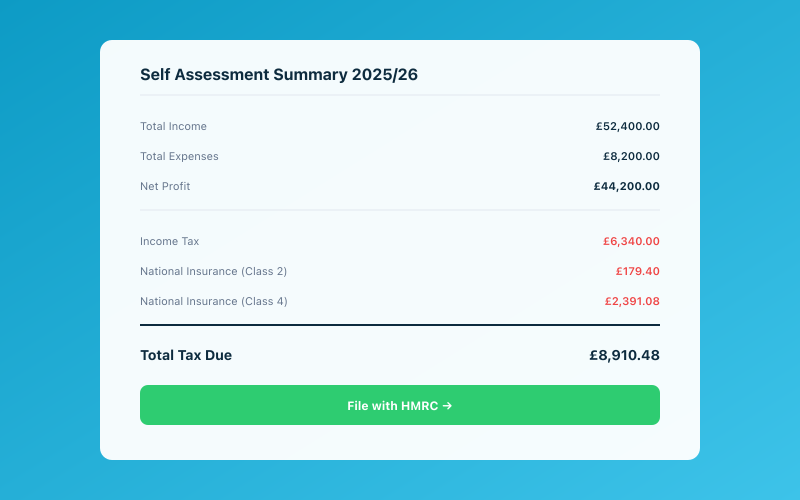 Your Accounted dashboard shows your real-time tax position
Under UK tax law, married couples are treated as connected persons, which gives certain advantages — particularly around Capital Gains Tax, where transfers between spouses happen at no gain, no loss. These advantages continue until the end of the tax year in which you separate.
So if you separate on 15 November 2025, you're still treated as spouses for CGT purposes until 5 April 2026. Any asset transfers between you during that period can still happen at no gain, no loss. After 5 April 2026, that protection ends, and any transfers of assets between you will be treated as disposals at market value, potentially triggering CGT.
This window is critically important for business owners. If assets need to be transferred between you as part of the separation — shares in a business, property, equipment — doing so before the end of the tax year of separation avoids what could be a substantial CGT bill.
It's worth noting that this changed relatively recently. Prior to April 2023, you only had until the end of the tax year of separation. The rules were updated to give separating couples up to three years from the date of separation (or until the financial settlement is finalised, if sooner) to transfer assets at no gain, no loss. This extended window is much more practical, but the earlier you act, the more flexibility you have.
Valuing Your Business
In any divorce, the matrimonial assets need to be identified and valued. If you're a sole trader, your business is an asset — and its value may need to be determined.
Valuing a sole trader business isn't always straightforward. Unlike a limited company with shares, there's no clear market price. The value typically comes from a combination of:
- Goodwill — the value of your client relationships, reputation, and brand
- Physical assets — equipment, vehicles, stock, and tools
- Net current assets — money owed to you minus money you owe
- Future earning potential — though this is more relevant to the overall financial settlement than to the business valuation itself
In many cases, a forensic accountant or business valuer will be needed to provide a fair and defensible valuation. This valuation will be used in the financial settlement negotiations and, if necessary, by the court.
It's important to approach this honestly. Understating the value of your business might seem tempting, but family courts are experienced at spotting this, and being caught out will severely damage your credibility. Provide accurate records and cooperate with the valuation process.
Having well-organised financial records makes this process much smoother. If you've been using Accounted to manage your bookkeeping, your profit and loss statements, income records, and expense tracking will be readily available — which saves time, reduces professional fees, and demonstrates transparency.
Capital Gains Tax on Asset Transfers
When assets are transferred between separating spouses as part of a financial settlement, CGT is the main tax to watch.
As mentioned, transfers during the extended window (up to three years from separation, or until the financial settlement) happen at no gain, no loss. This means neither party pays CGT at the time of transfer. Instead, the receiving spouse inherits the original base cost, and CGT will be due when they eventually sell the asset.
After the window closes, any transfer is treated as a disposal at market value. This can create an immediate CGT liability, even though no money has changed hands. For this reason, it's important to ensure that asset transfers are completed within the qualifying period.
Common assets that trigger CGT considerations in a divorce include:
-
The family home — usually exempt under Principal Private Residence (PPR) relief, but the rules are more complex when one spouse has moved out. You get PPR relief for the final nine months of ownership even if you're not living there, which provides some breathing room.
-
Buy-to-let properties — these don't qualify for PPR relief and will be subject to CGT on any gain. Transferring a rental property to your ex-spouse during the no-gain-no-loss window avoids an immediate charge, but they'll face CGT when they eventually sell.
-
Business assets — equipment, goodwill, and other business assets transferred as part of the settlement. If these are transferred within the qualifying period, no CGT arises immediately.
For a more detailed look at how CGT applies specifically in divorce situations, our guide on tax implications of divorce for the self-employed goes into greater depth.
Income Tax Implications
Separation and divorce can affect your income tax position in several ways.
Marriage Allowance ends. If you've been using Marriage Allowance (where one spouse transfers part of their Personal Allowance to the other), this will need to be cancelled. It continues until the end of the tax year of separation, but after that, both of you revert to your individual Personal Allowances.
Maintenance payments. If you pay maintenance to your ex-spouse, these payments are not tax-deductible. You can't reduce your taxable business profit by the amount of maintenance you pay. Equally, maintenance received by your ex-spouse is not taxable income for them.
Child maintenance follows the same principle — not deductible for the payer, not taxable for the recipient.
Changes to your household income could affect other tax-related calculations. For example, if you were previously affected by the High Income Child Benefit Charge because of your combined household income, your position may change after separation. If you're the parent receiving Child Benefit and your individual income is below £60,000, you'll no longer need to repay any of it — regardless of your ex-spouse's income.
Payments on Account may need adjusting. If your income changes significantly as a result of the separation — perhaps because your spouse was contributing to the business, or because you're paying maintenance that reduces your available cash — you can apply to reduce your Payments on Account to avoid cash flow pressure.
What Happens to Shared Business Arrangements
If your spouse was involved in your business, separation creates some practical challenges.
If your spouse was a paid employee, you'll need to decide whether they continue working in the business. If not, you'll need to handle the termination properly — including notice, final pay, and any redundancy considerations. From a tax perspective, losing an employee's salary as a deduction will increase your taxable profit.
If you ran the business as a partnership, the partnership may need to be dissolved. The Partnership Agreement (if you have one) should cover what happens in this situation. If there's no formal agreement, the Partnership Act 1890 provides default rules — including that any partner can dissolve the partnership by giving notice. The tax implications of dissolving a partnership are similar to those of closing a sole trader business, but with additional complexity around the allocation of assets and the final partnership return.
If your spouse managed your finances or bookkeeping, you'll need to take over these responsibilities or find someone else to handle them. This is where tools like Accounted become particularly valuable. Penny can take over the routine categorisation and organisation of your financial records, ensuring nothing falls through the cracks during a turbulent period.
Protecting Your Business Going Forward
While you can't undo the past, there are steps you can take to protect your business during and after a divorce.
Get specialist advice early. A family solicitor with experience in cases involving business owners is essential. The way the financial settlement is structured can have a major impact on your tax position and the viability of your business.
Keep your business finances impeccable. Clean, accurate records strengthen your position in settlement negotiations and prevent disputes about income and expenses. If your records are disorganised, now is the time to sort them out.
Understand the difference between income and capital. In a financial settlement, your business income determines the maintenance calculation, while the capital value of your business determines the asset split. These are different things, and confusing them can lead to unfair outcomes.
Consider the timing of any asset sales. If you need to sell business assets as part of the settlement, the timing can significantly affect the CGT due. Work with your accountant and solicitor to plan disposals in the most tax-efficient way.
Update your will and estate planning. Divorce doesn't automatically revoke your will in England and Wales (it does in Scotland). You should update your will to reflect your new circumstances. Also review any life insurance policies, pension beneficiary nominations, and other financial arrangements.
Think about pensions. Pensions are often the second most valuable asset after the family home, and they can be shared or offset in a divorce settlement. A Pension Sharing Order can split a pension between the two parties, creating a separate pension fund for the receiving spouse. The tax implications of pension sharing are complex, and specialist advice is strongly recommended.
Moving Forward
Divorce is rarely straightforward, and the tax and business implications add another layer of complexity. But with the right advice and proper planning, it's possible to protect your business, minimise your tax exposure, and emerge from the process in a position to rebuild.
The key is to act early, be transparent about your finances, and work with professionals who understand the intersection of family law and business taxation. And through it all, keeping your day-to-day bookkeeping in order means one less thing to worry about during an already difficult time.
For more on the specific tax questions that arise in this situation, see our detailed guide on tax implications of divorce for the self-employed.
Related reading:
- Tax Implications of Divorce for the Self-Employed
- Self-Assessment and Marriage Tax
- Closing a Sole Trader Business — Tax Implications
Accounted helps UK sole traders stay on top of their bookkeeping and tax. Start your free 30-day trial at getaccounted.co.uk.
Related Reading
Start your free trial and let Penny handle your bookkeeping automatically.
Penny, your AI bookkeeper, tracks your tax position in real time and flags opportunities to reduce your bill. Meet Penny →
Tax & Compliance Specialists
Our tax specialists have decades of combined experience in UK sole trader and small business taxation, MTD compliance, and HMRC submissions. All content is reviewed against current HMRC guidance before publication and updated quarterly to reflect legislative changes.
Ready to try Accounted?
Join UK sole traders who are simplifying their bookkeeping and tax.
Start your 14-day free trial