Research and Development Tax Relief for Sole Traders
When people hear "R&D tax relief," they tend to think of laboratories, pharmaceutical companies, and tech startups with venture capital funding. It sounds like something reserved for large corporations with dedicated research departments.
But here is the thing — R&D tax relief is available to sole traders too. If you are self-employed and your work involves solving technical problems, developing new processes, or creating innovative products, you might well qualify. The relief can reduce your tax bill significantly, and yet most sole traders never even consider claiming it.
What Is R&D Tax Relief?
R&D tax relief is a government incentive designed to encourage innovation in the UK. It allows businesses — including sole traders — to claim additional tax deductions for expenditure on qualifying research and development activities.
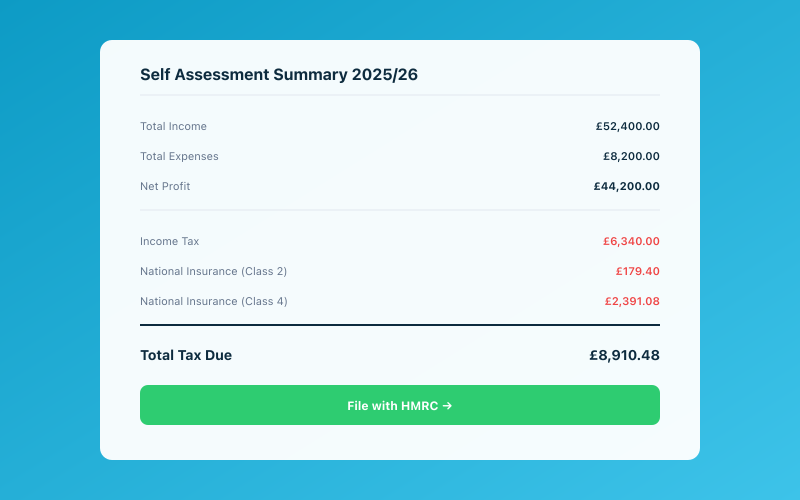 Your Accounted dashboard shows your real-time tax position
For sole traders, the relief works as an enhanced deduction against your trading profits. You can deduct an additional percentage of your qualifying R&D expenditure on top of the normal 100% deduction you would already claim as a business expense.
The effect is to reduce your taxable profit, which in turn reduces your income tax and National Insurance liabilities.
For more background on reliefs available to sole traders, see our guide on how to reduce your tax bill as a sole trader.
What Counts as R&D?
HMRC uses a specific definition of R&D based on guidelines from the Department for Science, Innovation and Technology (DSIT). The key test is whether your project seeks to achieve an advance in overall knowledge or capability in a field of science or technology through the resolution of scientific or technological uncertainty.
That sounds academic, but it is broader than you might think. Here are the essential elements:
There Must Be a Technological Advance
Your work must aim to create something that is not already publicly available or commonly known in the field. It does not need to be a world-first breakthrough — an advance that is new to your sector or field is sufficient.
There Must Be Technological Uncertainty
You must be trying to solve a problem where the solution is not readily deducible by a competent professional in the field. If an experienced person in your area would not know how to achieve what you are attempting, that qualifies as uncertainty.
The Work Must Be Systematic
There should be a planned, structured approach to resolving the uncertainty. Random experimentation without a clear methodology is unlikely to qualify.
It Must Be in Science or Technology
Work in the arts, humanities, or social sciences does not qualify. However, the definition of "technology" is quite broad and includes software development, engineering, manufacturing processes, food science, and many other fields.
Examples of R&D for Sole Traders
To make this more concrete, here are some examples of sole trader activities that could qualify:
- A software developer building a new algorithm to process data in a way that has not been done before, or finding a novel way to integrate systems that were previously incompatible.
- A food producer developing a new preservation technique that extends shelf life without compromising quality, where the science behind the method is not established.
- An engineer designing a bespoke manufacturing process to produce a component with specifications that existing methods cannot achieve.
- A craftsperson developing a new material or technique that overcomes limitations of existing approaches — for example, a ceramicist creating a glaze that withstands higher temperatures than previously possible.
- A farmer trialling new growing methods or biological pest controls where the effectiveness is genuinely uncertain.
The common thread is that you are pushing beyond what is already known and available. Routine development, cosmetic changes, or using established techniques in a standard way do not count.
What Expenditure Can You Claim?
Qualifying expenditure for sole traders typically includes:
- Staff costs — If you employ people to work on the R&D project, their salaries, wages, NI contributions, and pension contributions qualify. If you subcontract work, a portion of those costs may also qualify.
- Consumable materials — Raw materials, components, and utilities used directly in the R&D activity.
- Software — Licences for software used directly in the R&D work.
- Your own time — As a sole trader, the cost of your own labour is not a separate deductible expense (since your profit already reflects your effort). However, the enhanced deduction applies to the other qualifying costs you incur.
It is worth noting that capital expenditure (buying equipment, for example) does not qualify for the R&D revenue deduction, though there may be separate capital allowances available.
How Much Can You Save?
The merged R&D scheme (which applies from April 2024 onwards) provides an enhanced deduction of 86% on top of the normal 100% deduction for qualifying expenditure. This means for every £100 of qualifying R&D spend, you can deduct £186 from your trading profits.
If you are a higher rate taxpayer, the tax saving on that additional £86 deduction is £34.40 (40% × £86). For a basic rate taxpayer, it is £17.20 (20% × £86).
That may not sound transformative on small amounts, but if your qualifying expenditure runs to several thousand pounds, the savings add up. For example:
- £10,000 of qualifying R&D spend creates an additional deduction of £8,600
- At 40% tax rate, that saves £3,440 in income tax
- Plus savings on Class 4 National Insurance contributions
How to Claim R&D Relief as a Sole Trader
The claim is made through your Self Assessment tax return. You include the enhanced deduction when calculating your trading profits.
Here is the process:
- Identify qualifying projects — Determine which of your activities meet the HMRC definition of R&D.
- Calculate qualifying expenditure — Total up the relevant costs associated with those projects.
- Apply the enhanced deduction — Deduct the additional percentage on top of your normal expenses.
- Include in your tax return — Report the enhanced figure in your self-employment section.
- Keep supporting records — Document what you did, why it involved uncertainty, how you attempted to resolve it, and what you spent.
The documentation point is critical. HMRC may enquire into R&D claims, and you need to be able to demonstrate that your work genuinely qualifies. A contemporaneous record of your R&D activities is far more convincing than a retrospective write-up.
For more detail on R&D claims specifically, have a look at our R&D tax relief guide.
Common Mistakes With R&D Claims
Overclaiming
The temptation to stretch the definition of R&D is real, but HMRC are increasingly scrutinising claims. If your work does not genuinely involve technological uncertainty, do not claim. An aggressive claim that gets challenged can result in penalties and interest on top of the repaid relief.
Underclaiming
Equally common — many sole traders do qualifying work and never think to claim. If you are doing something genuinely innovative in your field, it is worth investigating.
Poor Record-Keeping
Without clear records of what you did and why, defending a claim becomes very difficult. Keep project notes, emails, technical specifications, and financial records as you go.
Confusing Innovation With R&D
Not all innovation qualifies. Using a new piece of software for the first time, applying an established technique to a new market, or improving your products in ways that do not involve scientific or technological uncertainty — none of these would typically qualify.
Getting Help With Your Claim
R&D tax relief is an area where professional advice can pay for itself, especially for a first claim. An accountant or specialist R&D adviser can help you identify qualifying activities, calculate the claim correctly, and prepare the supporting documentation.
That said, keeping your underlying financial records in order is your responsibility. Accounted makes it easy to track your expenses by category throughout the year, so when it comes time to identify R&D expenditure, the data is already there. Penny can even help you flag expenses that might be relevant to an R&D claim.
Is It Worth the Effort?
For sole traders with significant qualifying expenditure, absolutely. The enhanced deduction can reduce your tax bill by thousands of pounds. Even for smaller claims, it is money you are entitled to — why leave it on the table?
The key is to be honest about whether your work genuinely qualifies. If it does, the claim process through Self Assessment is relatively straightforward, provided you have the supporting evidence.
Related Reading
Start Tracking Your R&D Expenditure
If you think your work might qualify for R&D tax relief, start keeping records now. The better your documentation, the stronger your claim.
Start your free trial and let Penny handle your bookkeeping automatically.
Accounted helps UK sole traders stay on top of their bookkeeping and tax. Start your free 30-day trial at getaccounted.co.uk.
Penny, your AI bookkeeper, tracks your tax position in real time and flags opportunities to reduce your bill. Meet Penny →
Tax & Compliance Specialists
Our tax specialists have decades of combined experience in UK sole trader and small business taxation, MTD compliance, and HMRC submissions. All content is reviewed against current HMRC guidance before publication and updated quarterly to reflect legislative changes.
Ready to try Accounted?
Join UK sole traders who are simplifying their bookkeeping and tax.
Start your 14-day free trial