Salary Sacrifice — How It Reduces Your Tax Bill
If you've ever looked at your payslip and wondered where all your money went, you're not alone. Between income tax and National Insurance contributions, it can feel like a significant chunk of your earnings vanishes before it even reaches your bank account. But there's a perfectly legitimate way to keep more of your hard-earned cash — and it's called salary sacrifice.
Salary sacrifice (sometimes called salary exchange) is one of those tax-saving strategies that sounds complicated but is actually quite straightforward once you understand how it works. In this guide, we'll walk you through everything you need to know about salary sacrifice arrangements in the 2025/26 tax year, including how they reduce your tax bill, which benefits qualify, and whether it's the right move for you.
What Is Salary Sacrifice?
Salary sacrifice is an agreement between you and your employer where you give up a portion of your gross salary in exchange for a non-cash benefit. The key word here is "gross" — the reduction happens before tax and National Insurance are calculated, which is precisely why it saves you money.
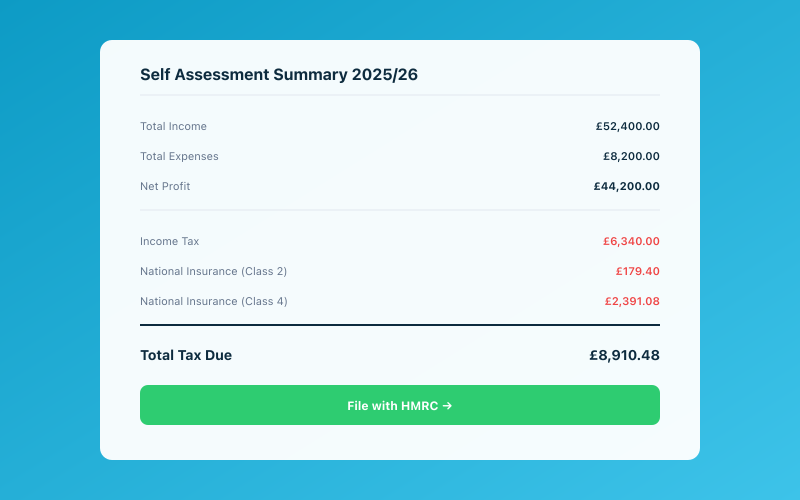 Your Accounted dashboard shows your real-time tax position
For example, instead of receiving £50,000 in salary and then paying tax and NI on the full amount, you might agree to reduce your salary to £45,000 and have your employer put the remaining £5,000 directly into your workplace pension. Because that £5,000 never counts as your income, you don't pay income tax or employee National Insurance on it.
How It Differs from Net Pay Deductions
It's important not to confuse salary sacrifice with a standard payroll deduction. With a normal deduction, your employer takes money from your pay after tax and NI have been calculated. With salary sacrifice, the reduction happens before those calculations, meaning both you and your employer save on National Insurance contributions.
How Salary Sacrifice Reduces Your Tax Bill
The tax savings from salary sacrifice come from two places: income tax and National Insurance. Let's look at the numbers for the 2025/26 tax year.
Income Tax Savings
With the personal allowance set at £12,570 and the basic rate of income tax at 20%, every pound you sacrifice below the higher rate threshold saves you 20p in income tax. If you're a higher rate taxpayer (40%) or an additional rate taxpayer (45%), the savings are even more significant.
Example: Sarah earns £55,000 and sacrifices £5,000 into her pension.
- Without sacrifice: She pays 40% tax on the portion above £50,270, so that £5,000 costs her £2,000 in income tax.
- With sacrifice: Her taxable salary drops to £50,000, and she avoids the £2,000 tax charge entirely.
National Insurance Savings
This is where salary sacrifice really shines compared to other tax-saving methods. Employee NI contributions are charged at 8% on earnings between £12,570 and £50,270 in 2025/26. By reducing your salary, you reduce the amount subject to NI — and unlike pension tax relief through other methods, there's no way to reclaim NI contributions after the fact.
Your employer also saves on their NI contributions (13.8% in 2025/26), which is why many employers are happy to offer salary sacrifice arrangements. Some even pass a portion of their NI savings back to employees as an additional benefit.
Which Benefits Qualify for Salary Sacrifice?
Not every workplace benefit can be provided through salary sacrifice. HMRC has specific rules about what qualifies. Here are the main options:
Pension Contributions
This is by far the most popular use of salary sacrifice. The annual allowance for pension contributions in 2025/26 is £60,000 (or 100% of your earnings, whichever is lower), giving plenty of room for tax-efficient saving. If you haven't used your full allowance in previous years, you may be able to carry forward unused allowances to boost your contributions further.
Childcare Vouchers and Workplace Nurseries
Although the childcare voucher scheme closed to new entrants in October 2018, those already in the scheme can continue to benefit. Workplace nursery provision remains a valid salary sacrifice benefit and is exempt from tax and NI without any cap.
Cycle to Work Schemes
You can sacrifice salary to cover the cost of a bicycle and cycling equipment for commuting. The benefit is exempt from tax and NI, making it a genuinely cheaper way to get a bike.
Ultra-Low Emission Vehicles
Company car schemes for electric and ultra-low emission vehicles have become increasingly popular. With the benefit-in-kind rate for zero-emission cars still very low in 2025/26, salary sacrifice for an electric car can be remarkably cost-effective compared to buying or leasing privately.
Technology Schemes
Some employers offer salary sacrifice for laptops, phones, and other technology, though the tax treatment here is more nuanced and the benefit-in-kind charges can reduce the overall savings.
Things to Watch Out For
Salary sacrifice isn't without its potential downsides. Before you sign up, consider these important points.
Impact on Your Take-Home Pay
Your contractual salary will be lower, which means your take-home pay is reduced. While the tax and NI savings offset much of this, you need to make sure you can still comfortably cover your living expenses. It's worth doing the sums carefully — or using a salary sacrifice calculator — before committing.
Effect on Other Benefits
Because your official salary is lower, anything calculated based on your salary could be affected. This includes:
- Mortgage applications: Lenders look at your contractual salary, so a lower figure could reduce how much you can borrow.
- Statutory payments: Statutory maternity pay, statutory sick pay, and redundancy pay are all based on your actual salary. If your sacrifice pushes your earnings below certain thresholds, you could receive less.
- Life insurance and income protection: If these are calculated as a multiple of salary, a lower salary means lower cover.
The National Minimum Wage Floor
Your employer cannot allow you to sacrifice salary below the National Minimum Wage (or National Living Wage). This sets a hard floor on how much you can sacrifice, which is particularly relevant for lower earners.
You Can't Easily Reverse It
Most salary sacrifice agreements run for a fixed period (often 12 months), and you can't simply opt out whenever you like. HMRC does allow changes in certain "lifestyle events" — such as marriage, divorce, or a partner losing their job — but generally, you're locked in for the agreed term.
Is Salary Sacrifice Right for You?
Salary sacrifice works best for people who:
- Are employed (it's not available to sole traders or the self-employed, though if you run a limited company and pay yourself a salary, you could set up an arrangement)
- Pay income tax at the basic, higher, or additional rate
- Want to maximise their pension contributions in a tax-efficient way
- Are considering an electric car through their employer
- Can afford a temporary reduction in take-home pay
If you're self-employed, salary sacrifice isn't directly available to you, but there are plenty of other ways to reduce your tax bill as a sole trader. Tools like Accounted can help you identify allowable expenses and plan your tax position throughout the year, so you're never caught off guard.
How to Set Up a Salary Sacrifice Arrangement
Setting up salary sacrifice is straightforward, but it needs to be done properly to satisfy HMRC:
- Speak to your employer or HR department about what salary sacrifice schemes they offer.
- Review the terms carefully, including the duration of the agreement and any restrictions on opting out.
- Sign a formal agreement that confirms the change to your terms and conditions of employment. This must be prospective — you can't sacrifice salary you've already earned.
- Check your payslip after the arrangement starts to confirm the deductions are being applied correctly.
If your employer doesn't currently offer salary sacrifice, it might be worth raising it with them. Many employers are receptive because they save on their own NI contributions — it's a genuine win-win.
Making the Most of Your Tax Planning
Salary sacrifice is just one piece of the tax planning puzzle. Combined with using your full personal allowance of £12,570, making the most of pension allowances, and ensuring you're claiming all the reliefs and allowances available to you, it's possible to keep significantly more of what you earn.
The key is to plan ahead rather than scramble at the end of the tax year. A good year-end tax planning review can help you identify opportunities you might otherwise miss.
Accounted helps UK sole traders stay on top of their bookkeeping and tax. Start your free 30-day trial at getaccounted.co.uk
Related reading:
- How to Pay Less Tax Legally in the UK
- Pension Contributions Before April — Use It or Lose It
- Tax Year-End Planning Guide
Related Reading
- Inheritance Tax and Business Property Relief — Protecting Your Business
- Tax on Cryptocurrency Staking and DeFi Income
Start your free trial and let Penny handle your bookkeeping automatically.
Penny, your AI bookkeeper, tracks your tax position in real time and flags opportunities to reduce your bill. Meet Penny →
Tax & Compliance Specialists
Our tax specialists have decades of combined experience in UK sole trader and small business taxation, MTD compliance, and HMRC submissions. All content is reviewed against current HMRC guidance before publication and updated quarterly to reflect legislative changes.
Ready to try Accounted?
Join UK sole traders who are simplifying their bookkeeping and tax.
Start your 14-day free trial