Pension Contributions Before Tax Year End: Why April Matters
The UK tax year ends on 5 April. Once that date passes, your 2025/26 annual allowance is gone. Any pension contribution you make after that counts towards 2026/27 instead. If you want to reduce this year's tax bill, you need to act before the deadline. This guide explains why April matters, how the tax relief works, and what strategies you can use in the final weeks of the tax year.
Why the Tax Year End Matters for Pensions
Pension contributions reduce your taxable income in the tax year they are made. A contribution made on 4 April 2026 reduces your 2025/26 tax bill. The same contribution made on 6 April 2026 reduces your 2026/27 tax bill instead.
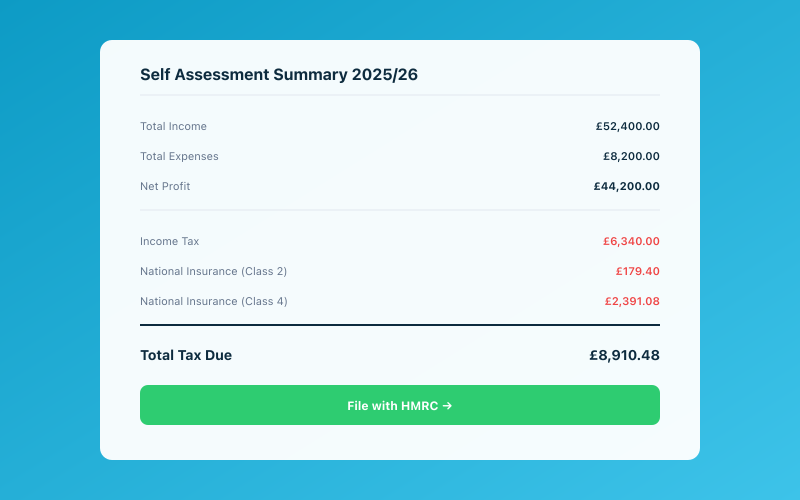 Your Accounted dashboard shows your real-time tax position
This might not matter if your income is the same every year. But for self-employed people, income often varies. If 2025/26 has been a good year and you expect 2026/27 to be quieter, bringing a pension contribution forward into this tax year makes it more valuable — you are offsetting tax at a higher effective rate.
There are also specific tax thresholds where a well-timed contribution has an outsized impact. Getting below these thresholds before the year end is where the real planning opportunities lie.
Key Thresholds to Watch
The higher rate threshold: £50,270
If your taxable income for 2025/26 is above £50,270, you are paying 40% tax on the excess. A pension contribution that brings your income back to £50,270 or below means you pay basic rate (20%) instead of higher rate (40%) on that slice.
For every £1,000 of income you push below the higher rate threshold, you save £200 in tax (the difference between 40% and 20%).
Example: Your self-employed profit is £58,000. A pension contribution of £7,730 (gross — you pay £6,184 and the provider claims £1,546 in basic rate relief) brings your taxable income down to £50,270. You save £3,092 in tax that you would have paid at 40%.
The personal allowance trap: £100,000 to £125,140
Once your income exceeds £100,000, you start losing your personal allowance at a rate of £1 for every £2 of income above £100,000. By £125,140, the personal allowance is gone entirely.
This creates an effective marginal tax rate of 60% on income between £100,000 and £125,140. For every £1,000 earned in this range, you pay £400 in higher rate tax plus £200 because of the lost personal allowance.
A pension contribution that takes your income below £100,000 restores your full personal allowance and avoids this 60% effective rate. The tax saving is substantial.
Example: Your profit is £115,000. Without a pension contribution, your personal allowance is reduced by £7,500 (half of the £15,000 above £100,000), leaving only £5,070 of allowance.
A gross pension contribution of £15,000 brings your income to £100,000 and restores the full £12,570 personal allowance. The tax saving on the contribution is effectively 60% on the amount within the £100,000 to £115,000 band — that is £9,000 in tax saved.
The child benefit charge: £60,000 to £80,000
If you or your partner claims Child Benefit and either of you has adjusted net income between £60,000 and £80,000, the High Income Child Benefit Charge applies. (The thresholds increased from £50,000 and £60,000 in April 2024.)
A pension contribution reduces your adjusted net income. If it takes you below £60,000, you keep all your Child Benefit with no charge. Between £60,000 and £80,000, the charge is gradually tapered.
For a family with two children, Child Benefit is worth about £2,075 per year for 2025/26. A pension contribution that preserves this benefit provides an additional return on top of the standard tax relief.
Basic Rate vs Higher Rate Relief: How It Works
When you contribute to a pension using relief at source (which most SIPPs and personal pensions use), the process works in two stages.
Stage 1: Basic rate relief at source
You pay in from your after-tax money. The pension provider claims 20% basic rate relief from HMRC and adds it to your pot. This happens automatically, regardless of which tax band you are in.
You pay £8,000. The provider claims £2,000. Your pension receives £10,000.
Stage 2: Higher rate relief via Self Assessment
If you are a higher rate (40%) or additional rate (45%) taxpayer, you are entitled to further relief. But you must claim it yourself on your Self Assessment tax return. HMRC does not give it to you automatically.
This extra relief comes as a reduction in your tax bill — it does not go into your pension pot. For a higher rate taxpayer contributing £10,000 gross:
- £2,000 is added by the provider (basic rate relief)
- £2,000 comes back through Self Assessment (the difference between 40% and 20%)
- Your actual cost: £6,000 for a £10,000 pension contribution
Many people forget to claim this higher rate relief. Make sure you complete the pension section of your tax return correctly — enter the gross contribution (including basic rate relief), not the net amount you paid.
Employer Contributions for Limited Company Directors
If you operate through a limited company, there is an additional strategy worth considering before the tax year end. Your company can make pension contributions on your behalf as an employer contribution.
Why employer contributions are powerful
Employer pension contributions are:
- A deductible business expense for the company (reducing Corporation Tax)
- Not subject to National Insurance (saving up to 13.8% employer NI and 2% employee NI)
- Not treated as your personal income (so they do not push you into higher tax bands)
The contribution still counts towards your annual allowance, but the NI saving makes it more efficient than taking the money as salary and making a personal contribution.
Timing for company contributions
For the contribution to count in 2025/26 for annual allowance purposes, it must reach the pension scheme before 5 April 2026. For Corporation Tax, it is deductible in the accounting period when paid — so a payment on 3 April may fall in a different Corporation Tax period than the pension tax year.
Last-Minute Strategies
Lump sum top-up
If you have been making regular monthly pension contributions throughout the year but have not used your full annual allowance, a one-off lump sum before 5 April can use up the remaining allowance.
Check your total contributions so far this year (including employer contributions and tax relief). Subtract from £60,000 (or your tapered allowance if applicable). The difference is what you can still contribute.
Carry forward boost
If you have not used your full annual allowance in the previous three tax years, carry forward lets you contribute more than £60,000 this year. This is especially powerful if your 2025/26 income is unusually high.
Calculate your unused allowance from 2022/23, 2023/24, and 2024/25. Add it to your current year's allowance. Make sure your earnings support the total contribution.
Salary sacrifice for the last month
If you are employed alongside self-employment, or are a director of your own company, arranging a salary sacrifice for March's pay converts salary into an employer pension contribution, saving NI on both sides.
Bring forward contributions from next year
If you planned to start regular contributions in 2026/27, starting a month early means those contributions count towards 2025/26 — useful if this year's income is higher.
Practical Deadlines
The contribution must reach the pension scheme before 5 April 2026. For bank transfers, allow 1-3 working days to clear. For direct debits, check with your provider for the last collection date. Do not leave it to the last day.
For employer contributions, the same 5 April deadline applies. Higher rate tax relief is claimed on your Self Assessment return for 2025/26, due by 31 January 2027.
Common Last-Minute Mistakes
Contributing more than your earnings. You will not get tax relief on contributions exceeding your relevant UK earnings.
Forgetting employer contributions. These count towards your annual allowance. A large personal top-up could push you over.
Missing the payment deadline. A contribution initiated on 4 April but received on 7 April counts towards 2026/27. Do not cut it fine.
Not claiming higher rate relief. Basic rate relief happens automatically. Everything above 20% must be claimed on your tax return.
Know Where You Stand with Accounted
The best tax year end planning starts with knowing your exact profit for the year. If you are guessing, you risk either under-contributing (missing out on tax relief) or over-contributing (triggering an annual allowance charge). Accounted keeps your self-employed income and expenses up to date throughout the year, so when March arrives, you know precisely what you can afford to contribute. Penny, the AI bookkeeper, tracks your numbers so there are no surprises.
If you want to make smart pension decisions before 5 April, start with accurate books. Try Accounted's free trial and get clarity on your numbers before the tax year closes.
Related Reading
Start your free trial and let Penny handle your bookkeeping automatically.
Penny, your AI bookkeeper, tracks your tax position in real time and flags opportunities to reduce your bill. Meet Penny →
Tax & Compliance Specialists
Our tax specialists have decades of combined experience in UK sole trader and small business taxation, MTD compliance, and HMRC submissions. All content is reviewed against current HMRC guidance before publication and updated quarterly to reflect legislative changes.
Ready to try Accounted?
Join UK sole traders who are simplifying their bookkeeping and tax.
Start your 14-day free trial