Tax Year End Pension Deadline: Why Contributing Before 5 April Saves You Money
The 5 April deadline is one of the most valuable dates in the UK tax calendar, and it is one that too many people miss. Pension contributions made before the end of the tax year qualify for tax relief in that year. Contributions made on 6 April or later count towards the following year instead. The difference is not just about timing — if you do not use your annual allowance, you lose it permanently (unless you have carry-forward room from previous years).
This guide explains exactly how pension tax relief works, shows worked examples at different tax rates, and helps you calculate how much you could save by acting before 5 April 2026.
How Pension Tax Relief Works
When you contribute to a pension, the government effectively refunds the tax you paid on that income. The mechanism depends on whether you are contributing to a personal pension or a workplace scheme, and whether you pay basic rate or higher rate tax.
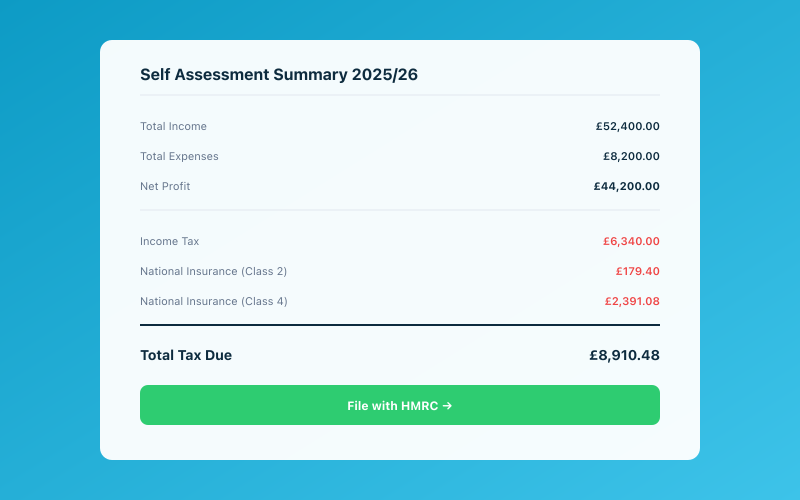 Your Accounted dashboard shows your real-time tax position
Basic Rate Relief at Source
If you contribute to a personal pension or a Self-Invested Personal Pension (SIPP), the provider claims basic rate tax relief automatically. You pay 80% of your intended gross contribution, and the provider claims the other 20% from HMRC. So if you want to add £10,000 to your pension, you pay £8,000 and the provider claims £2,000.
This happens automatically, but it does take time. Providers typically claim the relief in bulk, so the additional 20% may not appear in your pension pot for several weeks. However, the important date for tax purposes is the date of your contribution, not the date the relief arrives.
Higher Rate and Additional Rate Relief
If you are a higher rate taxpayer (40%) or an additional rate taxpayer (45%), you are entitled to further relief beyond the basic rate. This additional relief is claimed through your Self Assessment tax return. HMRC does not pay it into your pension — instead, it reduces your tax bill or increases your refund.
A higher rate taxpayer contributing £10,000 gross pays £8,000 out of pocket (with £2,000 claimed at source by the provider), then claims another £2,000 through Self Assessment. The effective cost of a £10,000 pension contribution at the higher rate is £6,000. At the additional rate, the effective cost drops to £5,500.
Worked Examples
Example 1: Basic Rate Taxpayer
Sarah is a sole trader with taxable profits of £35,000. After her personal allowance of £12,570, she pays 20% tax on £22,430, giving her an income tax bill of £4,486.
She contributes £5,000 gross to her SIPP before 5 April. She pays £4,000 from her bank account, and her SIPP provider claims £1,000 from HMRC. Her effective cost is £4,000, and her pension pot increases by £5,000.
The tax relief rate for Sarah is 20%, saving her £1,000 on a £5,000 contribution.
Example 2: Higher Rate Taxpayer
James is a freelance consultant with taxable profits of £65,000. He pays 20% on income between £12,571 and £50,270, and 40% on income between £50,271 and £65,000.
He contributes £15,000 gross to his SIPP. He pays £12,000 from his bank account, and his provider claims £3,000 from HMRC. Through his Self Assessment, he claims a further £3,000 in higher rate relief (the 20% difference between higher rate and basic rate on the portion of his income taxed at 40%).
His effective cost is £9,000 for a £15,000 pension contribution. The blended relief rate across basic and higher rate is 40% on the amount falling within the higher rate band.
Example 3: Sole Trader Near the Higher Rate Threshold
Emma has taxable profits of £48,000. She is just below the higher rate threshold. If she makes no pension contribution, all her income is taxed at the basic rate (after her personal allowance).
But consider a different scenario. If Emma's profits were £55,000, she would pay higher rate tax on £4,730 (the amount above £50,270). A pension contribution of £4,730 would bring her adjusted income back down to the higher rate threshold, effectively saving her 40% on that portion instead of 20%. That is an extra £946 in relief compared to making the same contribution next year if her income does not change.
This kind of threshold planning is exactly where Penny's seasonal tax nudges add real value. Accounted tracks your year-to-date income and alerts you when a pension contribution could shift you into a lower tax band.
Example 4: Using Carry Forward
David has not made any pension contributions for the last three years. His annual allowance is £60,000 per year, so he has up to £180,000 in unused allowance from 2022/23, 2023/24, and 2024/25, plus £60,000 for the current year, giving a theoretical maximum of £240,000.
However, carry forward is limited by his earnings in the current year. If David earns £90,000 in 2025/26, his maximum tax-relievable contribution is £90,000 (100% of earnings, up to the available allowance). If he contributes £90,000 gross, the tax relief at his marginal rate would be substantial — up to £36,000 if all of it falls within the higher rate band.
Carry forward is a powerful tool, but the unused allowance from 2022/23 disappears permanently on 5 April 2026. This is the last chance to use it.
The Annual Allowance: Know Your Limit
The standard pension annual allowance for 2025/26 is £60,000. This is the maximum gross contribution that qualifies for tax relief in a single tax year, unless you have carry-forward room from earlier years.
The Tapered Annual Allowance
If your adjusted income exceeds £260,000, your annual allowance is reduced by £1 for every £2 over that threshold, down to a minimum of £10,000. If you are in this bracket, careful calculation is essential before making large contributions.
The Money Purchase Annual Allowance
If you have already accessed your defined contribution pension flexibly — for example, by taking income drawdown — your annual allowance for money purchase contributions drops to just £10,000. This is a common trap for people who have taken pension income and then want to resume contributing.
Why the 5 April Deadline Matters So Much
The 2025/26 tax year ends on 5 April 2026. Any pension contribution you make on or before that date counts towards your 2025/26 annual allowance. If you wait until 6 April, it rolls into 2026/27 instead.
This matters for several reasons. Your income may be different next year, potentially falling into a lower tax band where relief is worth less. You lose the 2022/23 carry-forward allowance permanently. And if you have already used some of your 2026/27 allowance through workplace contributions, you may have less room than you think.
Timing Practicalities
Be aware that contributions need to reach your pension provider by 5 April, and some providers need several business days to process payments. If you are making a large contribution, do not leave it until 4 April. Most advisers recommend completing pension contributions at least a week before the deadline to ensure they are processed in time.
For SIPP contributions made by bank transfer, check your provider's cut-off times. Some require funds to arrive by midday on the last business day before 5 April.
How Penny Helps You Never Miss This Deadline
One of the features Accounted users value most is Penny's seasonal tax nudges. In February and March each year, Penny analyses your year-to-date income and tax position and sends you a personalised nudge if a pension contribution would save you money.
This is not a generic reminder. Penny calculates your actual marginal rate, checks whether you are near a threshold, identifies any carry-forward room based on your contribution history, and shows you the specific saving a contribution would generate. It turns a complex calculation into a clear recommendation.
Penny also tracks pension contributions you have already made during the year, through both personal and workplace schemes, so you always know exactly how much annual allowance you have remaining.
Take Action Before 5 April
The window for making 2025/26 pension contributions is closing. If you have not yet reviewed your pension position this year, now is the time to do it. Calculate your unused annual allowance, check whether you have carry-forward room from 2022/23 that is about to expire, and consider whether a contribution before 5 April could save you tax at your marginal rate.
If you are not already using Accounted, start your free trial today and let Penny show you exactly how much you could save. With the tax year end just weeks away, there is still time to act — but not much.
Related Reading
Start your free trial and let Penny handle your bookkeeping automatically.
Penny, your AI bookkeeper, tracks your tax position in real time and flags opportunities to reduce your bill. Meet Penny →
Tax & Compliance Specialists
Our tax specialists have decades of combined experience in UK sole trader and small business taxation, MTD compliance, and HMRC submissions. All content is reviewed against current HMRC guidance before publication and updated quarterly to reflect legislative changes.
Ready to try Accounted?
Join UK sole traders who are simplifying their bookkeeping and tax.
Start your 14-day free trial