How to Pay Less Tax Legally in the UK: 12 Strategies for 2026
Nobody wants to pay more tax than they have to. The good news is that the UK tax system includes a wide range of reliefs, allowances, and planning opportunities that are specifically designed to be used. Claiming them is not aggressive tax avoidance — it is simply paying the correct amount.
Here are twelve practical, entirely legal strategies for reducing your tax bill in 2025/26. Some apply to everyone, some are specific to sole traders, and some are particularly relevant if you are approaching key thresholds.
1. Claim Every Allowable Business Expense
This is the most fundamental strategy and the one most people get wrong — not by claiming things they should not, but by failing to claim things they should.
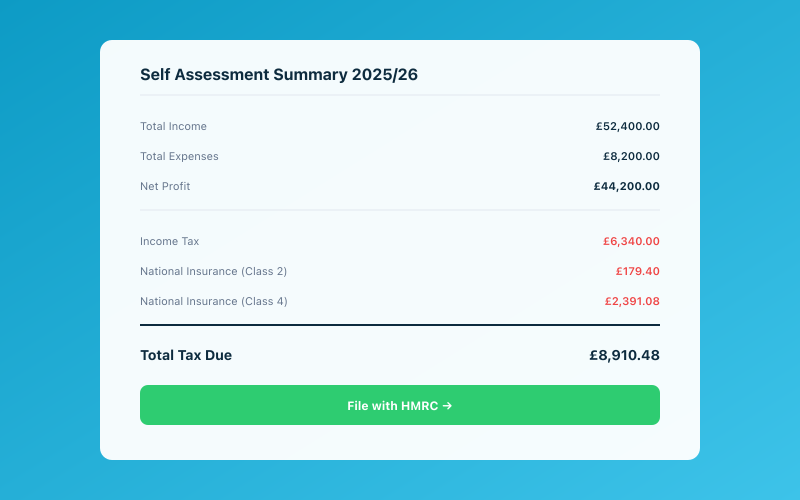 Your Accounted dashboard shows your real-time tax position
Common expenses people forget to claim include professional subscriptions, books and training, home office costs, bank charges, small tools, mileage for business journeys, and the business proportion of their phone and broadband bills.
Every pound of expense you miss increases your taxable profit by a pound. If you are a basic rate taxpayer, that is 20p of unnecessary Income Tax plus 6p of Class 4 National Insurance. At the higher rate, it is 40p plus 2p.
The single most effective thing you can do is keep thorough records and review your expenses carefully before filing your return. Better yet, use software that categorises expenses automatically so nothing slips through.
2. Make Pension Contributions
Pension contributions are one of the most powerful tax-saving tools available. When you contribute to a personal pension (such as a SIPP), the government adds basic rate tax relief at source. If you contribute £8,000 to your pension, your provider claims back £2,000 from HMRC, so £10,000 goes into your pension pot. If you are a higher rate taxpayer, you claim the additional 20% relief through your Self Assessment return, making the effective cost of a £10,000 pension contribution just £6,000.
For 2025/26, the annual allowance for pension contributions is £60,000 (or 100% of your earnings, whichever is lower). You can also carry forward unused allowance from the previous three tax years, which can allow much larger contributions in a single year.
Pension contributions reduce your adjusted net income, which is important if you are near the £100,000 threshold where the Personal Allowance starts to taper. More on that in strategy 5.
3. Use Your ISA Allowance
Individual Savings Accounts (ISAs) shelter your savings and investments from tax. For 2025/26, the ISA allowance is £20,000 per person. You can split this across Cash ISAs, Stocks and Shares ISAs, Innovative Finance ISAs, and Lifetime ISAs (the last has a lower £4,000 limit within the overall £20,000).
Any interest, dividends, or capital gains earned within an ISA are completely tax-free. While this does not reduce your self-employment tax bill directly, it reduces tax on your savings and investments, lowering your overall tax burden.
4. Claim Capital Allowances
If you buy equipment, tools, computers, or vehicles for your business, you can claim capital allowances. The Annual Investment Allowance (AIA) lets you deduct 100% of the cost of qualifying plant and machinery, up to £1,000,000 per year.
Do not overlook smaller items. A new laptop, a set of tools, office furniture, a printer — these all qualify. If you are on cash basis accounting, most equipment purchases are simply treated as allowable expenses, making the process even simpler.
Timing matters too. If you are planning a significant purchase, buying it before the end of the tax year means you claim the relief a year earlier.
5. Protect Your Personal Allowance
The standard Personal Allowance for 2025/26 is £12,570. However, if your adjusted net income exceeds £100,000, the allowance is reduced by £1 for every £2 above that threshold. It disappears entirely at £125,140.
This creates an effective marginal tax rate of 60% on income between £100,000 and £125,140 — because you are paying 40% Income Tax and losing £1 of Personal Allowance (worth 40%) for every £2 earned.
If your income is near this range, consider making pension contributions or charitable donations (both of which reduce your adjusted net income) to bring your income back below £100,000 and restore your full Personal Allowance.
For example, if your income is £110,000 and you make a £10,000 pension contribution (gross), your adjusted net income drops to £100,000, restoring £5,000 of Personal Allowance and saving £2,000 in Income Tax on top of the pension tax relief itself.
6. Transfer the Marriage Allowance
If you are married or in a civil partnership and one partner earns less than the Personal Allowance of £12,570 while the other is a basic rate taxpayer, you can transfer £1,260 of the non-earner's allowance to the earning partner. This saves up to £252 per year.
It is not a life-changing amount, but it costs nothing, takes five minutes to set up online, and you can backdate a claim for up to four previous tax years.
7. Time Your Income and Expenses
If you have flexibility in when you invoice or when you make purchases, timing can shift income and expenses between tax years in a way that reduces your overall tax.
Bring forward expenses: If you know you will need to buy equipment or pay for training, doing it before 5 April rather than after means you get the tax deduction in the current year.
Defer income: If you are close to a tax threshold — for example, the higher rate band at £50,270 or the £100,000 Personal Allowance taper — delaying an invoice until after 5 April pushes the income into the next tax year. This is only worth doing if it genuinely reduces your tax, not if it just defers it.
Note: If you use cash basis accounting, income is taxed when you receive payment. If you use accruals, it is taxed when you earn it (issue the invoice). The method you use affects what timing strategies are available.
8. Claim Loss Relief
If your business makes a loss in a tax year, you do not just lose that loss — you can use it to reduce tax in other years. The options include:
- Carry sideways: Offset the loss against your other income in the same tax year (for example, employment income).
- Carry back: Offset the loss against your trading income from the previous year.
- Carry forward: Offset the loss against future trading profits from the same business.
Loss relief is particularly valuable in the early years of a business, when start-up costs often exceed income. If you have employment income as well, offsetting a trading loss against it can generate a tax refund.
9. Claim Working from Home Expenses
If you work from home — and most sole traders do for at least part of the time — claim the costs. The simplified flat rate of up to £26 per month (£312 per year) requires no evidence beyond your hours worked. If your actual home office costs are higher, use the actual cost method to claim a proportion of your rent/mortgage interest, council tax, utilities, and broadband.
Many self-employed people forget to claim this entirely. Over several years, the unclaimed amounts add up significantly.
10. Claim Mileage Properly
The approved mileage rate of 45p per mile for the first 10,000 business miles represents a significant tax deduction for anyone who drives regularly for work. On 10,000 miles, that is a £4,500 deduction, saving a basic rate taxpayer £900 in Income Tax alone.
Keep a mileage log. Record every business journey with the date, destination, purpose, and distance. Without a log, you cannot make the claim.
11. Make Charitable Donations Through Gift Aid
If you make donations to registered charities through Gift Aid, the charity reclaims basic rate tax on your behalf, and you — as the donor — can claim higher or additional rate relief through your Self Assessment return.
A £100 Gift Aid donation costs you £100 out of pocket. The charity receives £125 (reclaiming the basic rate tax). If you are a 40% taxpayer, you can claim an additional £25 back through your return, making the effective cost to you £75.
Charitable donations also reduce your adjusted net income, which can help protect your Personal Allowance if you are near the £100,000 threshold.
12. Consider Salary Sacrifice (If You Also Have Employment Income)
If you are employed as well as self-employed, salary sacrifice arrangements with your employer can reduce your taxable employment income. Common salary sacrifice benefits include:
- Workplace pension contributions — you give up salary in exchange for your employer making a larger pension contribution. This saves both Income Tax and employee National Insurance on the sacrificed amount.
- Cycle to work schemes — you acquire a bicycle through a tax-efficient hire arrangement.
- Electric vehicle salary sacrifice — you lease an electric car through your employer, saving on tax and NI.
Salary sacrifice does not apply to your self-employment income, but if you have both sources, it can reduce your overall tax burden.
Bonus: Dividend Planning for Company Directors
If you operate through a limited company, the way you extract profits — salary vs dividends — has a significant impact on your tax bill. For 2025/26, the tax-free dividend allowance is £500. Dividends above this are taxed at 8.75% (basic rate), 33.75% (higher rate), or 39.35% (additional rate).
A common strategy is to pay yourself a salary up to the National Insurance threshold (£12,570 for 2025/26 to use the full Personal Allowance) and take the rest as dividends. This can be significantly more tax-efficient than taking everything as salary. However, the right balance depends on your specific circumstances, and you should take professional advice.
How Accounted Helps You Pay the Right Amount
Accounted is designed to make sure you never overpay tax. Penny, the AI bookkeeper, automatically categorises your expenses, tracks your mileage, calculates your home office deduction, and estimates your tax bill in real time. If you are approaching a key threshold, Penny flags it so you can take action before the end of the tax year.
You should not need to memorise twelve strategies. You just need software that applies them for you.
Start your free trial of Accounted today and let Penny find every legitimate saving — so you keep more of what you earn.
Related Reading
-
Can I Claim Clothing as a Business Expense? HMRC Rules Explained
-
Overlap Relief Explained: What Happens When Basis Periods Change
Start your free trial and let Penny handle your bookkeeping automatically.
Penny, your AI bookkeeper, tracks your tax position in real time and flags opportunities to reduce your bill. Meet Penny →
Tax & Compliance Specialists
Our tax specialists have decades of combined experience in UK sole trader and small business taxation, MTD compliance, and HMRC submissions. All content is reviewed against current HMRC guidance before publication and updated quarterly to reflect legislative changes.
Ready to try Accounted?
Join UK sole traders who are simplifying their bookkeeping and tax.
Start your 14-day free trial